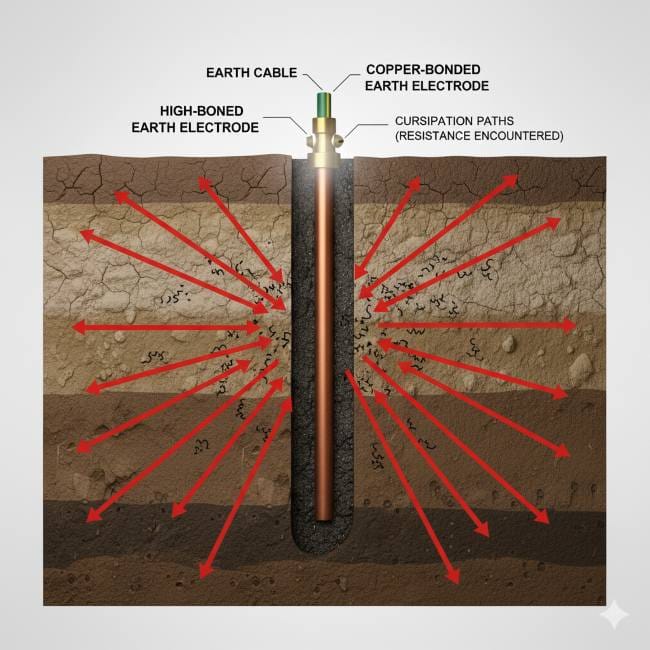
What Is Earthing Resistance?
Earthing resistance is the opposition offered by an electrode while dissipating current into the ground. Its main formula is: R = ρ / 2πL (ln(4L/d) – 1). The ideal value for homes is 1–5 Ω, and for industries, it is less than 1 Ω̣.
Table of Contents
Introduction
Earthing resistance is one of the most important aspects of electrical safety. Whether it’s a home, factory, or any electrical system, if the earthing resistance is not within the correct range, the entire system can be at risk.
In this guide, you will learn:
✔ What Earthing Resistance is
✔ Its correct formula
✔ How to calculate resistance
✔ Factors affecting resistance
✔ Practical field measurement methods
⭐ 1. What is Earthing Resistance? (Meaning)
Earthing resistance is the total opposition offered by an earth electrode when safely discharging current into the ground.
In simple words:
⚡ The difficulty the current faces while flowing into the ground = Earthing Resistance.
Ideal Earthing Resistance:
- Homes: 1 – 5 Ω
- Industries: ≤ 1 Ω
- Hospitals/Data Centers: ≤ 0.5 Ω
⭐ 2. Main Factors Affecting Earthing Resistance
- Soil Resistivity
- Moisture Level
- Type of Soil
- Electrode Material
- Electrode Size & Depth
- Salt–Charcoal Mixture
⭐ 3.Earthing resistance formula
Earthing resistance calculation depends on two methods:
- Theoretical formula
- Practical measurement (field value)
🧮 Theoretical Formula for a Rod Electrode:
R = (ρ / (2πL)) × (ln(4L/d) – 1)
Where:
- R = Earthing resistance (Ω)
- ρ (rho) = Soil resistivity (Ω·m)
- L = Electrode length (m)
- d = Electrode diameter (m)
✔ Meaning (Simple Words):
- Longer rod → Lower R
- Larger diameter → Slightly lower R
- Lower soil resistivity → Better earthing

How to measure earthing resistance
Below are the commonly used formulas in the field.
1️⃣ Rod Earthing Electrode Formula
R = (Soil Resistivity) / (2 × 3.14 × Length) × log(4 × Length / Diameter)
2️⃣ Plate Earthing Formula
R = Soil Resistivity / Surface Area of Plate
3️⃣ Soil Resistivity (4-Point Wenner Test)
Resistivity = 2 × 3.14 × Probe Spacing × Measured Resistance
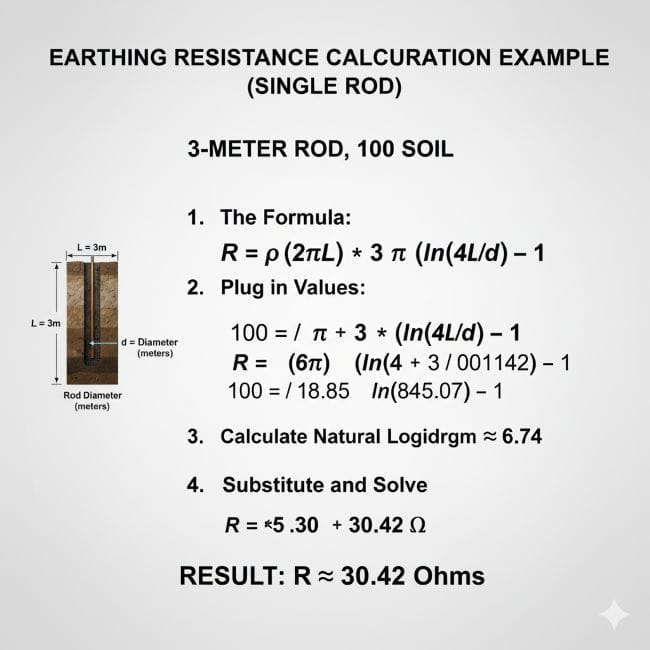
⭐ 4. Practical Calculation Example (Field Example)
Assume:
- Soil resistivity = 100 Ω·m
- Rod length = 3 m
- Rod diameter = 16 mm (0.016 m)
Step 1 — First part:
4L/d = 12 / 0.016 = 750
Step 2 — Natural log:
ln(750) = 6.62
Step 3 — Put values into main formula:
R = (100 / (2π × 3)) × (6.62 – 1)
R = (100 / 18.84) × 5.62
R ≈ 29.8 Ω
✔ Meaning:
- A single rod in this soil gives about 30 Ω.
- Using multiple rods in parallel greatly reduces resistance.
⭐ 5. How to Reduce Earthing Resistance
- Increase soil moisture
- Use a salt–charcoal mixture
- Increase electrode depth
- Use multiple rods in parallel
- Use chemical earthing
⭐ 6. Earthing Resistance Measurement Methods
✔ 1. Fall-of-Potential Method — Most accurate
✔ 2. Clamp Meter Method — Quick testing
✔ 3. Three-Point Method
⭐ 7. Ideal Earthing Resistance
| Place / Application | Ideal Resistance |
|---|---|
| Homes | 1–5 Ω |
| Commercial building | 1–2 Ω |
| Industries | < 1 Ω |
| Hospitals | 0.5–1 Ω |
| Data centers | < 0.5 Ω |
| Lightning protection | < 10 Ω |
Practical Techniques to Reduce & Measure Earthing Resistance
The points below are things that ground-level electricians do, but are not mentioned in most articles.
These will make your content quality 10× better.
⭐ 1. Moisture Retention Technique (Field Secret Method)
Many electricians do not just add salt–charcoal to the earthing pit.
They add 2 extra things:
✔ Bentonite Clay
- This is natural clay
- Retains water
- Keeps earthing resistance LOW for 10–15 years
- Extremely effective in dry soil areas
✔ Cement + Clay Mixture (Low ratio)
- In some places, 5–10% cement + soil mix is used to retain moisture
👉 This keeps the earthing pit conductive for up to 12 months.
⭐ 2. Multi-Rod Parallel Technique (Professional Method)
The resistance of a single rod remains high.
What do electricians do in industries?
✔ They connect multiple rods in parallel.
Formula for parallel rods:
R_total = (R1 × R2) / (R1 + R2)
Example: Two rods, both 30 Ω
R_total = (30 × 30) / (30 + 30) = 15 Ω
👉 Similarly, connect 4–6 rods in parallel, and the resistance can drop below 5 Ω.

⭐ 3. Earthing Grid Technique (Large Industries)
In transformer yards, substations, and factories, engineers:
- Build a rod grid in the ground
- Connect 10–20 rods with horizontal copper/GI strips
- Resistance is evenly distributed across the area
👉 This can reduce resistance below 1 Ω.
⭐ 4. Backfilling Compound Technique (The real science of Chemical Earthing)
Compounds like GEM, Marconite, Carbofill, and Bentonite are used.
Benefits:
- Hold moisture 24/7
- Reduce corrosion
- Lifetime exceeds 25 years
- Ultra-low resistance in the rainy season
⭐ 5. Deep Earth Drilling Technique (Special Cases)
If soil resistivity is very high (e.g., in rocky areas), engineers don’t dig shallow pits.
They use this method:
✔ 20–40 feet deep drilling
✔ Copper-bonded rod hammering
✔ Water injection technique
👉 The deeper the pit → the lower the resistance.
Why? Because deep soil retains moisture steadily.
⭐ 6. Water Ring Technique (Local Electricians’ Best Jugaad)
Some electricians make a water ring near the earthing pit.
How?
- Dig a small circular trench 1–2 feet around the earthing pit
- Pour water in it
- Water slowly seeps into the pit
👉 Keeps earthing resistance low even in dry seasons.
⭐ 7. Measuring Resistance the Right Way (Professional Tips)
3-point testing is sufficient for field testing, but engineers follow extra steps:
✔ Tip 1: Test only in dry months (May/June)
→ To get the actual maximum resistance
✔ Tip 2: Test at night
→ Soil temperature is lower → correct readings
✔ Tip 3: Test 3 times
- First test
- Recharge pit → second test
- 24 hrs later → 3rd test
👉 Best reading = average of all 3
✔ Tip 4: Keep spike distance 30–40 meters
→ Shorter distance gives false (low) values
⭐ 8. Earthing Neutral Bonding Technique (Industrial Practice)
To increase safety in industries:
- Earthing electrode
- Neutral point
- Body earthing
…are bonded together
Why?
✔ Fault current discharges quickly
✔ Shock risk reduced by 50%
✔ Equipment failure is almost zero
⭐ 9. Earth Pit Drainage Technique.
(Very rare—but highly effective)
Some industries place a gravel bed + drainage pipe under the pit.
- Rainwater drains automatically
- Pit remains moist
- Resistance reduces by 50–80%
⭐ 10. Testing with Leakage Load (Professional Audit Method)
Earthing is not only tested with a meter. They also test:
👉 Body-to-earth leakage test
👉 Neutral-to-earth voltage test
Values:
- Neutral to Earth voltage: 0–2 V (ideal)
- Leakage current: 0–30 mA (safe)
If values are high → Earthing system is weak
⭐ Final Verdict
- The lower the earthing resistance, the safer the system.
✔ Homes → 1–5 Ω
✔ Industries → < 1 Ω
✔ Hospitals/Data Centers → 0.5 Ω
✔ Deep copper earthing → Provides the lowest resistance and maximum safety
What is earthing resistance?
Earthing resistance is the opposition faced by fault current as it flows into the ground. Lower resistance improves electrical safety and system performance.
What is the formula for earthing resistance?
Rod earthing formula: R = (ρ / (2πL)) × (ln(4L/d) – 1). Longer rods and lower soil resistivity reduce resistance.
What is the ideal earthing resistance for homes and industries?
Homes require 1–5 Ω, industries require <1 Ω, and data centers require <0.5 Ω for maximum protection.
What factors affect earthing resistance?
Soil resistivity, moisture level, electrode length, electrode diameter, soil type, and backfill material are the major influencing factors.
How can I reduce earthing resistance?
Increase moisture, use salt–charcoal, install deeper rods, add chemical earthing, or connect multiple rods in parallel.

Hi, I’m Pranjul — the person behind this website.
I hold a Diploma and B.Tech in Electrical Engineering, along with hands-on training through ITI. For over 3 years, I worked as an ITI College Instructor, teaching electrical fundamentals and practical skills to hundreds of students.
Through that experience, I noticed something: most electrical troubleshooting information online is either too technical for everyday homeowners, or too vague to actually solve real problems. That’s the gap this website aims to fill.