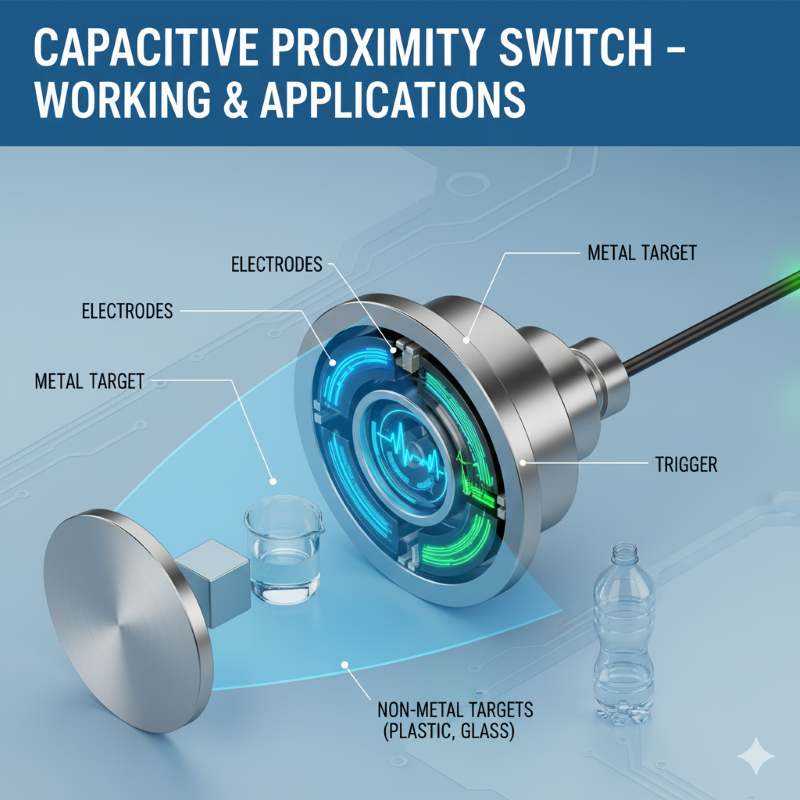
What is a Capacitive Proximity Switch?
A Capacitive Proximity Switch is a non-contact sensor that detects the presence or absence of an object by sensing changes in capacitance.
It can detect both metallic and non-metallic materials such as plastic, glass, wood, paper, and liquids — making it ideal for industrial automation applications.
Construction of Capacitive Proximity Switch
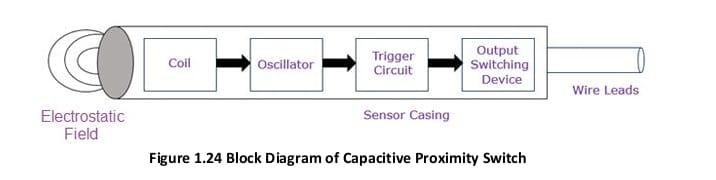
A capacitive proximity switch consists of five main parts — sensing electrode, oscillator circuit, trigger circuit, output stage, and housing.
The sensing electrode detects capacitance changes, while the oscillator and trigger circuits generate and process the signal to produce an ON/OFF output.
Working Principle of Capacitive Proximity Switch
A capacitive proximity switch works on the principle of change in capacitance.
When an object enters the electrostatic field of the sensor, the capacitance changes, activating the oscillator and triggering the output signal.
As the object moves away, the capacitance returns to normal, and the output switches off.
Types of Capacitive Proximity Switches
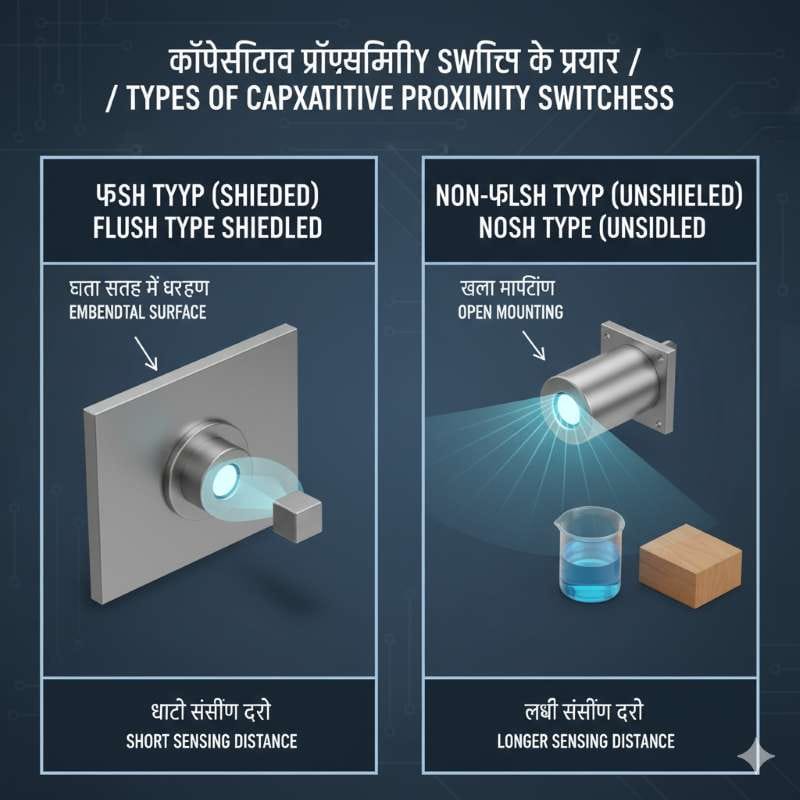
There are two main types of capacitive proximity switches: Flush Type (Shielded) and Non-Flush Type (Unshielded).
Flush type can be mounted level with metal surfaces and offers short-range detection, while non-flush type provides longer range but requires open mounting space
Difference Between Inductive and Capacitive Proximity Switch
An inductive switch detects only metals using an electromagnetic field, while a capacitive switch detects both metals and non-metals using an electrostatic field.
Inductive sensors are cheaper but have shorter range, whereas capacitive sensors are more versatile with slightly higher cost.
Applications of Capacitive Proximity Switch
Capacitive proximity switches are widely used for liquid level detection, sheet sensing, object counting, robotic position sensing, and level monitoring in silos or bins.
They are ideal for industrial automation, packaging, and process control.
Table of Contents
Introduction: What is a Capacitive Proximity Switch?
A Capacitive Proximity Switch is a type of non-contact sensor that detects the presence or absence of an object based on changes in capacitance.
This sensor is used in applications where it is necessary to detect an object without physically touching it.
Unlike an Inductive Sensor, which can only detect metallic objects, a Capacitive Proximity Switch can sense both metallic and non-metallic materials such as plastic, glass, wood, paper, and even liquids.
In simple terms, it is a smart electronic sensor that changes its output signal when an object comes close — without any physical contact.
Construction of a Capacitive Proximity Switch
A typical Capacitive Proximity Switch is made up of several electronic components that work together to detect the presence of an object without physical contact.
Its construction consists of the following key parts 👇
| Part | Description |
|---|---|
| Sensing Electrode | The main component that senses the change in capacitance caused by the presence of a nearby object. |
| Oscillator Circuit | Generates a high-frequency electric field that extends around the sensing surface. |
| Trigger Circuit | Activates when the input signal crosses a certain threshold level, causing the sensor output to switch. |
| Output Stage | Converts the trigger signal into a practical ON/OFF output, typically using a relay or transistor. |
| Housing | The outer enclosure that protects all the internal electronic components, usually made of plastic or metal. |
Working Principle and Explanation of a Capacitive Proximity Switch
A Capacitive Proximity Switch is a smart non-contact electronic sensor that detects the presence or absence of an object without any physical contact.
Unlike inductive sensors (which can detect only metals), a capacitive proximity switch can sense both metallic and non-metallic materials such as paper, glass, wood, plastic, liquids, and even fabrics.
Because of this versatility, it is widely used in industrial automation and process control systems.
⚙️ Working Principle
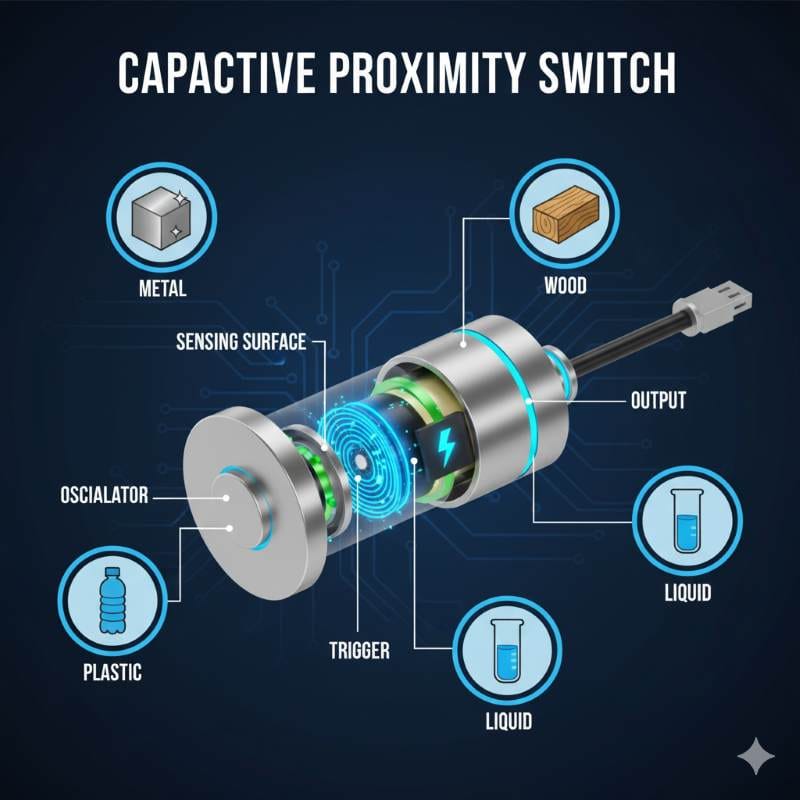
Inside a capacitive proximity switch, there is a high-frequency oscillator connected to a sensing surface made up of two metal electrodes.
These electrodes form a capacitor, which continuously monitors small changes in capacitance around its sensing field.
When an object approaches the sensor, it enters the electrostatic field, causing a change in capacitance.
This change activates the oscillator, increasing its amplitude.
Once the signal reaches a threshold level, the sensor output switches — turning ON.
When the object moves away, the capacitance returns to normal, the oscillator amplitude decreases, and the sensor returns to its OFF state.
🧠 In Simple Terms
A Capacitive Proximity Switch senses tiny electrical variations that occur when an object comes near it and converts those variations into a reliable ON/OFF output signal.
Since the entire process is contactless, the sensor enjoys a long lifespan, high reliability, and maintenance-free operation.
Types of Capacitive Proximity Switches
Capacitive Proximity Switches are mainly classified into two types — Flush Type (Shielded) and Non-Flush Type (Unshielded).
Both operate on the same working principle, but they differ in construction and sensing distance.
1️⃣ Flush Type (Shielded Type)
Construction and Working:
A Flush Type Sensor is designed to be mounted level (flush) with a metal surface.
It has a shielded construction, which confines the electrostatic field to the front side only.
When an object approaches the sensing face, it disturbs this field and changes the capacitance.
This change triggers the internal circuit of the sensor, switching the output ON.
As soon as the object moves away, the sensor returns to the OFF state.
Uses:
Flush-type capacitive sensors are ideal where:
- Precise detection is required at short sensing distances.
- The sensor must be mounted within metal panels or machine surfaces.
- Common applications include packaging machines, conveyor systems, and robotic arms for object presence detection.
2️⃣ Non-Flush Type (Unshielded Type)
Construction and Working:
A Non-Flush Type Sensor has an unshielded design, allowing its electrostatic field to expand in all directions.
Because of this, it can detect objects from a greater distance.
However, it requires open mounting space, as nearby metal surfaces may distort the sensing field.
Uses:
Non-flush sensors are preferred where:
- Long-range sensing is needed.
- The sensor can be mounted away from metal surfaces in an open environment.
- Common applications include:
- Liquid level detection in tanks,
- Bottle or container presence detection on packaging lines, and
- Detection of non-metallic materials like plastic or wood.
Difference Between Inductive and Capacitive Proximity Switch
Although inductive and capacitive sensors look similar in appearance, their working principles are entirely different:
- An inductive sensor generates an electromagnetic field and detects only metallic objects.
- A capacitive sensor, on the other hand, generates an electrostatic field, which is affected by both metallic and non-metallic materials.
Hence, a capacitive proximity switch has a much broader detection range compared to an inductive one.
Both Inductive and Capacitive Proximity Switches are non-contact sensors used for object detection.
However, they differ significantly in their working principle, detection range, and types of materials they can sense.
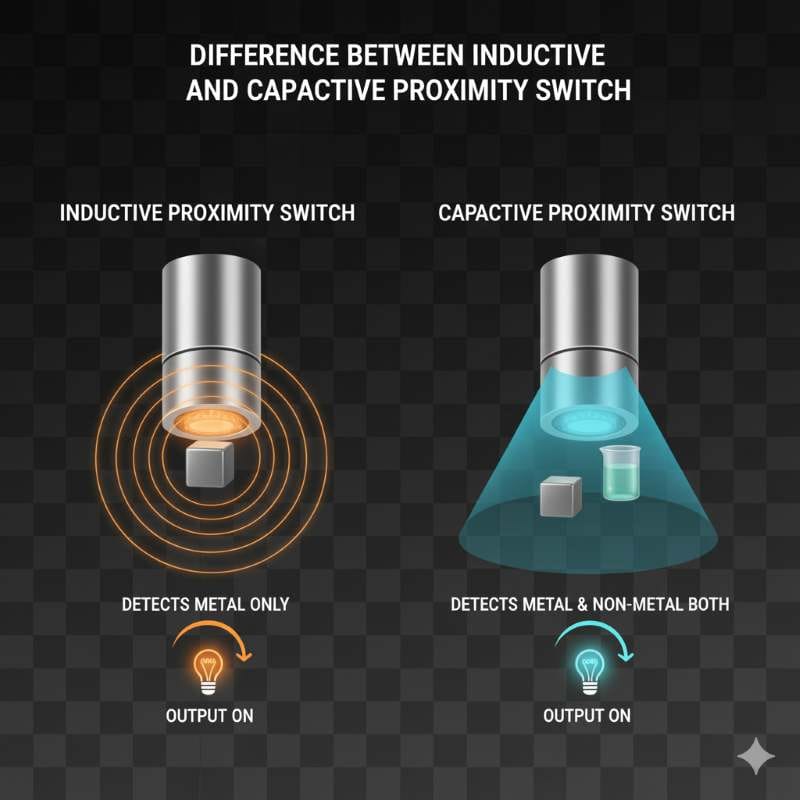
🔹 Key Differences
| Feature | Inductive Proximity Switch | Capacitive Proximity Switch |
|---|---|---|
| 1. Object Detection | Detects only metallic objects. | Detects both metallic and non-metallic objects such as wood, plastic, glass, paper, and liquids. |
| 2. Working Principle | Works on the electromagnetic field principle. When a metal object enters the field, eddy currents are generated, which activate the sensor. | Works on the electrostatic field (capacitance change) principle. When an object approaches, the capacitance changes, causing the sensor to turn ON. |
| 3. Sensing Range | Has a shorter sensing range, usually a few millimeters. | Has a longer sensing range, especially for non-metallic materials. |
| 4. Cost | Generally less expensive. | Slightly more costly due to its versatility in detecting different materials. |
Applications
The Capacitive Proximity Switch has become an essential part of many industrial and automation systems today.
Since this sensor can detect both metallic and non-metallic objects without physical contact, it is used in applications where accurate and safe detection is required.
Below are some of its key applications 👇
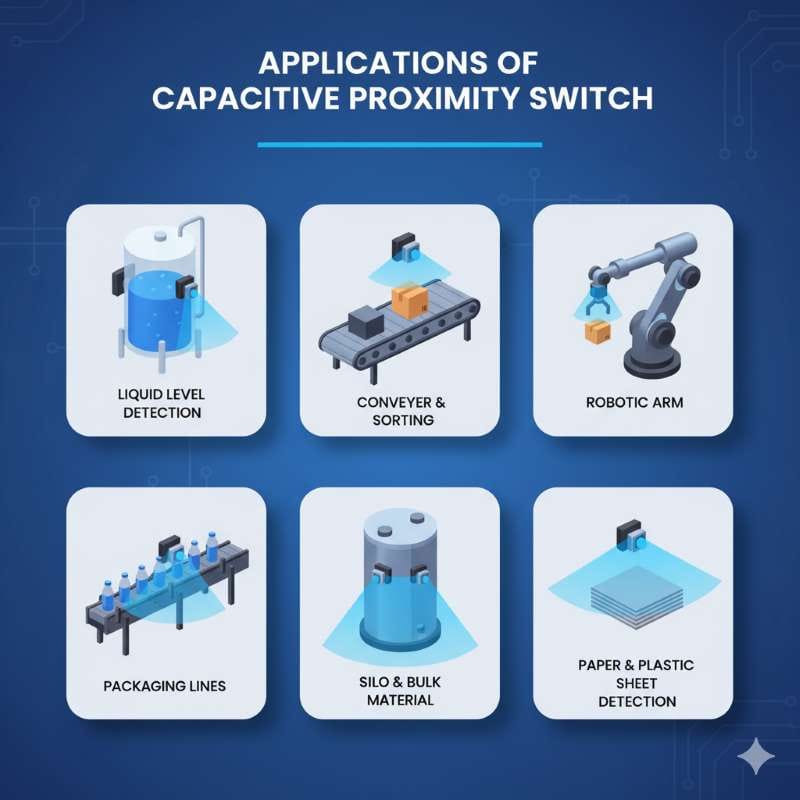
🔹 Common Applications
1️⃣ Liquid Level Detection in Tanks
Used to detect the level of liquids (such as water, oil, or chemicals) in tanks or containers.
2️⃣ Detection of Paper, Plastic, or Glass Sheets
In printing, packaging, and sheet-feeding machines, it detects the presence of sheets like paper, glass, or plastic.
3️⃣ Object Counting in Packaging Machines
Used on packaging lines to count or detect the presence of objects.
4️⃣ Position Sensing in Robotics & Conveyors
Helps in accurately sensing the position or movement of objects in robotic arms or conveyor systems.
5️⃣ Level Detection in Silos or Bins
Used to monitor the level of powders, grains, or granules in silos and bins.
6️⃣ Detection of Wood or Cardboard
Very useful in production lines to detect the presence of wood, cardboard, or packaging materials.
Advantages
✅ Can detect both metallic and non-metallic materials.
✅ Non-contact operation means no mechanical wear and tear.
✅ High sensitivity and reliability.
✅ Works effectively even in dusty, humid, or oily environments.
✅ Compact design and easy to install.
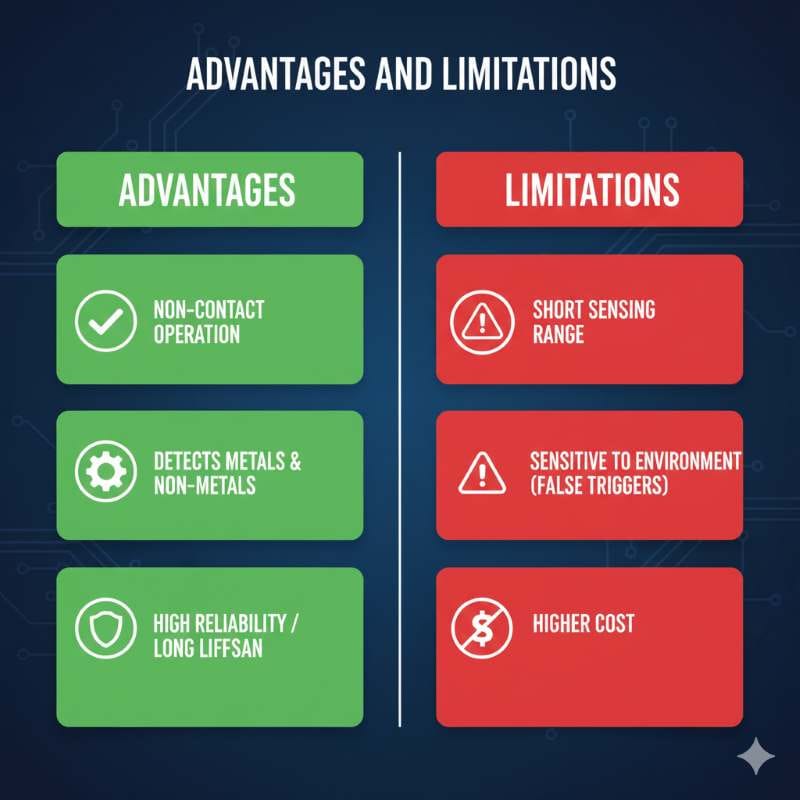
⚠️ Limitations
❌ Limited sensing range — typically between 2 to 25 mm.
❌ May cause false triggering if moisture, dust, or oil accumulates on the sensor surface.
❌ Slightly more expensive compared to inductive sensors.
FAQ
What is the sensing range of a capacitive proximity switch?
Typically 2 mm to 25 mm, depending on the material and sensor design.
Can capacitive proximity sensors detect glass or liquid?
Yes, they can detect glass, plastic, wood, and even liquids — unlike inductive sensors.
Where are capacitive proximity switches used?
In automation systems, packaging machines, and level detection in tanks and silos.
What is the main difference between capacitive and inductive sensors?
Capacitive sensors can detect any material, while inductive sensors detect only metals.
Conclusion
The Capacitive Proximity Switch is an essential component in modern automation systems.
Its ability to detect any object without physical contact makes it ideal for harsh or sensitive environments.
Compact design, reliability, and versatility make it one of the most valuable sensors in industrial automation today.

Hi, I’m Pranjul — the person behind this website.
I hold a Diploma and B.Tech in Electrical Engineering, along with hands-on training through ITI. For over 3 years, I worked as an ITI College Instructor, teaching electrical fundamentals and practical skills to hundreds of students.
Through that experience, I noticed something: most electrical troubleshooting information online is either too technical for everyday homeowners, or too vague to actually solve real problems. That’s the gap this website aims to fill.