Table of Contents
Magnetic Flux Density
Have you ever seen how magnets pull things without touching them? This invisible force spreads out in space like magic. But how do we measure this magnetic power in a certain area? That’s where Magnetic Flux Density comes in.
🌟 What is Magnetic Flux Density?
Magnetic Flux Density is a way to measure how much magnetic force is passing through a certain area.
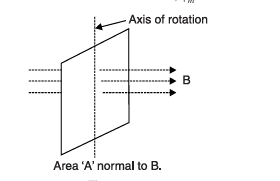
Imagine you have a big square board, and invisible magnetic lines are moving straight through it. The Magnetic Flux Density tells us how many of those lines are passing through each square metre of that board.
📏 Formula of Magnetic Flux Density
We write it like this:
Magnetic Flux Density (B) = Magnetic Flux (ϕ) ÷ Area (A)
🧲 B = ϕ / A
- ϕ (phi) is the total magnetic flux in Weber (Wb)
- A is the area in square meters (m²)
- The unit of B is Wb/m², and this is also called Tesla (T)
So, if a strong magnet sends a lot of magnetic force through a small area, the Magnetic Flux Density is high.
🧲 Importance of magnetic flux density
It tells us how strong and how focused the magnetic field is in a specific area.
Think of it like rain:
- If a lot of rain falls on a small patch of land, it’s heavy rain.
- If the same rain spreads over a large field, it becomes light rain.
The same goes for magnetic fields. Flux density helps us understand where the field is strong and where it’s weak.
🔀 Magnetic Flux Density Changes With Angle
Sometimes, the way an object is placed in a magnetic field changes how much magnetic force it feels. Here’s how:
(i) Coil is Perpendicular to the Magnetic Field
When the coil stands straight up, facing the magnetic lines, the maximum flux goes through it.
👉 Formula: Flux = B × A
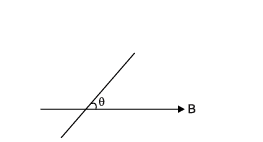
(ii) Coil is Tilted at an Angle θ
If the coil is tilted, only a part of the flux enters.
👉 Formula: Flux = B × A × sin(θ)
So, the more you tilt the coil, the less flux it gets.
(iii) Coil is Parallel to the Magnetic Field
If the coil lies flat, completely in line with the field, then no magnetic flux goes through it.
👉 Because sin(0°) = 0, so: Flux = 0
🎯 Why Magnetic Flux Density Matters
In real life, we care more about flux density than just the total flux. Why?
Because magnetic machines like motors, transformers, and generators work based on how dense the magnetic field is in certain places.
Also, remember:
- Magnetic Flux Density is a Vector — it has a direction and a value.
- It helps us design smart electrical systems that are safe, powerful, and efficient.
Magnetic Intensity or Magnetizing Force (H)
Let’s imagine a magnet. You know that a magnet can pull things like iron nails or pins. But how do we know how strong a magnet is at a certain point? That’s where Magnetic Intensity, also called Magnetising Force, comes in.
What is Magnetic Intensity?
Magnetic Intensity (H) tells us how strong a magnetic field is at a particular point. It is like asking, “If we place a small north pole here, how much force will act on it?”
To understand this better, imagine placing a unit north pole (a small imaginary north pole of strength 1 weber) at a point inside the magnetic field. The force it feels is called the Magnetic Intensity at that point.
Unit of Magnetic Intensity
The unit of Magnetic Intensity (H) is newton per weber (N/Wb).
This means:
H = Force acting on a unit north pole (1 Wb)
So, if more force is felt, that means the magnetic intensity is higher.
How to Calculate Magnetic Intensity (H)
Now let’s learn how to find magnetic intensity near a magnetic pole.
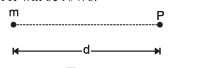
Suppose you have a magnetic pole of strength m weber, and you want to find the magnetic intensity H at a point P, which is d metres away from the pole.
Then the formula is: H=μ04π⋅md2H
Where:
- HHH is the magnetic intensity
- mmm is the pole strength in webers
- ddd is the distance from the pole in metres
- μ0\mu_0μ0 is a constant (in air, it is a fixed value)
Don’t worry about the formula too much. Just remember, the closer you are to the magnet, the stronger the magnetic intensity.
Key Points About Magnetic Intensity (H)
Let’s keep it simple and clear:
- Magnetic Intensity is a vector
This means it has both size (how strong) and direction (which way it’s pushing or pulling). - If you put a magnetic pole in a magnetic field, the force it feels is: F=m⋅HF = m \cdot HF=m⋅H So the force = pole strength × magnetic intensity
Magnetic Potential
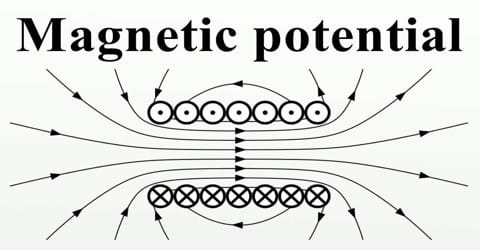
Let’s imagine a magnetic field as an invisible playground where tiny magnetic forces are always at work. In this playground, if we move a small magnet (called a unit north pole) from far, far away (infinity) to a point inside the magnetic field, we must do some work to fight the pull or push of the magnetic force.
This work done is what we call the Magnetic Potential.
💡 What is Magnetic Potential?
Magnetic Potential at a point is the amount of work done in moving a unit north pole (which means it has a strength of 1 Weber) from infinity to that point against the magnetic force.
So basically, it tells us how much energy is needed to bring a magnetic pole into the magnetic field.
🔍 Simple example of magnetic potential
Suppose we have a magnetic pole of strength m (in webers) placed in a space filled with a material. This material has a special quality called relative permeability, shown by the symbol μᵣ (mu-r).
If you pick any point that is d metres away from this magnetic pole, and you want to find out how much magnetic potential is at that point, here’s what happens.
The force (F) on a unit north pole at a distance x from the magnetic pole is:
<br>F = (μ₀ μᵣ m) / (4πx²)
Now, if we move this unit north pole just a tiny bit closer (by a distance dx), the small amount of work done (dW) is:
<br>dW = – (μ₀ μᵣ m dx) / (4πx²)
We use a negative sign because we’re moving against the force — toward the magnetic pole.
📘 Magnetic potential and energy relation
Now, to find the total magnetic potential (V) at a distance d, we add up all the tiny bits of work from infinity to d:
<br>Magnetic Potential, V = (μ₀ μᵣ m) / (4πd)
This is the final formula for magnetic potential at a distance d.
👉 Remember, Magnetic Potential is a scalar quantity, which means it only has magnitude — no direction.
🧲 Absolute and Relative Permeability
To better understand Magnetic Potential, we also need to know two simple ideas:
- Absolute permeability (μ₀): It tells us how easily a material allows magnetic lines to pass through in free space.
- Relative permeability (μᵣ): It tells us how much better (or worse) a material is at carrying magnetic lines compared to free space.
When we talk about magnetism, we often hear the word permeability. But what does it really mean? Let’s break it down in a clean, beautiful, and easy way that anyone can understand.
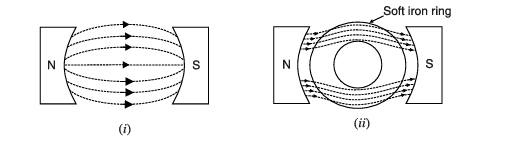
🌟 What is Permeability?
Permeability is a special property of a material. It tells us how easily magnetic lines can pass through it.
Think of magnetic lines as invisible roads for magnetic force. Some materials allow these lines to pass through very easily — like a smooth highway. Others block them or slow them down — like a rough road.
🔹 What is Absolute Permeability?
Absolute permeability is the true, actual ability of a material to allow magnetic lines to flow through it.
The symbol for absolute permeability is µ (the Greek letter “mu”).
- For air or vacuum, this value is very low. That means air is a poor conductor of magnetic lines.
- The value of absolute permeability for air or vacuum is always the same:
µ₀ = 4π × 10⁻⁷ H/m
This is like saying: “Air lets magnetic lines through, but not very well.”
But some materials, like iron, are really good at letting magnetic lines pass. Their absolute permeability is much higher than air.
🔸 What is Relative Permeability?
Relative permeability is a way to compare how good a material is at carrying magnetic lines — compared to air.
We write it like this:
µᵣ = µ / µ₀
Where:
- µ = absolute permeability of the material
- µ₀ = absolute permeability of air
- µᵣ = relative permeability
For air or non-magnetic materials like plastic, rubber, or glass, the relative permeability is:
µᵣ = 1
That means they are just as bad as air at carrying magnetic lines.
But for magnetic materials like soft iron, the relative permeability can be huge — even 8,000!
That means soft iron can carry magnetic lines 8,000 times better than air.
Some special alloys, like permalloy (which contains nickel and iron), have a relative permeability of up to 50,000! That’s like a magnetic superhighway!
⚙️ Why Does This Matter?
The idea of absolute and relative permeability is very important in making things like:
- Transformers
- Motors
- Generators
- Electromagnets
These devices need materials that can carry magnetic force easily. That’s why we use iron and other magnetic alloys — their relative permeability is very high, so magnetic energy flows easily through them.
📌 Final Thoughts on Absolute and Relative Permeability
Let’s quickly remember:
- Absolute permeability (µ) tells us how much magnetic flow a material can carry.
- Air has very low absolute permeability.
- Relative permeability (µᵣ) compares a material’s magnetic strength to air.
- Magnetic materials like iron have high µᵣ, so they’re used in machines and electrical tools.
Understanding absolute and relative permeability helps us design smarter, stronger, and more efficient electrical systems.
Understanding the Relation Between B and H – Explained Simply
Let’s talk about two very important things in magnetism: B (magnetic flux density) and H (magnetising force). These two are best friends. One depends on the other. When one goes up, the other also goes up.
This connection between B and H is very important in understanding how magnetic materials work.
🔁 What is the Relation Between B and H?
It’s very simple. B increases when H increases, and B decreases when H decreases.
In easy words:
More magnetising force = more magnetic strength inside the material.
We can write it like this:
👉 B is directly proportional to H
That means:
👉 B ∝ H
Now, when two things are always in proportion, their ratio stays the same. So, the ratio B divided by H always gives a fixed value. This value is called the absolute permeability of the material.
🧲 What is Permeability?
Permeability is just a fancy word to describe how easily magnetic lines can pass through a material. If magnetic lines love to go through a material, it has high permeability. If they don’t like to go through it, the permeability is low.
We write this as:
👉 B = µ × H
Here,
- B = Magnetic flux density (how many magnetic lines are inside)
- H = Magnetising force (how strong the push is)
- µ (mu) = Permeability of the material
🧵 Magnetic fields in air vs materials
Let’s say we apply a magnetising force H in the air. It creates some magnetic strength, let’s call it B₀.
Now, we take out the air and place a magnetic material like soft iron in the same space, but we keep the force H the same. Guess what happens?
The new magnetic strength (flux density) becomes much more! It becomes Bₘₐₜ.
That’s because magnetic materials allow the magnetic lines to pass through them more easily.
The formula becomes:
👉 Bₘₐₜ = µ₀ × µᵣ × H
Where:
- µ₀ = Permeability of free space (air)
- µᵣ = Relative permeability (how much better the material is compared to air)
🔍 What Does Relative Permeability Mean?
Relative permeability (µᵣ) tells us how much better a material is than air at letting magnetic lines pass through it.
For example:
If the µᵣ of soft iron is 8000, it means:
👉 Soft iron allows 8000 times more magnetic lines to pass than air does — with the same force H and same space.
This is why soft iron is used in machines, motors, transformers — because it can carry strong magnetism easily.
✅ Quick Summary – Relation Between B and H
- B is the magnetic strength inside a material.
- H is the magnetic force applied from outside.
- They are directly linked: B = µ × H
- In air: B = µ₀ × H
- In a material: B = µ₀ × µᵣ × H
- The more the relative permeability (µᵣ), the stronger the magnetic effect.
Important Terms in Magnetism – Explained Simply
When we bring a magnetic material close to a magnet or apply a magnetic field to it, the material changes. It becomes magnetised. But how do we measure this change? What does it mean when we say a material is “easily magnetised”? To understand all this, we use two very important terms in magnetism:
- Intensity of Magnetisation
- Magnetic Susceptibility
Let’s explore both terms in a simple, clear, and child-friendly way.
💡 1. Intensity of Magnetisation (I)
When a magnetic material is placed inside a magnetic field, something interesting happens. The material starts to act like a magnet itself. It gets magnetised.
But how strong is this magnetism inside the material? That is measured by Intensity of Magnetisation, often written as I.
👉 What is Intensity of Magnetisation?
It tells us how much magnetism has been created inside the material.
To say it more clearly:
Intensity of Magnetisation is the magnetic moment (magnetic strength) produced inside a material, divided by how much space (volume) the material takes up.
🔢 In simple words:
If a material gets magnetised more in a small space, it has a high intensity of magnetisation.
📏 Formula:
I = M / V
Where:
- I = Intensity of Magnetisation
- M = Magnetic moment (how strong the magnetism is)
- V = Volume of the material
This shows that I depends on the material itself. Some materials get magnetised quickly and strongly. Others do not.
🔬 Another way to look at it:
Let’s say:
- m is the strength of each magnetic pole inside the material
- a is the cross-sectional area
- 2l is the magnetic length (distance between poles)
Then, intensity of magnetisation can also be written as:
I = m / a
Which means:
Intensity of Magnetisation is also the pole strength per unit area.
🧪 SI Unit:
The unit of Intensity of Magnetisation is A/m (Ampere per metre).
This is a way to tell how strong the magnetism is in a given length of material.
💡 2. Magnetic Susceptibility (χm)
Now imagine two different materials placed in the same magnetic field. One becomes a strong magnet. The other barely changes. Why?
The answer lies in Magnetic Susceptibility, written as χm (the Greek letter Chi with a subscript ‘m’).
👉 What is Magnetic Susceptibility?
It tells us how easily a material can be magnetised when we apply a magnetic field.
Some materials say “yes” to magnetism very quickly. Others resist.
In simple words:
Magnetic Susceptibility is the ratio of how much a material gets magnetised (I) compared to how much magnetic force we apply to it (H).
📏 Formula:
χm = I / H
Where:
- χm = Magnetic Susceptibility
- I = Intensity of Magnetisation
- H = Magnetising force applied
Since both I and H have the same units, magnetic susceptibility has no unit. It’s just a number. That number tells us how “magnet-friendly” a material is.
A high χm means the material gets magnetized very easily. A low χm means it’s hard to magnetize.
FAQ
What is magnetic flux density in simple words?
A: Magnetic flux density is the amount of magnetic field (or magnetic lines of force) passing through a certain area. It tells us how strong the magnetic field is in that area.What is the formula of magnetic flux density?
A: The formula is:
B=Φ/A
Where:
B = Magnetic flux density (in tesla)
Φ = Magnetic flux (in weber)
A = Area (in square meters)What is the SI unit of magnetic flux density?
A: The SI unit of magnetic flux density is tesla (T).What does magnetic flux density tell us?
A: It tells us how strong and concentrated the magnetic field is in a specific area. A higher value means a stronger magnetic field.What is the difference between magnetic flux and magnetic flux density?
A:
Magnetic flux (Φ) is the total number of magnetic field lines passing through an area.
Magnetic flux density (B) is the magnetic flux per unit area.Can magnetic flux density be negative?
A: The magnitude of magnetic flux density is always positive, but its direction can be opposite, which is shown using a negative sign.

Hi, I’m Pranjul — the person behind this website.
I hold a Diploma and B.Tech in Electrical Engineering, along with hands-on training through ITI. For over 3 years, I worked as an ITI College Instructor, teaching electrical fundamentals and practical skills to hundreds of students.
Through that experience, I noticed something: most electrical troubleshooting information online is either too technical for everyday homeowners, or too vague to actually solve real problems. That’s the gap this website aims to fill.