
Last updated on December 11th, 2025 at 06:18 am
Thank you for reading this post, don't forget to subscribe!What Is a Battery?
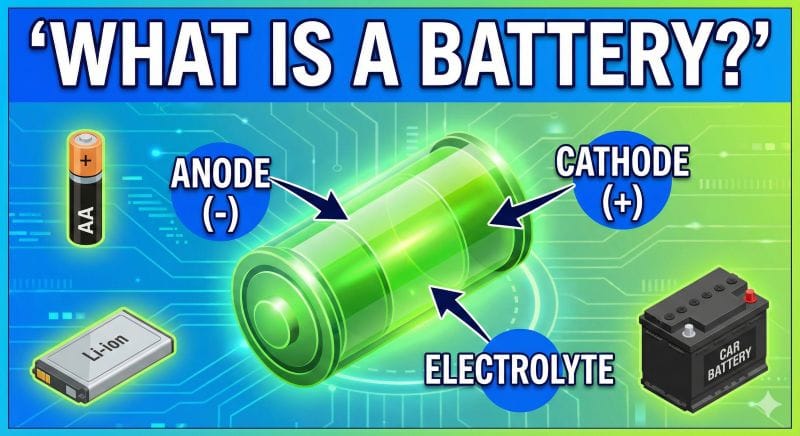
A battery is a device that converts chemical energy into electrical energy and supplies current for use.
A chemical reaction occurs between the two electrodes and the electrolyte inside, producing EMF (Electromotive Force).
When the battery is connected to a closed circuit, electrons begin to flow, and electric current is produced.
From small watches to cars and even satellites, batteries are the fundamental source of energy everywhere.
🔌 2. What is the Difference Between a Cell and a Battery?
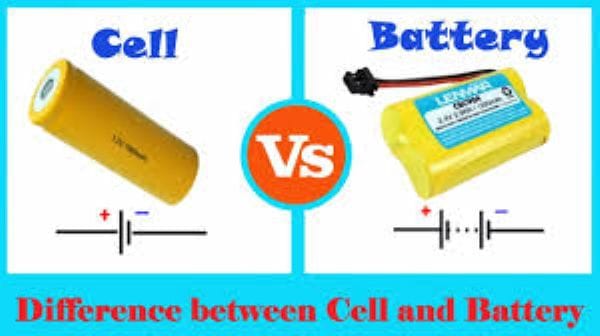
A cell is a single electrochemical unit that generates its own EMF and can supply current independently.
For example, a dry cell gives 1.5V, and a Li-ion cell gives about 3.7V.
A battery, on the other hand, is made by connecting two or more cells to obtain higher voltage or current.
For example, a 12V car battery contains 6 cells, each producing about 2V.
⚡ 3. Main Characteristics of a Battery
A battery’s EMF always depends on its chemical reaction, and the voltage of a battery depends on its chemical materials, not on its size.
Larger electrodes can supply more current because they offer more surface area for chemical reactions.
During discharge, internal resistance increases and voltage gradually decreases.
Under heavy load, voltage drops quickly, and at the end of discharge, the voltage suddenly falls to a “dead” level.
🧩 4. Important Parts of a Battery
A battery is made of several scientific components:
- Anode (–): releases electrons
- Cathode (+): accepts electrons
- Electrolyte: allows ion flow and stabilizes the reaction
- Separator: prevents direct contact between electrodes and avoids short-circuit
- Container: safely holds all components
- Terminals: allow the battery to deliver energy or be charged
- Many batteries also contain a safety valve that relieves pressure when gases build up.
🔋 5. Primary Batteries
Primary batteries cannot be recharged after one use.
They are used in small devices like remotes, clocks, torches, and signaling systems.
Special types such as Daniel cell, Fuller cell, gravity cell, and Lalande cell provide reliable and stable voltage.
Their biggest advantage: no charging needed, maintenance-free, and useful even in areas without electricity.
🔌 6. Secondary Batteries
Secondary batteries can be recharged and used repeatedly for a long time.
They are used in mobile phones, laptops, UPS systems, electric vehicles (EVs), solar energy storage, and industrial applications.
Major types include Lithium-ion, Lead-acid, Nickel-cadmium (NiCd), Nickel-iron (Ni-Fe), and Sodium-ion batteries.
They provide high capacity, better efficiency, and long life, though they have a higher initial cost and require charging time.
🔌 7. Common Battery Sizes
Batteries are made in various sizes depending on the device:
- AAA: small gadgets like remotes and small toys
- AA: cameras, toys, and common electronic devices
- C size: portable speakers, lamps
- D size: large torches and high-power devices
🏭 8. Classification of Batteries Based on Use
Batteries are classified into three main categories based on application:
- Domestic batteries: used in watches, cameras, flashlights, and small electronic devices
- Industrial batteries: used in railways, telecom systems, large backup power systems, and factories
- Automotive batteries: specially designed for cars, motorcycles, and boats — capable of supplying high current
Introduction
Batteries are an essential part of our daily lives, without which today’s modern electronic devices would not function.
From mobile phones to cars, inverters, laptops, flashlights, UPS, and even satellites—the battery is the primary source of energy everywhere.
In simple terms, a battery is a device that converts chemical energy into electrical energy.
The two electrodes and an electrolyte inside them together generate a voltage (EMF). When a battery is connected to a circuit, a chemical reaction begins, and a flow of electrons, i.e., electric current, is produced.
The features of the battery are:
- It is portable (can be taken anywhere)
- It provides an independent power source
- Gives backup power even when electricity goes out
- From small (coin cell) to large (EV battery pack)—available in all sizes
In today’s world, batteries are not just a convenience, but a reliable, safe, and essential source of energy.
What is a battery?
An electric battery is a device that generates electromotive force (EMF) through chemical reactions.
Whenever a battery is connected to a closed electrical circuit, the chemical energy present in it is converted into electrical energy.
When two dissimilar solid conductors are immersed in a conducting liquid, an EMF (Electromotive Force) is generated between them.
- Solid conductor = Electrodes
- Conducting liquid = Electrolyte
The chemical reaction between these three forms a voltaic cell, which produces EMF.
Difference Between a Cell and a Battery
People often think a cell and a battery are the same, but scientifically, they are very different.
A battery is formed only when two or more cells are connected together inside a pack.
1️⃣ What is a Cell?
A cell is a single electrochemical unit that:
- Generates its own EMF (Electromotive Force)
- Can supply current independently
- Acts as a small, standalone power source
Every cell has three main components:
- Anode (Negative electrode)
- Cathode (Positive electrode)
- Electrolyte
A single cell provides limited voltage, for example:
- Dry Cell: 1.5V
- Li-ion Cell: 3.6–3.7V
- Lead-acid Cell: 2V
✔ Meaning: A cell is always a simple EMF source.
2️⃣ What is a Battery?
A battery is formed when two or more cells are connected (in series or parallel).
The purpose of a battery is to:
- Increase voltage (through series connection)
- Increase current capacity (through parallel connection)
- Provide a longer backup
A battery is a complete energy-storage unit where multiple cells work together to provide a stable and continuous power supply to any device.
example
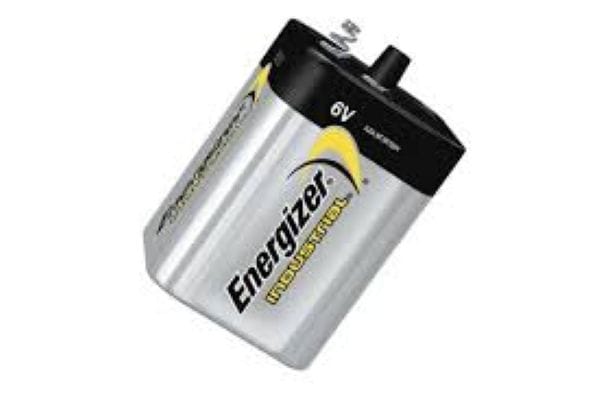
Car Battery (12V Lead-Acid)
A car battery is 12V because it contains:
- 6 large cells
- Each cell provides approximately 2V
Total voltage:
6 × 2V = 12V
All the cells are placed inside a single container, but they are separated into individual internal compartments.
Characteristics of a Battery
The efficiency, life, and performance of a battery depend on several important characteristics. Based on the paragraph you provided, each characteristic is explained below in a heading-wise, in-depth, and clear paragraph.
🟦 1. EMF Generation
The most fundamental characteristic of a battery is its EMF (Electromotive Force), which is always generated by the chemical reaction taking place within it. When two different metals (electrodes) are immersed in a conducting liquid (electrolyte), a chemical reaction begins spontaneously, generating EMF. The EMF determines the battery’s “potential difference,” and this is the fundamental reason for drawing current in the external circuit.
🟦 2. Voltage Depends on Chemistry, Not Size
A battery’s voltage depends on the material of its electrodes and electrolyte, not its size or dimensions. For example, a lead-acid cell always delivers approximately 2V, and a lithium-ion cell approximately 3.6–3.7V. This means that the battery’s chemistry determines its voltage, and changing its size does not change the voltage.
🟦 3. Current and Power Depend on Cell Size
The amount of current a battery can deliver depends on the size of its electrodes and the amount of active material it contains Larger electrodes have a greater surface area for chemical reactions so that they can provide more current. This is why small AAA batteries only power small devices, while car batteries can power a starter motor by providing high current.
🟦 4. Internal Resistance
The electrolyte and electrode materials inside the battery create some resistance to the flow of current, called internal resistance. As discharge progresses, this internal resistance increases, causing the battery’s terminal voltage to gradually decrease. New, freshly charged batteries have lower internal resistance, while old, discharged batteries have higher resistance.
🟦 5. Terminal Voltage Behavior
The battery’s terminal voltage does not always remain constant. During discharge, the battery’s voltage gradually decreases. In the final stage of discharge, when the active material is almost exhausted, the voltage suddenly drops sharply. This is natural behavior and indicates that the battery is completely discharged.
🟦 6. Effect of Discharge Rate
The faster a battery discharges, the faster its voltage drops. Under heavy loads, the voltage drops rapidly, while under light loads, the battery provides a more stable voltage. This characteristic is crucial for battery selection in power systems, automobiles, UPS, and electronics.
🟦 7. Limited Practical Combinations
In theory, countless combinations of electrodes and electrolytes can produce EMF, but only a few are used in practice. This is because not every chemical combination is safe, stable, inexpensive, and long-lasting. Therefore, commercially, lead-acid, lithium-ion, alkaline, and nickel-based batteries are most commonly used.
🟦 8. Discharge End Characteristics
Battery voltage drops slowly when it begins to discharge, but as the active chemical nears depletion, the battery’s voltage suddenly drops significantly. This sudden voltage drop indicates that the battery is “dead” and unable to handle further load.
✔ Lithium compounds + Graphite + Organic electrolyte → Li-ion system
Parts of a Battery
As simple as a battery looks on the outside, it is equally scientific and intricately designed on the inside. Each small part is responsible for some important function—that’s why a battery can both safely store energy and efficiently deliver it when needed.
Below, the main parts of a battery are explained in depth.
🔋 1️⃣ Electrodes
Electrodes are the “heart” of the battery—this is where the real chemical reactions occur. A battery has two electrodes, each performing completely different functions.
✔ Anode – Negative Electrode
- It releases electrons (oxidation process).
- As soon as the battery is connected to a device, electrons flow from the anode into the external circuit.
- The anode initiates the battery’s discharge process.
The anode material depends on the type of battery—e.g.:
- Lead-acid battery → Spongy Lead
- Lithium-ion battery → Graphite. The anode is designed to provide a larger surface area, allowing for greater current flow.
✔ Cathode – Positive Electrode
- The cathode accepts electrons (reduction process).
- Current returning from the external circuit enters the battery through the cathode.
- The battery’s voltage depends on the difference between the cathode and anode materials.
The cathode material determines the battery’s energy density and lifespan:
- Lead acid → Lead dioxide (PbO₂)
- Lithium ion → Lithium Cobalt Oxide / LiFePO₄ / NMC, etc.
⚡ 2️⃣ Electrolyte
Electrolyte is the battery’s “medium”—it’s where the ions move, and this movement creates electricity. Electrolytes can be liquid, gel, or solid-state.
It helps the battery perform three functions:
- Allows ions to move freely
- Enables electrode reactions
- Keeps the battery’s voltage and performance stable
Example:
- Lead-acid battery → Dilute sulfuric acid
- Lithium-ion battery → Lithium salt in organic solvent
- Dry cell → Ammonium chloride paste
Insight: The quality of the electrolyte directly affects the battery’s internal resistance, temperature performance, and charging efficiency.
🧵 3️⃣ Separator
The separator is a thin but extremely important layer inside the battery.
Its function:
- Prevents the electrodes from touching → to prevent a short circuit.
- Allows ions to move → so the reaction can continue.
Insight:
- The separator must be strong enough not to fuse even at high temperatures.
- Separator failure in lithium-ion batteries is the main cause of battery explosions.
📦 4️⃣ Container / Case
This is the outer body of the battery, which protects all the components inside.
Why is it important?
- Prevents acidic or reactive substances from leaking
- Protects against mechanical damage
- Can withstand high temperatures
Container materials:
- Polypropylene (lead-acid batteries)
- ABS plastic (Li-ion packs)
- Metal casing (cylindrical Li-ion cells)
🔌 5️⃣ Terminals
The positive (+) and negative (–) ends of the battery are called terminals.
Their function:
- To supply power to external devices
- To receive current during charging
- Terminals must be corrosion-free, as corrosion increases resistance and reduces performance.
🧪 6️⃣ Active Material
Active material is the chemical substance that stores energy in the battery and uses it during discharge.
Examples:
- Lead-acid → Lead dioxide (PbO₂), Spongy Lead
- Lithium-ion → Lithium compounds (LiCoO₂, LiFePO₄)
- The amount of active material determines the battery’s capacity (Ah rating). The greater the surface area, the more powerful the battery.
🛡 7️⃣ Vent / Safety Valve
This safety valve is mandatory in rechargeable batteries, especially sealed and lithium-ion batteries.
Its function:
- Release excess gas or pressure
- Prevent explosion or swelling
- Provide protection against thermal runaway.
- Without a safety valve, Li-ion batteries can become a fire hazard.
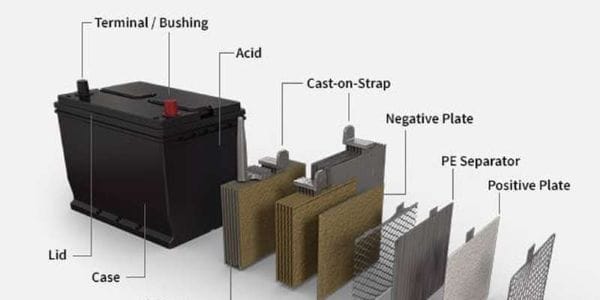
⚙️ 8️⃣ Battery Plates / Grids (Lead-acid batteries)
Lead-acid batteries have metallic grids to hold the active material.
Their function:
- Hold the active material
- Increase surface area → higher current output
- Grid design directly impacts battery life, charging speed, and durability.
Types of Battery
There are mainly two types of batteries:
- primary batteries and
- secondary batteries.
primary batteries
Primary batteries are those that cannot be recharged after use, such as zinc–carbon, alkaline, and lithium primary cells. They are used in remotes, watches, flashlights, and small household appliances.
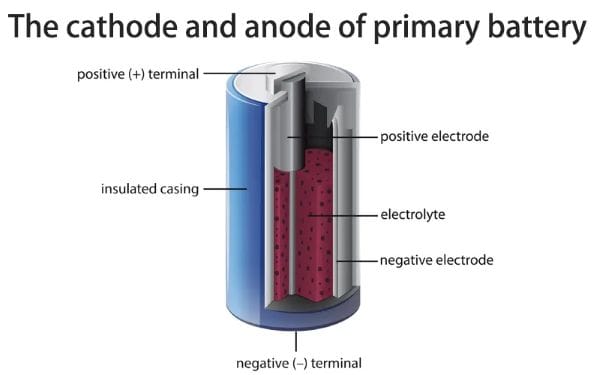
Daniell cell: A Daniel cell is a type of battery called a primary cell. It produces approximately 1 volt of current when it is continuously charged. There are many variations of the Daniel cell, each designed for a different purpose, but almost all have an EMF of approximately 1.07 volts.
The EMF of this battery does not vary much—
not with the amount of solution,
not with temperature,
not with resistance,
not with the purity of the zinc or copper.
Simply put, it is a battery that always produces approximately the same voltage, so it is considered a reliable and easy standard.
Fuller cell: A Fuller cell is a special type of battery. It’s used in telephones and other applications that require short-term use. It doesn’t break down even after months of use.
How is a Fuller cell made?
First, mix 6 ounces of potassium bichromate and 17 ounces of sulfuric acid with 56 ounces of water to form a liquid. Pour this liquid into a glass jar.
Then, add 1 teaspoon of mercury and 2 teaspoons of salt to a cup with a small hole. Place this cup and a zinc plate inside the jar.
Fill the jar with water, leaving about 2 inches empty at the top.
Finally, put the lid on and add the carbon plate. The cell is ready.
When this cell is working properly, its solution appears orange. Its resistance ranges from 0.5 to 4 ohms, depending on the condition of the solution and the cup.
gravity-type primary cell:- The gravity-type primary cell is a battery that was widely used in telegraph machines in ancient times.
This battery works best when the circuit is always connected and current flows continuously.
However, if it is left unattended for long periods, i.e., on an open circuit, it will not function properly and may fail quickly.
Lalande cell:- The Lalande cell, also known as the caustic soda cell, is a battery that operates well in both open and closed circuit applications.
This battery has a very robust construction, making it long-lasting and resistant to corrosion.
Advantages of Primary Batteries
These batteries are hassle-free to charge.
They don’t require frequent recharging like storage batteries. Their biggest advantage is that they work easily even in areas where electricity is not available. That’s why they’re so popular for machines operating in remote locations.
They provide reliable power.
Whether the battery is running continuously or intermittently, it always delivers good voltage and its full capacity. This means you don’t have to worry about current fluctuations.
They require almost no maintenance.
Once installed, just check them occasionally to make sure everything is working properly. They work for a long time without frequent contact.
Saves the cost of a charger.
No need to purchase or operate a charging machine. This means saving both money and effort.
They’re very easy to install.
They don’t require any specially trained personnel to install them. And because they don’t have to be transported to a charging station, they’re easy to handle.
Some batteries have good indicators.
These indicators give you a heads-up when the battery is weakening and about to run out. This prevents unexpected power failures and makes it easier to replace the battery on time.
Applications of Primary Batteries
These unique advantages of primary batteries make them suitable for use in a wide range of applications. They are particularly useful wherever batteries are required for direct power generation or as a backup during power outages. Such as:
- Navigation lights—warning lights installed on rivers, oceans, bridges, or in dangerous areas.
- Alarm systems—city fire alarms, police alarms, and fire and burglar alarms in factories, schools, banks, and homes.
- Bell/Annunciator systems—where signals are sent between different rooms.
- Electric fences—for farm or livestock protection.
- Elevator signals—such as floor indicators and alarms in elevators.
- Farm radios—small radios used in villages or farms.
- Lab equipment—various instruments in schools, colleges, and scientific laboratories.
- Communication and signal systems in mines, where electricity is difficult to supply.
- Railway signal and communication systems—signals between stations and trains.
- Telegraph system—local telegraph machines and long-distance wire lines.
Secondary Cell Battery
What Are Secondary Cell Batteries?
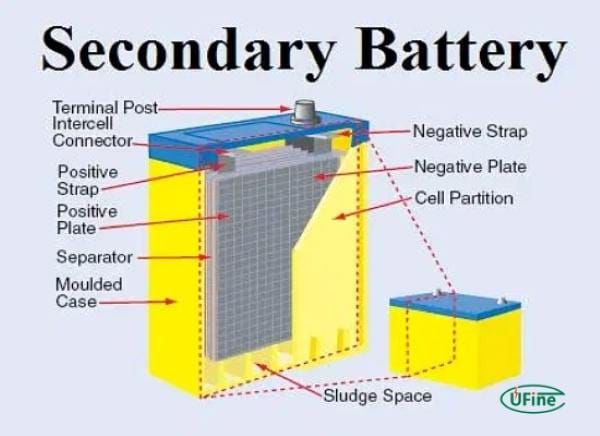
Secondary cell batteries are those that can be recharged after they are discharged. These batteries are used in devices where long backup and frequent recharging are required.
2️⃣ Nickel–Cadmium (NiCd) Battery
The nickel–cadmium battery uses nickel oxide hydroxide as the positive electrode and cadmium as the negative electrode. It can last for about 2000 charge–discharge cycles, and its cell voltage is around 1.2V.
The lead–acid battery was invented in 1859 by Gaston Planté. It uses lead and sulfuric acid as its active materials, and its cell voltage is about 2.1V. This is one of the oldest and most commonly used rechargeable batteries.
4️⃣ Nickel–Iron (Ni-Fe) Battery
The nickel–iron battery uses nickel oxide hydroxide as the positive electrode and iron as the negative electrode, while potassium hydroxide acts as the electrolyte. These batteries are widely used in railway signaling, trucks, forklifts, and mining applications because of their long life and durability.
5️⃣ Sodium–Ion Battery
Sodium-ion batteries use sodium ions as charge carriers. They are becoming popular due to their low cost and abundant raw materials.
6️⃣ Lithium–Ion Battery
Lithium-ion batteries are the most modern and widely used rechargeable batteries. They charge and discharge based on the movement of lithium ions and typically provide about 3.7V per cell.
Application of Secondary Cell Battery
Secondary cell batteries are used everywhere today because they can be recharged multiple times and used for a long period. They are found in almost all electronic devices such as mobile phones, laptops, tablets, headphones, and rechargeable lights. Their use is also rapidly increasing in the transportation sector—electric cars, hybrid vehicles, e-bikes, and electric scooters all rely on secondary batteries. These batteries are also widely used for storing excess energy generated from solar panels and wind turbines. Along with this, they play an important role in aerospace, military, defense, warehousing, material handling, and home energy storage systems.
Advantages of Secondary Battery
The biggest advantage of secondary batteries is that they can be recharged repeatedly and used for a long time, making them very cost-effective in the long run. Since they do not need frequent replacement, they also have a lower negative impact on the environment. Compared to primary batteries, they offer higher capacity and are convenient for continuous use. Because of their versatility, they work reliably everywhere—from small electronic devices to large energy storage systems and electric vehicles.
Disadvantages of Secondary Battery
Although secondary batteries are very useful, they do have some limitations. First, they take time to charge, during which battery-powered devices cannot be used. Second, their charge–discharge cycles are limited, meaning their capacity starts to reduce after a few years of use. They also have a higher initial cost compared to primary batteries. Additionally, the output voltage of some secondary batteries may be slightly lower than that of similar primary batteries.
Types of Batteries: Sizes
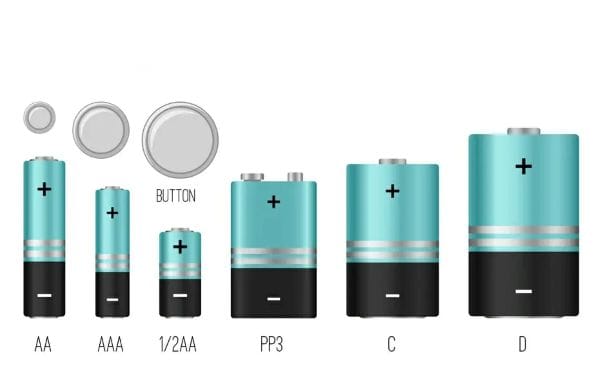
Batteries are made in many different sizes to meet the needs of different devices. Small electronic devices use AAA batteries. They are thin and lightweight, making them perfect for remote controls, small flashlights, and small gadgets. Slightly larger AA batteries are most commonly used in toys, cameras, portable radios, and small household appliances. Larger than AA, C-size batteries are found in medium-sized devices like portable speakers, hand lamps, and some toys. Next comes the D-size battery, which is larger and capable of delivering more power, making it used in larger flashlights, boomboxes, and devices that require more power for a longer period of time.
Classification of Batteries based on Applications
Batteries can also be classified based on their use, and are primarily categorized into household, industrial, and automotive applications. Household batteries are found in flashlights, watches, cameras, and small electronic devices, and include rechargeable batteries such as nickel-cadmium and lithium-ion, and non-rechargeable batteries such as silver-oxide, alkaline, and carbon-zinc cells. Industrial batteries are designed for heavy-duty applications and are used in railway systems, large backup power setups, and industrial machinery; nickel-iron and wet nickel-cadmium batteries are prominent among these. Vehicle batteries are specifically designed for cars, motorcycles, boats, and other automotive systems, with lead-acid batteries being the most common and reliable choice.
What is a battery in simple words?
A battery is a device that stores chemical energy and converts it into electrical energy to power electronic devices.
What is the difference between a cell and a battery?
A cell is a single electrochemical unit, while a battery is made by connecting two or more cells to increase voltage or current output.
How does a battery work?
A battery works through a chemical reaction between the anode, cathode, and electrolyte, which produces EMF and causes electrons to flow in a circuit.
. What are the main parts of a battery?
A battery is made of an anode (–), cathode (+), electrolyte, separator, container, and terminals. Some batteries also include a safety valve.
What are the different types of batteries?
The main types are primary (non-rechargeable) and secondary (rechargeable) batteries, including lithium-ion, lead-acid, alkaline, NiCd, NiMH, and sodium-ion batteries.
What is battery capacity?
Battery capacity refers to how much charge a battery can store, measured in mAh or Ah. Higher capacity means longer backup time.