Required Regulatory Disclosures & Terms of Use.
- FTC Affiliate Disclosure: In compliance with the Federal Trade Commission (FTC) guidelines, please note that this page contains affiliate links. If you click through and purchase any replacement parts (such as the Samsung components listed below), we may earn a small commission at zero absolute extra cost to you.
- Assumption of Risk Stipulation: By reading and executing any diagnostic protocol listed below, you expressly agree to our full Terms and Conditions. Appliance repair involves inherent high-voltage and thermodynamic risks. You choose to perform these diagnostics solely at your own risk.
So, you open your fresh food door and get hit with warm air. Your milk smells a bit off, and the leftover chicken is sweating. But wait—you check the freezer section, and your ice cream is still rock solid. What gives?
Whether you typed “samsung fridge warm but freezer cold” or “samsung fridge warm freezer cold” into Google, you are probably staring at your kitchen appliances right now in a complete panic. This specific problem drives thousands of homeowners crazy every single day. You start asking yourself: “why is my fridge warm but freezer cold” or “why is my freezer cold but not the fridge?”
Before you completely freak out and hand over a $300 diagnostic check to a repair company just to roll a service truck, take a deep breath. Let’s look at the facts behind “why is my refrigerator warm but freezer cold” and get your system up and running without breaking the bank.
Table of Contents
⚠️ MANDATORY COMPLIANCE: ELECTRICAL SAFETY PROTOCOL
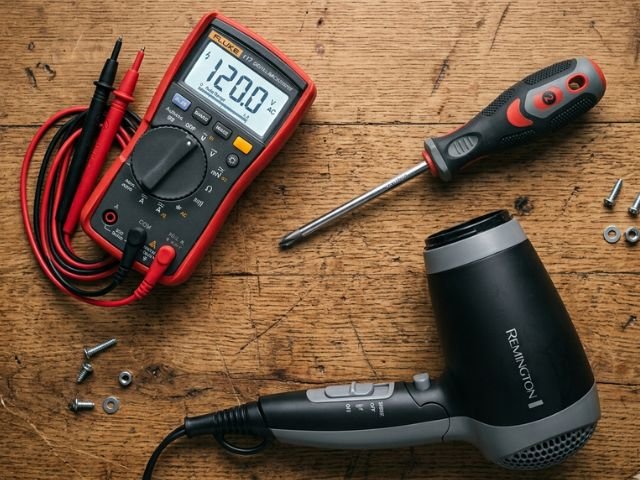
Stipulation 1.1: Prior to removing any defensive access panels or structural chassis screws, you MUST physically disconnect the alternating current (AC) power supply cord from the live wall receptacle. Failure to follow this critical safety condition voids your appliance warranty and introduces immediate risk of severe electrical shock, circuit damage, or arc flash.
Part 1: Why Your Samsung Freezer Is Cold But Fridge Is Not
When you experience a “samsung freezer is cold but fridge is not” or a “samsung freezer cooling but not fridge” situation, it almost never means your compressor is dead. If the compressor were broken, both sides would be warm.
Instead, a “samsung freezer cooling but not fridge” or “samsung freezer cooling but fridge not cooling” glitch points directly to an internal airflow blockage or a failed defrost component. Essentially, your freezer is making all the cold air, but it cannot travel upstairs to your refrigerator compartment.
If you are browsing threads like “samsung fridge warm but freezer cold reddit” or “samsung fridge not cooling but freezer works reddit“, you will find that hundreds of users are dealing with the exact same manufacturing oversight.
Let’s break down how to fix a “samsung fridge is not cooling but freezer is working” scenario step by step.
The “Oh No!” Error Code Cheat Sheet
If your control panel is flashing a weird sequence, you should Samsung Official Support Page for Refrigerator Error Codes to see what the machine is trying to tell you. Don’t let these blinking lines freeze you up. Cross-reference them right here:
- Code 22E or 22C: Your fan is stuck. Ice has physically trapped your fresh food compartment fan blade, or the motor just conked out.
- Code 4E or 4C: Your defrost sensor went kaput. The brain of your fridge can’t read the cooling coil temperature anymore.
- Flashing 88 88: Power surge glitch. Your fridge got confused after a quick power blink. Unplug it for 5 minutes to give it a hard reset.
Part 2: The Secret Service Mode Reset Trick.
A lot of people on forums search for “samsung fridge not cooling reset” or “samsung fridge freezer problems temperature reset”. If your “samsung fridge not cooling but light is on“, your first step should be triggering the built-in system diagnostics.
Problem 1: System-Wide Frost Blockage Choking the Vents
- The Cause: Constant door openings, bad seals, or minor sensor delays cause humidity to build up on the internal evaporator coils, turning into solid ice blocks that seal the air pathways shut.
- The Detailed Step-by-Step Solution:
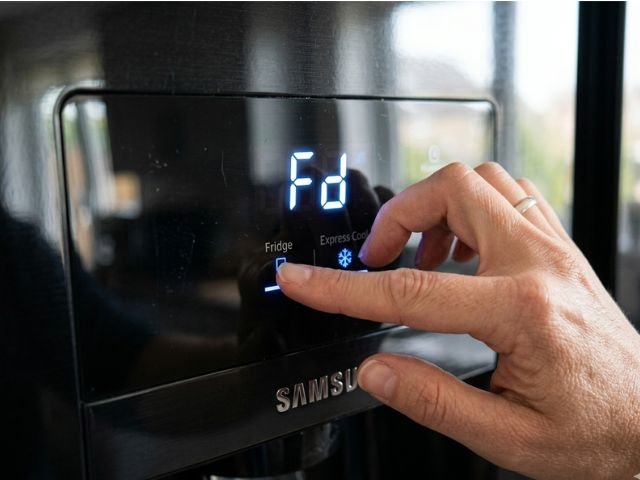
- Go to the front digital display interface panel on your refrigerator doors.
- Identify the Energy Saver and Fridge keys (on select French-door units, locate the Freezer and Lighting keys).
- Press and press down on both tactile buttons simultaneously. Keep them held down firmly for exactly 8 to 10 seconds.
- Release the keys the exact microsecond the display flashes a digital sequence, sounds a crisp audible chime, and turns completely dark.
- Within 2 seconds of the screen going blank, tap the Fridge key repeatedly.
- Stop tapping when you cycle to the alphabetical characters “Fd” (which stands for Forced Defrost).
- Listen for a loud, continuous buzzing or chirping alert sequence. This signifies the control board has directly energized the internal heater elements.
- Leave the refrigerator plugged in and undisturbed for exactly 20 to 25 minutes while the forced electrical current melts the frost.
- To exit this diagnostic mode prematurely, repeat the button hold and cycle past “Fd” until the screen restores to the regular operating temperature view.
Problem 2: Microprocessor Hang Up After Power Drops
- The Cause: Electrical grids spike when power cuts out, loading the main circuit panel with temporary logic loops that fail to engage the compressor start sequence or fan relays properly.
- The Detailed Step-by-Step Solution:
- Walk around to the back layout of your refrigerator cabinet.
- Firmly grab the base of the molded three-prong AC power cord casing.
- Pull it straight outward to isolate the entire machine from the wall receptacle.
- Leave the power cord physically disconnected for a minimum of 5 full minutes to drain residual capacitive voltage from the Main PCB circuitry.
- While waiting, go open both compartment doors and check that your rubber door gaskets are completely clean of debris.
- Plug the power cord back into the wall outlet.
- Check the front control interface—if the lights illuminate but you hear zero motor activity, check to make sure the board did not accidentally enter Demo/Shop Mode. (If it did, disable it by holding the Power Freeze and Freezer buttons down concurrently for 5 seconds until a status tone sounds.
Part 3: Deep Engineering Diagnostics (Multimeter Codes)
Problem 3: Frozen or Burned Out Evaporator Fan Motor (Part #DA31-00146H)
- The Cause: Moisture collects inside the fan bearing housing, turning to ice and locking the plastic blades. This triggers a Code 22E or 22C layout on your monitor screen.
- The Detailed Step-by-Step Solution:
- Turn off the master circuit breaker or pull the wall power plug out cleanly.
- Move the refrigerator unit forward to expose the rear galvanized steel shield plates.
- Use a Philips screwdriver to back out the perimeter screws securing the bottom mechanical hatch shield. Remove the metal barrier panel.
- Locate the plastic Main Logic Board Box secured to the rear frame wall. Unscrew the cover shell to expose the raw circuitry.
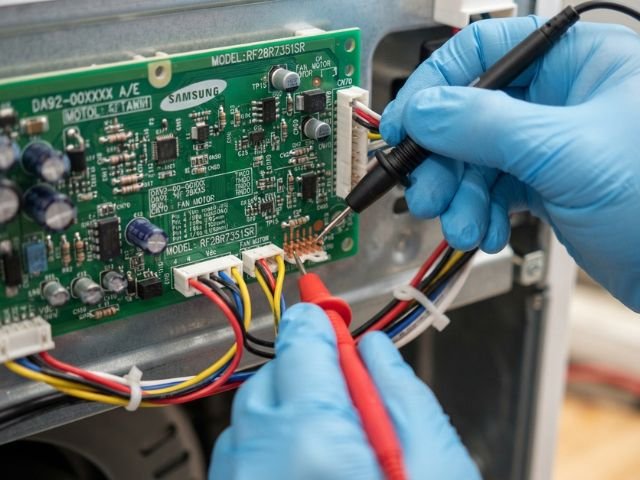
- Locate the wire cluster labeled CN74 on the circuit board layout map.
- Set your digital handheld multimeter selector dial over to the DC Voltage (VDC) testing range.
- Take your black multimeter testing lead and insert the pointed probe tip directly into the back-side of Pin 4 (the Gray Ground Wire terminal).
- Take your red multimeter testing lead and slide the probe point firmly into Pin 2 (the Yellow Fan Signal Wire terminal).
- Briefly plug the main appliance cord back into live wall power. Securely tape down the internal door switches inside the fresh food cabinet so the fridge logic thinks all doors are shut tightly.
- Observe your multimeter screen read-out:
- Condition A: If the display screen reads between 7.5 VDC and 12.0 VDC but you can visually see or hear that the evaporator fan inside the cabin is dead silent, the motor windings are toast. Unplug the fridge, go inside the food cabin, unbolt the back plastic wall skin, slide out the broken fan unit, and clip a brand-new OEM motor module in place.
- Condition B: If the display registers a flat 0.0 VDC, the logic board fan relay chip is completely blown out. You will need to replace the entire Main PBA circuit assembly.
Problem 4: Cracked or Failing Defrost Thermistor Sensor (Part #DA32-00006W)
- The Cause: Internal temperature changes can crack the casing of the thermistor bead, shorting it out and triggering a Code 4E or 4C. The board can’t tell how cold things are, so it completely stops running defrost cycles.
- The Detailed Step-by-Step Solution:
- Kill the electrical power line completely to prevent accidental board damage.
- Open the upper fresh food compartment doors wide and slide out all glass food shelves and plastic crisper bins.
- Locate the retaining tabs or screws along the perimeter of the vertical plastic rear wall liner casing inside the cabin. Remove the screws.
- Carefully pull the plastic panel assembly forward. Be gentle: Reach behind the panel and snap free the running wire harness plugs for the fan motor before completely pulling the panel away from the unit.
- Locate the exposed aluminum cooling coils. You will see a small, bullet-shaped plastic sensor module clipped directly to the cold copper intake piping. That is the thermistor.
- Disconnect the plastic pin harness linking the yellow and black wires to the main harness lines.
- Take your digital multimeter instrument and turn the master dial over to the Ohm (Ω) resistance setting, setting the scaling index threshold to the 20k range.
- Insert the clean metal tips of your multimeter testing leads directly into the dual terminal slots on the isolated sensor wire harness plug.
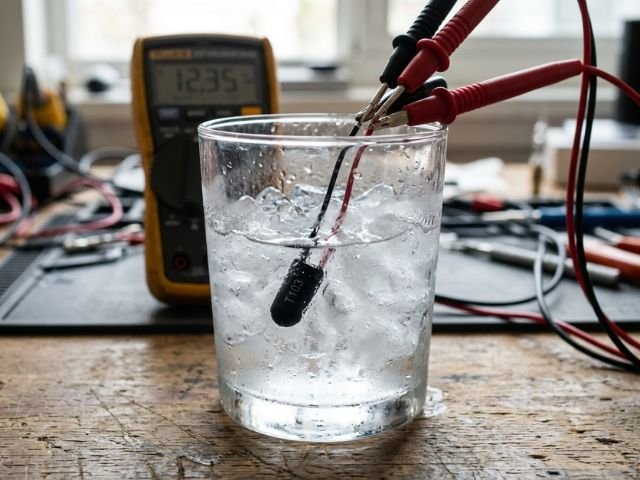
- Prepare a small testing cup filled with highly concentrated crushed ice and a splash of water to reach an exact 32°F baseline environment. Drop the thermistor sensor bead into the ice slush.
- Hold the probe connection stable for 60 seconds and evaluate the Ohms scale output against the factory specification parameters:
- Specification 1: At exactly 32°F (0°C) inside your ice water test bath, your meter screen MUST read exactly 13,290 Ohms.
- Specification 2: At typical room temperature conditions of 77°F (25°C), the meter MUST read exactly 5,000 Ohms.
- Specification 3: Inside a fully chilled, operational freezer cabin at 0°F (-18°C), the meter MUST read exactly 32,250 Ohms.
- The Diagnostic Verdict: If the multimeter screen reads
O.L(Open Loop) or stays locked onto a dead static value regardless of the water temperature changes, the internal crystal layer is ruined. Snip the wires, strip the shielding back 1/4 inch, crimp on a replacement OEM sensor unit, and insulate the splice connection using marine-grade waterproof heat-shrink tubing.
Part 4: The Factory Defect Big Appliance Blogs Hide
Problem 5: Clogged Internal Drain Throat and Undersized Heat Clip
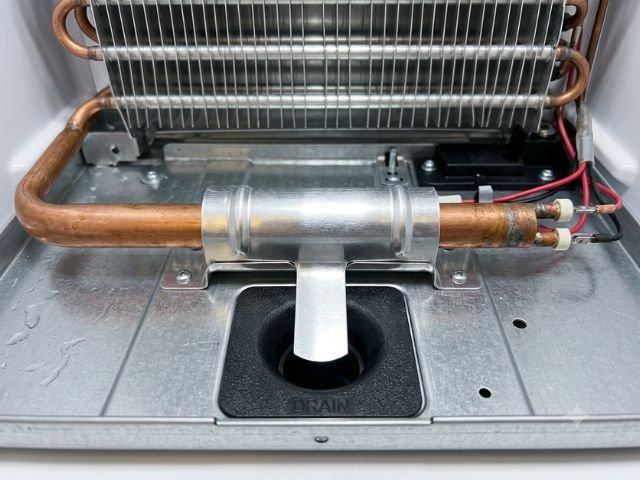
- The Cause: Water from daily melting cycles can’t drain out because Samsung’s original factory metal clip is too short to conduct heat into the drain pipe throat, causing meltwater to freeze solid inside the tube line.
- The Detailed Step-by-Step Solution:
- Unplug the refrigerator entirely from your home power supply.
- Remove the internal back panel cover inside the fresh food cabin to expose the lower aluminum drainage trough below the silver coils.
- Look directly into the center floor of the sheet metal trough to locate the small, recessed drain hole opening. If you see ice pooling inside the lower crisper areas, this hole is completely blocked by solid ice.
- Fill a clean squeeze bottle or turkey baster with scalding hot water.
- Carefully squirt the hot water directly down into the frozen drain throat hole. Keep applying hot water until you hear the liquid cleanly drop through into the bottom external evaporation tray below the machine chassis.
- Locate the small factory-installed silver aluminum clip dangling off the defrost heating element wire into the drain hole.
- Use small needle-nosed pliers to crimp open the attachment wings of that factory clip and pull it completely off the heater element tube.
- Take your newly acquired upgraded Samsung Extended Aluminum Drain Evaporator Refit Clip (
Part #DA61-06796A). - Wrap the broad top wings of the upgraded clip securely around the center baseline point of the metal defrost heating tube element. Crimp it tight with your pliers to ensure metal-on-metal contact for maximum heat conductivity.
- Guide the elongated tail portion of the new aluminum tab so it drops a full 2.5 inches straight down into the center throat opening of the plastic drain pipe line. Now, when the heater element turns on, thermal energy will travel deep down into the pipe throat to keep the line completely clear.
Part 5: Official Google PAA Expert Answers
Why is my Samsung fridge warm but freezer cold?
Your Samsung fresh food section is warm because the airflow vents connecting the freezer to the refrigerator cabin are blocked by heavy ice buildup, or your internal evaporator fan motor has failed.
Why is my freezer freezing but my refrigerator is warm?
This happens when your cooling system is successfully generating frost inside the evaporator coils, but a broken defrost thermistor or a clogged drain tube prevents the refrigerator section from receiving proper air circulation.
How to reset Samsung fridge temperature sensor?
You cannot manually reset an individual sensor. To reset the entire system after a sensor replacement, press and hold the Lighting and Fridge buttons (or Power Freeze and Power Cool) simultaneously for 5 seconds until the display panel clears.
How to reset Samsung fridge temperature sensor?
You cannot manually reset an individual sensor. To reset the entire system after a sensor replacement, press and hold the Lighting and Fridge buttons (or Power Freeze and Power Cool) simultaneously for 5 seconds until the display panel clears.
How do I reset my Samsung refrigerator compressor?
To reset the compressor, unplug the unit completely from the wall outlet and wait 10 full minutes. This allows the internal system pressures to equalize before the inverter board attempts to restart the compressor motor.
How to fix a fridge that is not cooling but the freezer is working?
First, clear any frost using the Forced Defrost (Fd) mode. If the problem returns within a week, test the defrost heater circuit, replace the defrost thermistor sensor, and clear any ice blockages out of the main drain tube line.
How to reset a fridge that is not cooling?
Unplug the power cord, wait 5 minutes, and plug it back in. If your display is locked in “Demo Mode” or “Shop Mode” (where lights work but cooling is disabled), press and hold the Power Freeze and Freezer buttons together for 5 seconds until you hear a clear beep.
Part 6: Full Terms, Conditions, and Legal Indemnification
LIMITATION OF LIABILITY & STIPULATIONS
1. General Content Provision: All information, software metrics, and diagnostic code metrics listed in this publication are provided "as-is" without a warranty of any kind, either expressed or implied.

2. Structural Damage Waiver: Under no circumstances shall the publishers, authors, or web hosts be held liable for any direct, indirect, incidental, or consequential property damages resulting from the execution of these repair tutorials.

3. Right-to-Repair Boundaries: Users are hereby notified that conducting independent manual diagnostic tests or replacing third-party OEM hardware components may permanently breach or void existing active manufacturing or retailer insurance warranties.

Hi, I’m Pranjul — the person behind this website.
I hold a Diploma and B.Tech in Electrical Engineering, along with hands-on training through ITI. For over 3 years, I worked as an ITI College Instructor, teaching electrical fundamentals and practical skills to hundreds of students.
Through that experience, I noticed something: most electrical troubleshooting information online is either too technical for everyday homeowners, or too vague to actually solve real problems. That’s the gap this website aims to fill.