What is a DC Series Current Relay?
A DC series current relay is a protection device that monitors current flow in a DC circuit. It’s connected in series with the load, and when current exceeds a preset limit, it activates contacts to open or close the circuit—preventing damage from overcurrent.
How does a DC Series Current Relay work?
It monitors the current through its series coil. Under normal conditions, the coil’s magnetism is weak. When the current rises beyond the threshold, the magnetic force pulls the armature, switching the relay contacts to cut off or activate the circuit and protect it from faults.
Types of DC Series Current Relay
There are two main types:
- Electromechanical – uses a coil, armature, and contacts.
- Solid-State – uses semiconductors such as MOSFETs and comparators for fast, contactless switching.
Solid-state types are faster and more reliable, while electromechanical ones are simple and affordable.
Why is Arc Suppression Important?
In DC circuits, no zero-crossing occurs, so arcs form when contacts open. This damages contacts and shortens relay life. Arc suppression using flyback diodes, RC snubbers, or TVS diodes prevents this and ensures reliable operation.
Can the DC Series Current Relay be used in AC Circuits?
No. It’s designed only for DC circuits. AC circuits have zero-crossing behavior and require AC-specific relays for correct operation.
Function in Protection Circuits
A DC series current relay disconnects or isolates the load when current exceeds safe limits, protecting against overcurrent, overload, and short-circuit faults for safe, reliable operation.
Table of Contents
Introduction
A DC Series Current Relay is an electromechanical or solid-state device that continuously monitors the current flowing in a Direct Current (DC) circuit.
When the current exceeds a predefined threshold (set point), the relay switches its contacts — either opening or closing the circuit.
This relay is primarily used in protection and control circuits, especially where it is necessary to detect overcurrent or fault conditions immediately and protect the circuit from damage.
In this article, we will cover —
- Working Principle of DC Series Current Relay
- Types and Designs
- Advantages and Limitations
- Applications
- Design and Selection Tips
- Common FAQs
🔹 DC Series Current Relay: Basic Principle
The term “Series Current Relay” refers to a relay that is connected in series with the load current path.
Hence, the entire load current passes through the relay coil or sensing element.
When the load current exceeds its normal limit, the relay coil becomes magnetically actuated.
As a result, the relay contacts change their state — either opening or closing — to isolate or bypass the circuit.
This type of relay provides overcurrent protection and safeguards electrical equipment from potential damage due to excessive current.
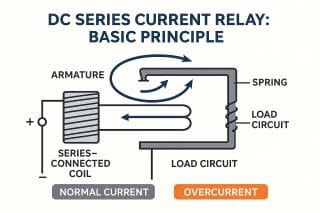
Working Principle of DC Series Current Relay
A DC Series Current Relay operates by changing its contact position in response to variations in the current flowing through its coil.
The relay coil is connected in series with the circuit whose current needs to be monitored.
When the current through the coil increases beyond a certain level, the coil becomes energized and generates the required magnetic flux.
As a result, the relay contacts change their state — that is, the Normally Open (NO) contact closes, or the Normally Closed (NC) contact opens.
The minimum current required to energize the relay coil and operate the contacts is called the Pull-in Current.
When the current drops below a specific threshold, the contacts return to their original position, and this current is known as the Drop-out Current.
In practical applications, the DC Series Current Relay is used in DC motor circuits as a current limiter or accelerator control.
It helps protect the motor from overcurrent conditions and provides real-time control of current flow in the circuit.
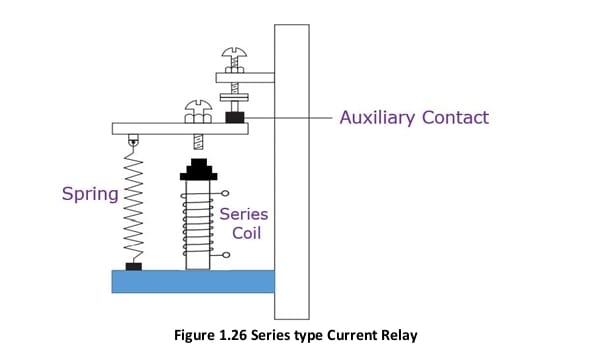
Types of DC Series Current Relay
DC Series Current Relays are mainly classified into two major categories —
1️⃣ Electromechanical DC Current Relay
2️⃣ Solid-State (Electronic) DC Current Relay
Although both types operate on the same basic principle, they differ significantly in construction, response time, durability, and application areas.

🅐 Electromechanical DC Current Relay
This is the traditional type of DC relay that contains mechanical components such as a coil, armature, spring, and contacts.
When sufficient current flows through the relay coil, it generates a magnetic field, attracting the armature, which in turn changes the position of the contacts (NO → Close or NC → Open).
Key Features:
- Conventional coil + armature + contacts structure
- Operation based on mechanical movement
- Simple, robust, and cost-effective design
- Subject to wear and tear due to moving parts
- Slightly slower response time
Applications:
Electromechanical DC relays are used in applications requiring moderate switching speed and rugged design, such as DC motors, battery circuits, and protection systems.
🅑 Solid-State / Electronic DC Current Relay
This is a modern type of relay that operates entirely on semiconductor components, including MOSFETs, comparators, sensing resistors, and operational amplifiers, with no moving parts.
When the current flowing through the sensing resistor exceeds a set limit, the comparator output changes, triggering the switching element (such as a MOSFET or transistor).
Key Features:
- No moving parts → high-speed switching
- Silent operation and long service life
- Highly reliable and maintenance-free
- Compact design with low power loss
- Requires snubber circuit or TVS diode protection for inductive loads
Applications:
Solid-state relays are used in high-speed protection systems, automation, power electronics, and DC motor drive circuits, where fast response and high reliability are essential.
Advantages
The DC Series Current Relay offers several key benefits, especially when used in overcurrent protection and DC motor control circuits.
Here are its major advantages:
1️⃣ Reliable Overcurrent Detection
The relay continuously monitors the current flowing through the DC circuit and accurately detects overcurrent conditions, ensuring circuit protection.
2️⃣ Faster Response
Especially in solid-state relays, there are no mechanical movements, enabling instant response and quick isolation of fault conditions.
3️⃣ No External CT (Current Transformer) Required
Since the relay is connected in series with the circuit, it does not require an external CT for current sensing, simplifying design and reducing cost.
4️⃣ Compact and Low Maintenance
Particularly in solid-state designs, the absence of moving parts results in longer service life and minimal maintenance requirements.
⚠️ Limitations / Challenges
Although the DC Series Current Relay provides many benefits, it also has some technical limitations and practical challenges:
1️⃣ Wear & Tear in Mechanical Relays
In electromechanical relays, issues such as contact erosion, bouncing, and mechanical wear can reduce reliability over time.
2️⃣ Difficult to Switch DC
DC circuits lack a zero-crossing point, making arc generation more severe during switching. This can lead to faster contact degradation.
3️⃣ Thermal Management Needed in Solid-State Relays
In solid-state versions, proper heat dissipation and transient protection (e.g., using snubber circuits or TVS diodes) are crucial to prevent overheating.
4️⃣ Voltage Drop Issue
A slight voltage drop may occur across the sensing coil or resistor, which can reduce efficiency slightly — particularly in low-voltage applications.
Applications of DC Series Current Relay
The DC Series Current Relay is used in circuits where current monitoring, overcurrent protection, or fault isolation is required.
Due to its high reliability and fast response, it serves as a vital protective component in many modern electrical and electronic systems.
⚙️ Main Application Areas
1️⃣ Battery Management Systems (BMS)
In solar energy storage systems, inverters, and UPS units, DC relays are used to monitor and control battery current, preventing overcharging or short-circuit conditions.
2️⃣ DC Motor Overcurrent Protection
Used in DC motors to protect motor windings from overcurrent and overload conditions, ensuring safe operation and longevity.
3️⃣ Electric Vehicles (EV) and E-Bike Systems
In EVs and electric scooters, the relay regulates current flow between the battery and motor and provides a power cut-off during fault conditions.
4️⃣ Telecom Equipment Power Protection
In telecom base stations and network systems, DC relays protect sensitive electronic circuits from voltage surges and overcurrent faults.
5️⃣ Industrial DC Power Supplies
Used in industrial control panels and automation systems for reliable current control and equipment protection.
6️⃣ Renewable Energy Circuits
In solar, wind, and hybrid renewable energy systems, DC relays play a key role in safe current management and system protection.
🔹 Design and Selection Tips for DC Series Current Relay
When selecting a DC Series Current Relay, several design and selection factors must be considered to ensure safe and efficient system operation.
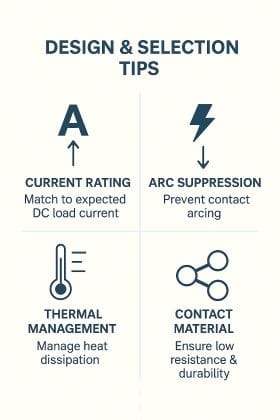
🧩 Key Design & Selection Tips
1️⃣ Current & Voltage Ratings
Choose a relay with a current rating slightly higher than the load current to prevent unnecessary stress due to overloads or surge currents.
2️⃣ Voltage Drop Control
Since the relay is connected in series, minimize voltage drop across the sensing coil or resistor to maintain system efficiency.
3️⃣ Arc Suppression
For inductive loads (e.g., motors, solenoids), use flyback diodes, snubber circuits, or TVS diodes to suppress arcing and increase contact life.
4️⃣ Thermal Management
Solid-state relays generate heat during operation, so proper heatsinks, cooling fans, or thermal pads are necessary to prevent overheating.
5️⃣ Response Time
The relay should be capable of detecting and isolating faults instantly to prevent damage to the load.
6️⃣ Contact Material
For electromechanical relays, use durable and arc-resistant contact materials such as silver alloy or special metal composites to handle DC arcing effectively.
7️⃣ Reliability & Safety
Incorporate redundancy or fail-safe mechanisms in the design to ensure that the system remains fully protected even under fault conditions.
Can a DC Series Current Relay be used in an AC Circuit?
Answer: No.
A DC Series Current Relay is specifically designed for Direct Current (DC) circuits.
In AC circuits, the current exhibits zero-crossing behavior, and the circuit involves impedance and reactive effects that are completely different from DC characteristics.
Therefore, AC circuits require AC-rated relays.Mechanical vs Solid-State Relay — Which is Better?
Answer:
Mechanical Relays are simple, cost-effective, and easy to replace, but they suffer from contact wear, bouncing, and arcing issues due to moving parts.
Solid-State Relays (SSR), on the other hand, have no moving parts, making them more reliable, faster, and low-maintenance. However, SSRs require proper heat dissipation and transient voltage protection.Can Two Relays Be Connected in Series to Handle Higher Current?
Answer: Not Recommended.
When two relays are connected in series, their contacts do not open or close exactly at the same time.
This causes uneven current distribution, leading to excessive electrical stress on one relay and potential contact damageWhat Happens When Switching Inductive Loads?
Answer:
When switching inductive loads (such as motors, solenoids, or coils), the collapsing magnetic field produces a high-voltage spike (known as back EMF) when the circuit opens.
This sudden voltage surge can damage relay contacts or semiconductor components.
Conclusion
The DC Series Current Relay is a highly important component that plays a crucial role in both the protection and control of DC circuits. It not only detects overcurrent and fault conditions but also instantly isolates the circuit to protect equipment from damage.
When the relay is properly selected, accurately designed, and combined with appropriate protection measures, it can significantly enhance the reliability, efficiency, and operational safety of any DC electrical system.
In summary, the DC Series Current Relay is a vital and dependable component of modern DC power control systems, ensuring stable, safe, and efficient operation at all times.

Hi, I’m Pranjul — the person behind this website.
I hold a Diploma and B.Tech in Electrical Engineering, along with hands-on training through ITI. For over 3 years, I worked as an ITI College Instructor, teaching electrical fundamentals and practical skills to hundreds of students.
Through that experience, I noticed something: most electrical troubleshooting information online is either too technical for everyday homeowners, or too vague to actually solve real problems. That’s the gap this website aims to fill.