Introduction
Now, when the supply is given to the main winding, at that time magnetic field is produced. This magnetic field produces the magnetic flux. Similarly, when the current flows through the armature conductor, the armature produces its own flux. Now, the interaction of the armature flux with the main flux produces a certain reaction and that reaction is called armature reaction in dc machine.
What is Armature Reaction
Armature reaction is nothing but the reaction of armature flux on the main field flux. The main field flux is produced when the stator is supplied with current. Due to this, the magnetic field is produced. Due to the magnetic field, whatever flux is produced, that is called the main field flux. When the current flows through the conductors of the armature, then whatever flux is produced, that is called the armature flux.
Interaction of Flux
This armature flux tries to interact with the main flux. Due to this, whatever resultant flux is produced, it gets distorted or demagnetized. This effect of armature flux on the main flux is called as armature reaction.
Main Field Flux Distribution
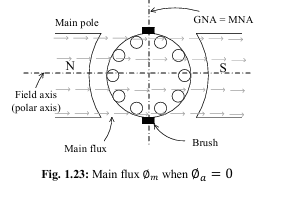
Now, consider the figure shows the main field flux distribution. Here, this is the north pole and this is the south pole. The conductors with the cross sign come under the north pole, whereas the conductor with the dot sign come under the south pole. Here, the current is not flowing, but the flux is shown in the direction it travels from north pole to south pole.
Now there are two axes, MNA and GNA. We can see MNA has coincided with GNA. MNA is called as magnetic neutral axis, and GNA is called as geometric neutral axis. Magnetic neutral axis consists of brushes, hence this axis is also called as axis of commutation. Magnetic neutral axis is always perpendicular to the resultant flux. Here, these are the lines which show the flux from north pole to south pole. We can see that magnetic neutral axis is exactly perpendicular to the resultant flux.
Only Main Flux
Now consider the figure Here, only the flux is flowing from north pole to south pole. There is no current in the armature conductor. We can say that when there is no current in the armature conductor, the total flux is only produced by the main pole, that is called as main pole flux. The direction of this flux is shown from north pole to south pole. Here, we can see that the magnetic neutral axis coincides with geometrical neutral axis and it is exactly perpendicular to the flux.
Armature Flux Distribution
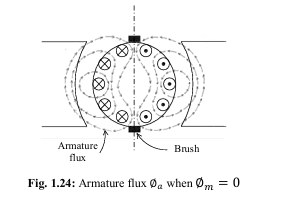
Now, consider a case as shown in the figure, which shows the armature flux distribution. In this case, only the armature is carrying the current, and there is no current in the main field flux.
In this case, we can see that the conductors which are shown with the cross sign come under the north pole, whereas the conductors which are shown with the dot sign come under the south pole. All the conductors which come under the north pole carry same current, whereas all the conductors which come under the south pole carry same current.
The direction of flux is shown by this way and the arrow. A similar direction is shown for the South Pole. As the conductors that come under the north pole carry the same current, the direction of the flux for all the conductors will be the same, and the resultant direction of all the conductor flux is in the downward direction. Similarly, all the conductors under the south pole carry the same current; hence, the resultant flux of all the conductors under the south pole will have the same direction, that is, in the downward direction.
But if we see the total effect of all the conductors under the north pole and south pole, their flux aligns itself in such a way that the resultant flux of all the conductors is in the downward direction, represented by
Resultant Flux Distribution
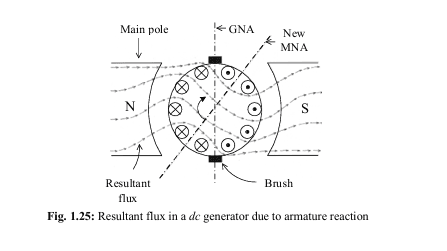
Now, you can see in Figure it shows the resultant flux distribution. Now here we can see that the magnetically neutral axis has moved to a certain extent than the original flux neutral plane.
Here, both the main field and the armature are carrying the current. So, as the main field is carrying the current, the main flux is produced, and as the armature is carrying the current, the armature flux is produced. Due to the interaction of both the fluxes, that is, the main field flux and armature flux, we can see the resultant flux is somewhat distorted. This effect of armature flux on the main flux is called armature reaction.
It is observed that the armature current (which produces ∅ₐ) causes displacement of the resultant flux in the direction of rotation of the rotor when the machine operates as a DC generator. However, when it operates as a DC motor, the displacement of resultant flux is opposite to the direction of rotation. This can be verified using the right-hand thumb rule and Fleming’s rules.
Shift of Magnetic Neutral Axis (MNA)
Now we know that the magnetically neutral axis should always be perpendicular to the resultant flux. Let Fm be the MMF of the main flux, Fa be the MMF of the armature flux. The resultant MMF Fr is as shown by this graph.
Now as we know the magnetic neutral axis is always perpendicular to the resultant flux. So as the armature will rotate, it will cause the distortion of the main flux. So whatever resultant flux is produced that will get distorted along with the rotation of the armature. So the magnetically neutral axis will always move in the direction of the rotation of the armature, becoming perpendicular to the resultant flux.
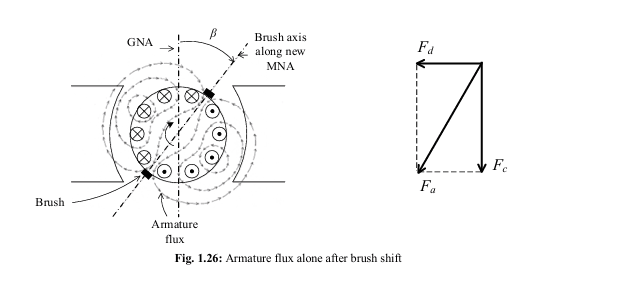
The machine operates as a generator and shifted backward opposite to the direction of rotation when operating as a motor, so that they lie on the new MNA. The angle by which brushes are shifted from GNA is denoted by θ, as shown in Fig. It is also observed that the flux density at the leading pole tip decreases, while it increases at the trailing pole tip.
Demagnetizing and Cross-Magnetizing Effect
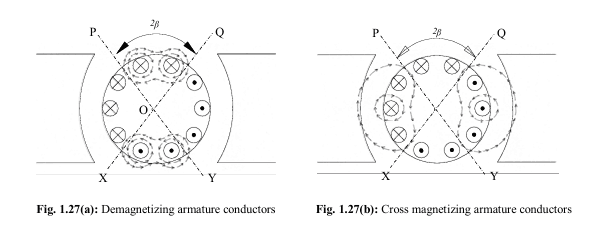
After the brush shift, armature flux ∅ will also get shifted as shown in Fig. The armature mmf ‘Fa’ can be resolved into two components ‘Fd’ and ‘Fc’. The direction of ‘Fd’ is in direct opposition to the direction of the main field ∅ and therefore is called the de-magnetizing mmf. The direction of ‘Fc’ is in quadrature to the direction of the main field ∅ , and it produces distortion or cross-magnetization of the main field ∅; it is called the distortional or cross-magnetizing mmf.
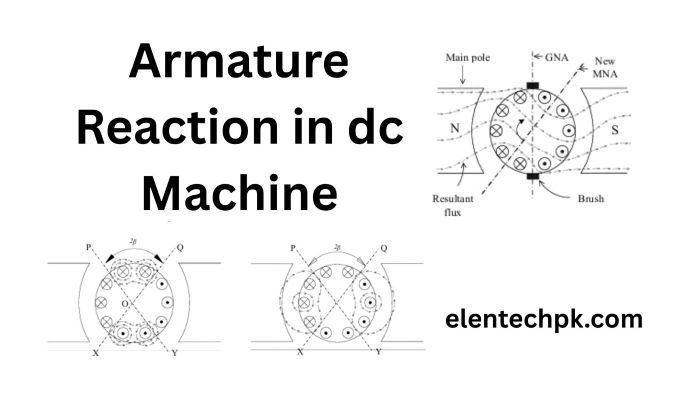
Thus, the armature winding is resolved into two components: (i) the de-magnetizing component and (ii) the cross-magnetizing component. The armature conductors lying within the angles POQ = θ/2 and XOY = θ/2 contribute to the demagnetizing effect, while all other conductors contribute to the cross-magnetizing effect.
Effects of Armature Reaction
The effect of armature reaction is to decrease the flux density under one pole tip and increase it under the other, causing saturation. Consequently, the resultant flux becomes less than what it would have been in the absence of armature reaction when only ∅ it is present, and therefore the generated emf decreases. The increased flux density in some parts of the machine increases iron loss.
It also increases the maximum voltage between adjacent segments of the commutator under load as compared to no-load. If this voltage exceeds 30V, there is a possibility of continuous sparking between adjacent segments, which may lead to a ring of fire. Armature reaction also causes delayed commutation, resulting in more sparking at the brushes, which leads to faster wear and tear of the commutator and brushes.
Finally, Armature Reaction in DC Machines is an important phenomenon in which the armature flux affects the main flux. This causes the flux distribution to change, distort, and, to some extent, weaken.
Armature reaction causes the MNA to shift, the brush positions to change, and directly impacts machine performance. Its two main effects—demagnetizing and cross-magnetizing—affect machine efficiency and commutation.
Therefore, it is very important to understand and control Armature Reaction in DC Machine (such as brush shifting, interpolation and use of compensating windings) so that the machine can function properly and effectively.
What is armature reaction in a DC machine?
When the armature flux affects the main flux and distorts or weakens it, this effect is called Armature Reaction in a DC Machine.
What are the main effects of armature reaction?
Ans: It has two main effects:
Distortion of flux (Cross-Magnetizing Effect)
Weakening of flux (Demagnetizing Effect)What is the demagnetizing effect?
When the armature mmf acts in the opposite direction to the main flux and reduces it, it is called the demagnetizing effect.
What is the cross-magnetizing effect?
When the armature mmf distorts the main flux, it is called the cross-magnetizing effect.
What effect does armature reaction have on the MNA?
Due to the armature reaction, the MNA (Magnetic Neutral Axis) shifts from its position, which also requires a change in the position of the brushes.

Hi, I’m Pranjul — the person behind this website.
I hold a Diploma and B.Tech in Electrical Engineering, along with hands-on training through ITI. For over 3 years, I worked as an ITI College Instructor, teaching electrical fundamentals and practical skills to hundreds of students.
Through that experience, I noticed something: most electrical troubleshooting information online is either too technical for everyday homeowners, or too vague to actually solve real problems. That’s the gap this website aims to fill.