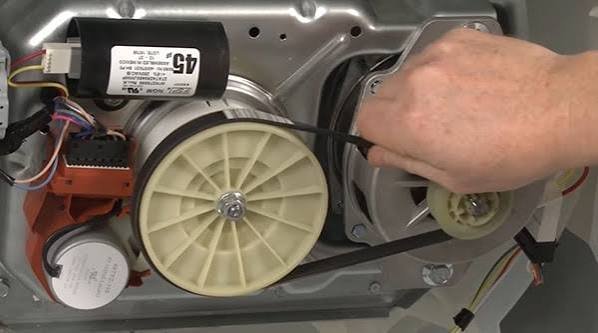
Grinding noise on spin…it’s one of those sounds that makes you wanna unplug the thing immediately, and honestly that instinct isn’t wrong. But before you start pricing out a whole new washer, there’s a handful of things that cause this on Roper top loaders, and most of them aren’t as expensive as you’d think.
Quick way to narrow it down…does it agitate fine but grind or stay stuck once spin kicks in? That points toward the motor coupling or the clutch. Does it grind pretty much the whole time, even during agitation, and get louder as spin speed picks up? That’s more likely a tub bearing, and that one’s a bigger job.
I’m an electrical engineer, been doing hands-on appliance diagnostics for about 8 years now, and grinding noise on these direct-drive Roper/Whirlpool-platform washers is one of the most common calls out there. Good news is a lot of the time it’s a cheap plastic part, not the transmission. Bad news is people skip straight to replacing the whole machine because “grinding” sounds expensive.
What You’ll Need
Basic hand tools — Phillips screwdriver, 7/16″ or 1/2″ nut driver depending on your model, needed to pull the cabinet or console apart to get at the motor/transmission area.
Motor coupling kit — this is the part that most often fails and causes grinding or a “washer runs but doesn’t spin” symptom on direct-drive models. It’s a small plastic-and-rubber coupler that sits between the motor and transmission. Confirm the exact part number against your model number before ordering, since it varies by machine.
Flashlight — for checking around and under the tub for anything that fell in and got stuck against the drum or pump.
What’s Actually Causing the Grinding
| Symptom | Likely Cause | Notes |
|---|---|---|
| Washer agitates fine, but grinds or won’t spin at all during spin cycle | Worn/broken motor coupling | Extremely common on direct-drive machines. Cheap part, moderate difficulty to access. |
| Motor runs (you can hear it) but tub doesn’t spin, or spins weak | Bad clutch assembly | Also a known issue on this platform — clutch either isn’t grabbing or the brake isn’t releasing. |
| Grinding gets louder as spin speed increases, present through the whole cycle | Worn tub bearing | Bigger repair — usually means pulling the tub. Often makes more sense to replace the tub and bearing together rather than just the bearing. |
| Loud clanging or banging, tub swinging and hitting the cabinet | Worn suspension rods/springs or snubber pads | These are what keep the tub from smacking the outer case during spin. Worth checking before assuming it’s a bearing. |
| Rattling or scraping that comes and goes | Foreign object in the tub or pump | Coins, buttons, underwire, anything small that escaped a pocket. |
Step-by-Step: Roper Top Load Washer Grinding Noise When Spinning
Step 1: Rule Out the Easy Stuff First
- Stop the cycle, open the lid, and check inside the tub and around the agitator for anything that shouldn’t be there.
- Pull the drain pump filter (if your model has an accessible one) and check for debris.
- Make sure the load isn’t wildly unbalanced — a single heavy item like a comforter can cause noise that sounds a lot worse than it actually is.
- Check that all four leveling legs are actually touching the floor and the lock nuts are tight. A washer that rocks can create noise that mimics a mechanical failure.
Step 2: Test the Motor Coupling
- Unplug the washer.
- Pull it away from the wall and remove the rear or lower access panel (varies by model — check your owner’s manual for the exact panel location).
- Locate the coupling between the motor and the transmission — it’s usually a small assembly with plastic ears/lugs.
- Look for cracked, sheared, or worn-down lugs. This part is designed to fail before the transmission does, so seeing it worn out is actually the “good” outcome here.
- If it’s damaged, replace it. This is typically a moderate difficulty repair — you’re not getting into the transmission itself.
Step 3: Check the Clutch
If the coupling looks fine but the tub still isn’t spinning right (or you hear the motor running with no real tub movement), the clutch assembly is the next suspect. It sits on the transmission and is responsible for gradually engaging the tub during spin-up. On these machines it’s a fairly well-known wear item.
Step 4: Last Resort — Tub Bearing
If none of the above fixes it and the grinding is constant and speed-related, it’s likely the tub bearing. This is the point where a lot of people decide to call a tech or weigh repair cost against the age of the machine, since it usually means pulling the entire tub assembly apart. If your washer’s older and already had other issues, this is worth factoring into whether repair is even worth it versus replacement.
Heads Up: Don’t Assume It’s the Transmission
A lot of people hear grinding and immediately think “transmission’s dead, machine’s toast.” Most of the time that’s not actually what’s going on. The coupling and clutch are specifically designed as wear parts that fail before the transmission does — that’s kind of their whole job. Actual transmission failure on these machines is a lot less common than people assume. Worth ruling out the cheap stuff first before writing the whole washer off.
FAQ
Is it safe to keep using the washer while it’s grinding?
Not really a great idea to keep running full loads on it. If it’s the coupling, you risk it failing completely mid-cycle. If it’s a bearing, running it longer can make the eventual repair (or the mess if it fails outright) worse. Best to get it diagnosed before you keep putting loads through it.
How do I know if it’s worth repairing versus replacing?
If it’s the coupling or clutch, that’s usually a low-cost repair and worth doing on almost any machine. If you’re looking at a tub bearing replacement on an older unit, it’s worth comparing that repair cost (parts plus labor if you’re not doing it yourself) against the cost of a new washer before committing.
Where to Look for More Help
Check your exact model number against Roper’s or Whirlpool’s official parts lookup before ordering a coupling, clutch, or bearing kit — these vary between models even within the same general platform. r/appliancerepair on Reddit is also worth searching if you want to see if others have dealt with the same noise on your specific model.
Quick disclaimer…part numbers, access panel locations, and exact repair steps vary by model. Always confirm against your washer’s specific model number before ordering parts or taking it apart.

Hi, I’m Pranjul — the person behind this website.
I hold a Diploma and B.Tech in Electrical Engineering, along with hands-on training through ITI. For over 3 years, I worked as an ITI College Instructor, teaching electrical fundamentals and practical skills to hundreds of students.
Through that experience, I noticed something: most electrical troubleshooting information online is either too technical for everyday homeowners, or too vague to actually solve real problems. That’s the gap this website aims to fill.