
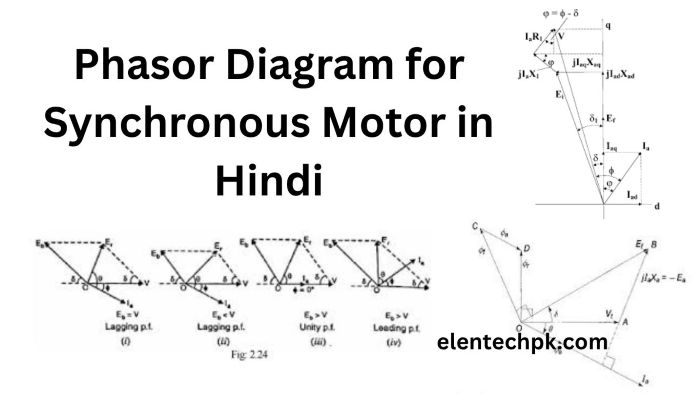
Equivalent Circuit of Synchronous Motor क्या होता है
इस topic में हम Phasor Diagram of Synchronous Motor in Hindi और उसके equivalent circuit को समझते हैं। Equivalent circuit का उपयोग किसी भी electrical machine के electrical characteristics को represent करने के लिए किया जाता है। Synchronous motor के equivalent circuit में V terminal voltage को denote करता है, Ra armature resistance per phase होता है, Xs synchronous reactance होता है, Zs synchronous impedance होता है और Ef excitation EMF को दर्शाता है। Synchronous impedance को से define किया जाता है, जहाँ armature resistance और synchronous reactance को combine किया जाता है।
Thank you for reading this post, don't forget to subscribe!Equivalent circuit of Synchronous Motor से main equation निकलती है , जिसे rearrange करने पर मिलता है। यही final equation है जिसकी मदद से phasor diagram बनाया जाता है।
यहाँ हम synchronous motor का phasor diagram draw करने का simplest तरीका discuss करेंगे और साथ ही इसके advantages (fayde) भी समझेंगे। Phasor diagram शुरू करने से पहले, हम सभी quantities के लिए अलग-अलग notations को एक जगह लिख लेते हैं:
- Ef: जो Excitation Voltage को दर्शाता है।
- Vt: जो Terminal Voltage को दर्शाने के लिए है।
- Ia: जो Armature Current को रिप्रेजेंट करता है।
- Θ (Theta): जो Terminal Voltage और Armature Current के बीच का angle है।
- ᴪ (Psi): जो Excitation Voltage और Armature Current के बीच के angle को दिखाने के लिए है।
- δ (Delta): जो Excitation Voltage और Terminal Voltage के बीच का angle है।
- ra: जो Armature per phase Resistance को दिखाने के लिए है।
Synchronous Motor के Phasor Diagram के लिए हम Vt को ही Reference Phasor के तौर पर लेंगे।
Phasor Diagram के Important Points
Phasor diagram draw करने से पहले कुछ important बातें ध्यान में रखनी होती हैं। Excitation EMF () और terminal voltage () एक ही direction में नहीं होते, बल्कि उनके बीच एक angle होता है जिसे load angle () कहते हैं। साथ ही excitation EMF हमेशा terminal voltage के पीछे रहता है, यानी हमेशा से lag करता है।
- हम जानते हैं कि अगर किसी मशीन को Synchronous Motor की तरह काम करने के लिए बनाया जाता है, तो Armature Current की जो दिशा (direction) है, वह Excitation EMF की दिशा के Phase Opposition (विपरीत फेज़) में होती है।
- जो Phasor Excitation EMF है, वह हमेशा Phasor Terminal Voltage से पीछे (behind) रहता है।
Synchronous Motor का Phasor Diagram बनाने के लिए ऊपर बताए गए ये दोनों पॉइंट्स बिल्कुल पर्याप्त (sufficient) हैं। Synchronous Motor का Phasor Diagram नीचे दिया गया है:
अब हम Synchronous Motor के लिए एक Complete Phasor Diagram बनाएंगे और साथ ही हर Case में Excitation EMF के लिए Expression भी derive करेंगे। हमारे पास नीचे लिखे गए ये तीन मुख्य Cases हैं:
(a) Motoring Operation at Lagging Power Factor:
(b) Motoring Operation at Unity Power Factor
(c) Motoring Operation at Leading Power Factor:
Motoring Operation के 3 Case और Expressions
अब हम synchronous motor का phasor diagram build करेंगे और हर case में excitation EMF के लिए mathematical expressions हासिल करेंगे। नीचे दिए गए 3 cases हैं:
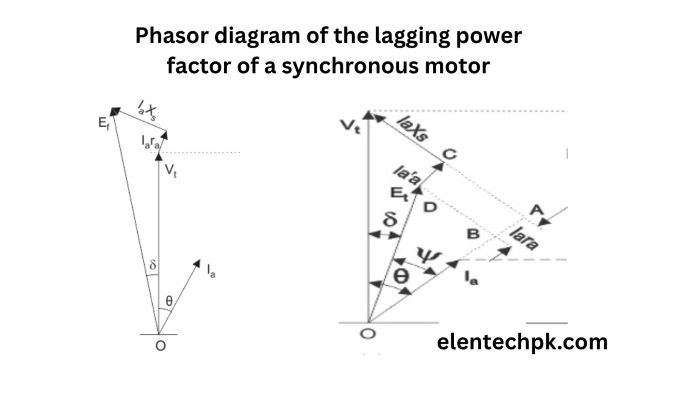
Phasor diagram of the Lagging Power Factor of a synchronous motor
Lagging power factor में armature current () terminal voltage () से पीछे रहता है। Phasor diagram बनाते समय सबसे पहले voltage का phasor drawn किया जाता है। उसके बाद excitation EMF को voltage के पीछे angle पर draw किया जाता है। Armature current को voltage से lag करते हुए दिखाया जाता है। Armature resistance के कारण का drop current की direction में होता है, जबकि reactance के कारण j component current के perpendicular होता है और 90° का angle बनाता है।
Lagging Operation के लिए Excitation EMF का Expression derive करने हेतु, हम सबसे पहले Terminal Voltage (Vt) का वह Component (घटक) लेते हैं जो Armature Current (Ia) की दिशा में हो। Armature Current की दिशा में यह Component Vt cosθ है। यहाँ मोटर Under-excited स्थिति में काम करती है और Armature Current, Terminal Voltage से पीछे (lag) रहता है।
चूँकि Armature (current) की दिशा Terminal Voltage की दिशा के विपरीत (opposite) होती है, इसलिए Voltage Drop −Ia Ra होगा; अतः Armature Current की दिशा में Total Voltage Drop (Vt cosθ − Ia Ra) प्राप्त होता है।
इसी प्रकार, हम Armature Current की दिशा के Perpendicular (लंबवत) दिशा में भी Voltage Drop की गणना कर सकते हैं। यहाँ Total Voltage Drop (Vt sinθ − Ia Xs) निकलकर आता है।
पहले Phasor Diagram में दिए गए Triangle BOD की सहायता से, हम Excitation EMF (Ef) के लिए Expression को इस प्रकार लिख सकते हैं:
Final Formula:
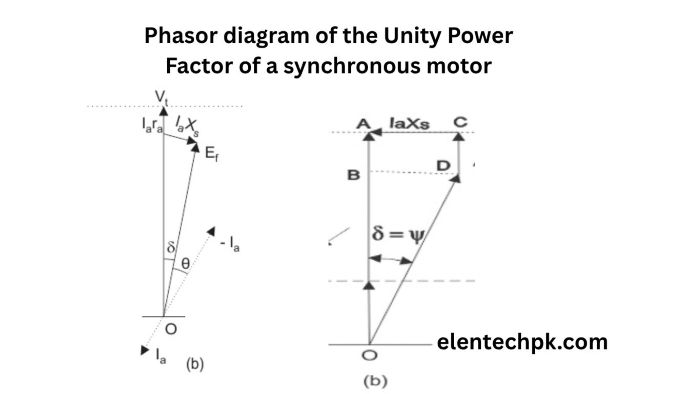
Phasor diagram of the Unity Power Factor of a synchronous motor.
Unity power factor में voltage और current के बीच कोई phase difference नहीं होता, यानी दोनों same direction में होते हैं। सबसे पहले voltage का phasor draw किया जाता है और उसी direction में armature current को भी draw किया जाता है। Excitation EMF हमेशा की तरह voltage के पीछे रहता है। Armature resistance drop () current की opposite direction में दिखाया जाता है और reactance component (j) perpendicular draw किया जाता है। इन सभी को combine करके synchronous impedance drop () प्राप्त होता है।
Unity Power Factor operation के लिए Excitation EMF (Ef) का Expression प्राप्त करने हेतु, हम पुनः सबसे पहले Terminal Voltage (Vt) का वह Component लेते हैं जो Armature Current (Ia) की दिशा में हो। इस Case में Current और Voltage दोनों एक ही phase में होते हैं, जिससे efficiency बेहतर मिलती है।
परंतु यहाँ (UPF होने के कारण), θ (theta) का मान zero (0) होता है, और इसी वजह से हमें ψ = δ प्राप्त होता है।
दूसरे Phasor Diagram में दिए गए Triangle BOD की सहायता से, हम Excitation EMF (Ef) के लिए Expression को सीधे इस प्रकार लिख सकते हैं:
Final Formula:
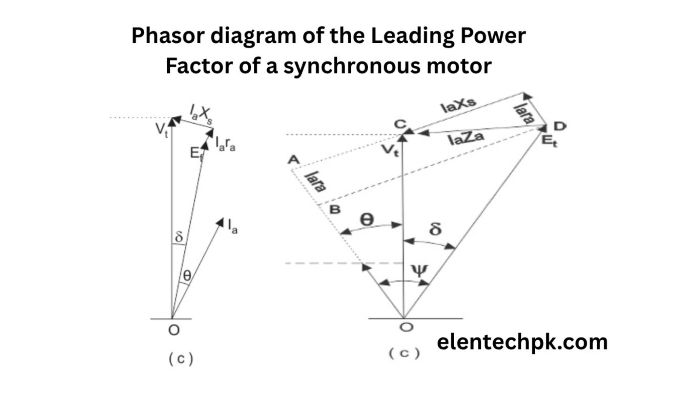
Phasor diagram of the Leading Power Factor of a synchronous motor
Leading power factor में armature current () voltage () से आगे रहता है। सबसे पहले voltage का phasor draw किया जाता है और उसके पीछे excitation EMF draw किया जाता है। Armature current को voltage से lead करते हुए दिखाया जाता है। Armature resistance का component current की opposite direction में draw होता है और reactance component j perpendicular होता है। इस condition में current voltage से lead करता है और phasor diagram में यह स्पष्ट दिखाई देता है।
Leading Power Factor operation के लिए Excitation EMF का Expression प्राप्त करने हेतु, हम पुनः सबसे पहले Terminal Voltage (Vt) का वह Component (घटक) निर्धारित करते हैं जो Armature Current (Ia) की दिशा में हो। Armature Current की दिशा में यह Component Vt cosθ है। यहाँ मोटर Over-excited होकर काम करती है, जहाँ Armature Current, Terminal Voltage से आगे (lead) निकल जाता है।
चूँकि Armature (current) की दिशा Terminal Voltage की दिशा के विपरीत (opposite) होती है, इसलिए Voltage Drop (−Ia Ra) होगा; अतः Armature Current की दिशा में Total Voltage Drop (Vt cosθ − Ia Ra) प्राप्त होता है।
ठीक इसी प्रकार, हम Armature Current की दिशा के Perpendicular (लंबवत) दिशा में भी Voltage Drop की गणना कर सकते हैं। यहाँ Total Voltage Drop (Vt sinθ + Ia Xs) निकलकर आता है।
पहले Phasor Diagram में दिए गए Triangle BOD की सहायता से, हम Excitation EMF (Ef) के लिए Expression को इस प्रकार लिख सकते हैं:
Final Formula:
Synchronous Motor के लिए Phasor Diagrams बनाने के 5 प्रमुख लाभ (Advantages)
Synchronous Motor के वर्किंग प्रिंसिपल और परफॉरमेंस को गहराई से समझने के लिए Phasor Diagrams सबसे महत्वपूर्ण टूल हैं जो इंजीनियरिंग में व्यापक रूप से उपयोग किए जाते हैं। इसके मुख्य लाभ नीचे दिए गए हैं:
(1) Physical Insight: Synchronous Motors के ऑपरेशन की Physical Insight (भीतरी समझ) प्राप्त करने के लिए Phasors अत्यंत उपयोगी होते हैं। इसकी मदद से हम यह विजुअलाइज कर सकते हैं कि मोटर के अंदर मैग्नेटिक फील्ड और इलेक्ट्रिकल क्वांटिटीज के बीच कैसा तालमेल है।
(2) Mathematical Derivation: Phasor Diagrams की सहायता से हम विभिन्न इलेक्ट्रिकल राशियों (Quantities) के लिए Mathematical Expressions और Equations बहुत ही सरलता से प्राप्त (derive) कर सकते हैं।
(3) Power Factor Analysis: इसकी मदद से हम यह आसानी से एनालाइज़ कर सकते हैं कि मोटर Lagging, Leading या Unity Power Factor पर किस तरह रिएक्ट कर रही है।
(4) Torque Angle Understanding: Phasor Diagram हमें Torque Angle ($\delta$) की स्पष्ट जानकारी देता है, जो मोटर की Stability और लोड उठाने की क्षमता को समझने के लिए बहुत ज़रूरी है।
(5) Performance Prediction: अलग-अलग लोड कंडीशंस और Excitation levels पर मोटर की परफॉरमेंस को प्रिडिक्ट (Predict) करने के लिए यह सबसे सटीक विजुअल तरीका है।
निष्कर्ष (Conclusion)
Synchronous Motor का Equivalent Circuit और Phasor Diagram motor के electrical behavior को समझने का सबसे आसान और प्रभावी तरीका है। इसके माध्यम से voltage, current और excitation EMF के बीच के संबंध को clearly analyze किया जा सकता है।
Lagging, Leading और Unity Power Factor conditions में phasor diagram अलग-अलग तरह से बनता है, जिससे motor की performance और working condition को समझना आसान हो जाता है।
इस प्रकार, equivalent circuit और phasor diagram synchronous motor के analysis, design और practical understanding के लिए बहुत महत्वपूर्ण होते हैं।
FAQ
Synchronous Motor का Equivalent Circuit क्या होता है?
Equivalent circuit एक electrical model है जो motor के voltage, current और impedance के संबंध को दर्शाता है।
Synchronous Impedance क्या होता है?
Synchronous impedance (Zs) armature resistance (Ra) और synchronous reactance (Xs) का combination होता है।
Phasor Diagram का क्या उपयोग है?
Phasor diagram से voltage, current और EMF के बीच phase relation को आसानी से समझा जा सकता है।
Load Angle (δ) क्या होता है?
Load angle (δ) excitation EMF और terminal voltage के बीच का angle होता है।
Lagging Power Factor में क्या होता है?
Lagging condition में armature current (Ia) terminal voltage (V) से पीछे रहता है।
Leading Power Factor में क्या होता है?
Leading condition में armature current (Ia) terminal voltage (V) से आगे रहता है।
Unity Power Factor में क्या खास होता है?
Unity power factor में voltage और current दोनों same direction में होते हैं।