
Introduction
Cells in which electrical energy is stored in the form of chemical reactions and, through chemical reactions again, electromotive force is produced are called secondary cells. Lead-acid cells, nickel–iron cells, and nickel–cadmium cells fall under the category of secondary cells. Here, a description of secondary cells is given. Now let’s understand the lead acid battery construction and working principle.
Thank you for reading this post, don't forget to subscribe!lead acid battery
A Lead-Acid Batteries is a device which can be used repeatedly for storing energy at one time in the form of chemical energy for use at another time in the form of electrical energy. It consists of two kinds of plates bearing the necessary electrochemically active materials immersed in a proper solution. The solution is called the electrolyte
The lead-acid cell is the most widely used at present. It is made with a hard rubber container.
lead acid battery construction and working principle
lead acid battery construction
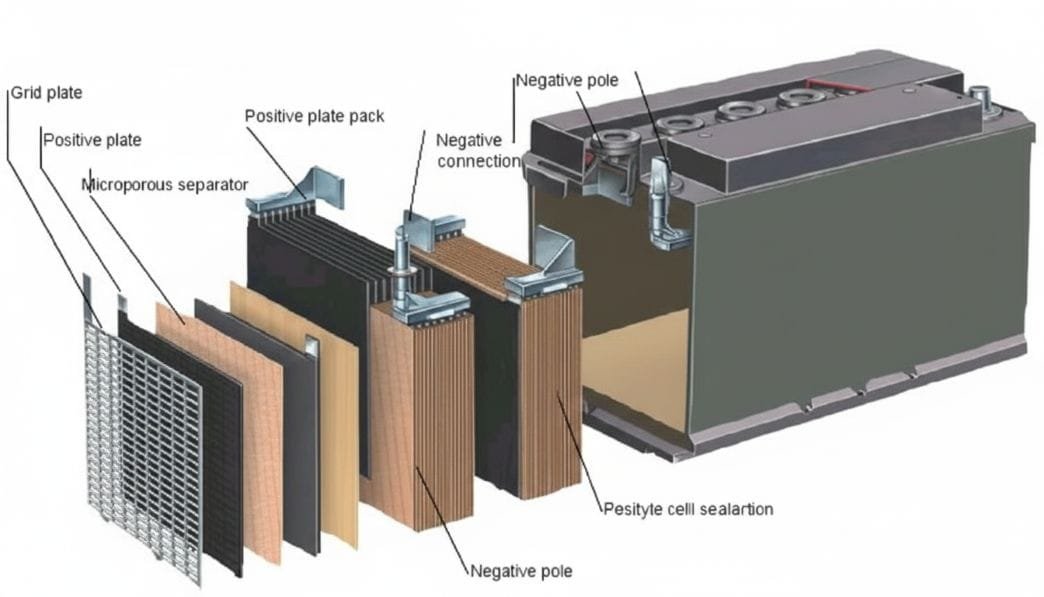
The main components of a lead-acid cell are as follows:
Explain the construction of lead acid battery:
The construction of a lead acid battery includes a hard rubber container, positive and negative plates, separators, sulfuric acid electrolyte, vent plugs, and sealing arrangements that work together to store and supply electrical energy efficiently.
(i) Container
(ii) Electrodes (plates)
(iii) Separator
(iv) Sealing compound
(v) Vent plug
(vi) Cell cover
(vii) Electrolyte
(viii) Active Material
(i) Container
It is made of hard rubber, glass, or celluloid. Acid has no effect on it. Separate compartments are provided in it to hold the positive and negative plates of each cell. Due to chemical action, liquid collects at the bottom of the container, for which a mud chamber is provided at the lower side of the container.
(ii) Electrode
Two metallic rods are required to pass an electric current through the electrolyte, which are called electrodes. These are of two types:
Anode: The metallic rod/plate through which the electric current exits the electrolyte is called the anode. It is connected to the positive (+) terminal of the battery.
Cathode: The metallic rod/plate through which the electric current enters the electrolyte is called the cathode. It is connected to the negative (-) terminal of the battery.
These are the plates of the cell, which are positive and negative.
Positive Plates
These are of the following two types:
(a) Plante Plates
(a) Planté plates are manufactured by repeatedly charging and discharging them. Initially, they are made from pure lead, which is converted into lead peroxide after charging.
(b) Faure Plates
(b) Faure plates are made from a rectangular grid of lead into which the active material, i.e., lead peroxide paste, is filled.
Negative Plates
These are made of rectangular grids, and their active material consists of spongy lead (Pb) in the form of paste.
(iii) Separator
These are thin plates made of porous wood or rubber. They are used to prevent short-circuiting between the positive and negative plates.
(iv) Sealing Compound
It is used to make the joints of the cell cover acid-tight. It is made of a bituminous compound.
(v) Vent Plug
A threaded, perforated cap made of hard PVC (polyvinyl chloride) or rubber is fitted in the cell cover, which is called the vent plug.
(vi) Cell Cover
The cell cover is made of hard rubber so that the electrolyte does not leak out.
(vii) Electrolyte
An electrolyte is a solution whose composition changes when an electric current is passed through it. It is usually an acidic and inorganic solution.
Electrolytes are usually simple inorganic compounds that, when dissolved in water, ionize and become conductors of electricity; that is, when dissolved in water, an electric current flows through them. Examples include vegetable oils, alcohols, spirits, distilled water, and alkalis.
In a lead-acid cell, the electrolyte is prepared by mixing pure water with concentrated H₂SO₄ (sulfuric acid). Through this electrolyte, current flows in the cell.
(viii) Active Material – The material in a cell which takes active participation in a chemical reaction (absorption or evolution of electrical energy) during charging or discharging is called the active material of the cell. The active elements of the lead acid are
1. Lead peroxide (PbO2) – It forms the positive active material. The PbO2 are dark chocolate broom in colour.
2. Sponge lead – Its form the negative active material. It is grey in colour.
3. Dilute Sulfuric Acid (H2SO4) – It is used as an electrolyte. It contains 31% of sulfuric acid. The lead peroxide and sponge lead, which form the negative and positive active materials have the little mechanical strength and therefore can be used alone.
working principle of lead acid battery
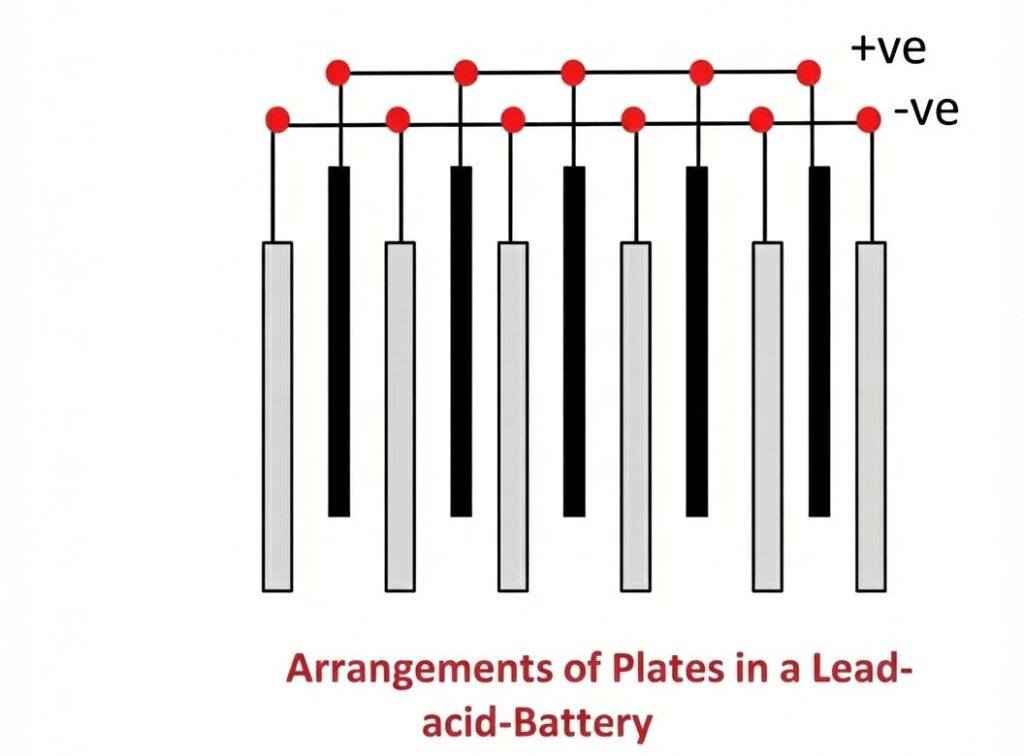
This system consists of two sets of plates: positive and negative. The number of positive plates is one less than the number of negative plates. The total number of plates is typically 11, 13, 17, 23, 25, etc. The number of negative plates is kept one greater so that each positive plate can function on both sides. Both types of plates are made of lead grids, and a paste of red lead (Pb₃O₄) is applied to them.
In the cell, dilute sulfuric acid (H₂SO₄) is used as the electrolyte. The container has rests at the bottom to support the plates, and separators are used to prevent them from short-circuiting. Each cell must have a vent plug to allow the gases produced during the chemical reactions to escape. The connecting terminals of both plate groups are brought out, and the container is sealed from the top. Initially, both electrodes of a lead-acid cell consist of lead sulfate (PbSO₄), but when the cell is charged through chemical reactions, the lead sulfate electrodes are converted into spongy lead (Pb) (negative plate) and lead peroxide (PbO₂) (positive plate). Simultaneously, the electrolyte solution becomes more concentrated, turning into sulfuric acid (H₂SO₄).
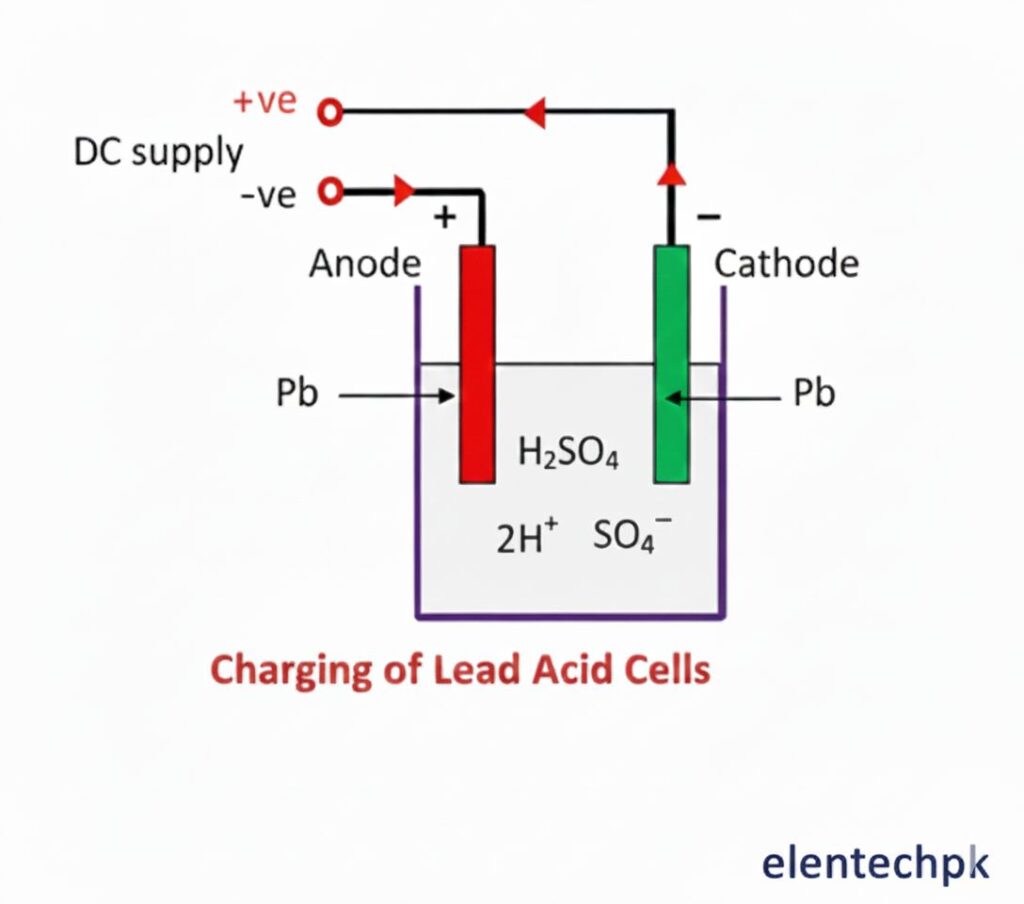
The working principle of lead acid battery is based on reversible chemical reactions. During discharging, the working principle of lead acid battery converts chemical energy into electrical energy through reactions between the plates and electrolyte. During charging, the working principle of lead acid battery is reversed, restoring the battery to its charged state.
Chemical Reactions off Lead-Acid Batteries
The chemical reactions in a lead-acid cell take place in the following stages:
(i) Chemical Action During Forming:
This process begins as soon as dilute sulfuric acid is filled into the cell. This is usually done by the battery vendor.
Pb3O4 + 2H2SO4 → PbO2 + 2PbSO4 + 2H2O
(ii) Chemical Action During Recharging
10-12 hours after filling the cell with dilute sulfuric acid, it is connected to a DC source so that electrical energy can be stored in the form of chemical reactions. For this purpose, the positive terminal of the cell is connected to the positive terminal of the source and the negative terminal to the negative terminal of the source. The following chemical reactions take place in the cell:
H2O → 2H+ + O2-
(a) At the anode: PbSO4 + 2H2O + SO42 – PbO2 + 2H2SO4
(b) At the cathode: PbSO4 + 2H+ → Pb + H2SO4
As a result of the charging process, the positive plates of the cell become lead peroxide (PbO2) and the negative plates become spongy lead (Pb).
(iii)Chemical Action During Discharging
When the charged cell is connected to a load, the discharging process begins.
H2O → 2H+ + O2-
(a) At the anode:
PbO2 + 2H+ + H2SO4 – PbSO4 + 2H2O
(b) At the cathode:
Pb + O²⁻ + H₂SO₄ → PbSO₄ + H₂O
As a result of the discharging process, both types of plates in the cell become lead sulfate (PbSO₄). Due to the formation of water in the chemical reaction, the acid becomes diluted, i.e., the specific gravity of the acid decreases.
(iv) )Chemical Action During Recharging:
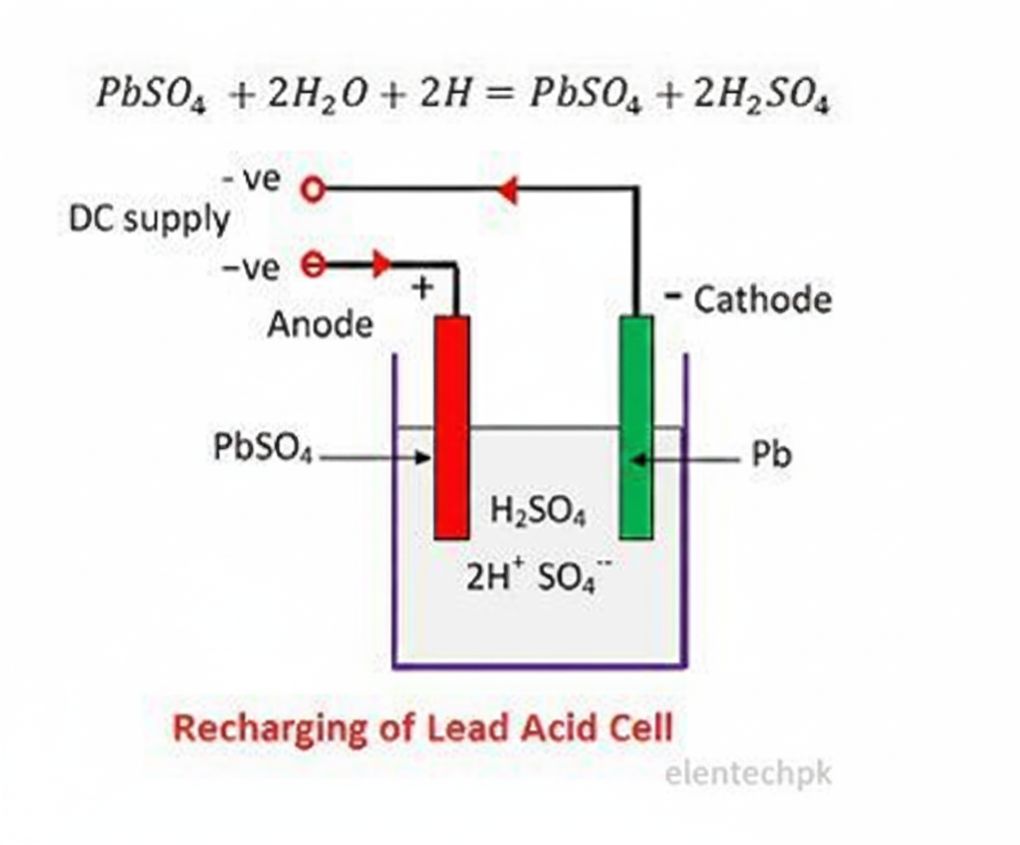
After the cell is discharged, it is recharged by connecting it to a DC source. This process is similar to the charging process and involves the same chemical reactions as those that occur during charging. In this process,
Due to the formation of sulfuric acid (H₂SO₄), the specific gravity of the electrolyte increases.
Different Types of Lead-Acid Cells
The different types of lead-acid cells are as follows:
(a) Lead-calcium cell: These cells are more resistant to corrosion, overcharging, and self-discharge, resulting in a longer lifespan. A larger electrolyte area is maintained above the plates of this cell. These cells require less maintenance.
(b) Lead-antimony cell: The main advantage of the enhanced lead-acid cell manufactured using antimony is the improvement in the mechanical strength of the electrodes. These cells have a longer service life than calcium cells. These cells are easy to charge when fully discharged.
(c) Valve-regulated lead-acid cells: These cells are also called sealed lead-acid cells. These cells are designed to reduce electrolyte loss due to defects such as evaporation and gassing.
Advantages off Lead-Acid Batteries
(i) It provides high current and low internal impedance.
(ii) The efficiency of this cell is higher compared to other cells.
(iii) It is available in large sizes and with high efficiency in the market.
Disadvantages off Lead-Acid Batteries
(i) This cell cannot be stored in a discharged state.
(ii) It has a negative impact on the environment.
Defects off Lead-Acid Batteries
The following four types of defects are found in lead-acid cells:
(i) Sedimentation: The plates of a lead-acid cell are not made of solid metal but of a paste of red lead (PbO). Therefore, during charging and discharging processes, some of the paste flakes off. In addition, due to the electrolysis of water, impurities from the water accumulate at the bottom of the cell. When a large amount of impurities accumulates at the bottom, there is a possibility of the plates short-circuiting; this defect is called sedimentation.
Prevention: To remedy this defect, add only distilled water to the cell whenever necessary.
(ii) Corrosion: Due to atmospheric moisture and acid spillage, a white-blue layer of copper and lead oxides forms on the cell connectors, which prevents a complete connection between the cell connectors and the conducting wire; this defect is called corrosion.
Prevention: To remedy this defect, the cell connectors should be cleaned periodically with a cloth soaked in hot water. In addition, applying a thin layer of grease to the connectors is also beneficial.
(iii) Buckling: When a lead-acid cell is charged or discharged at a high current rate, its plates may warp and short-circuit; this defect is called buckling.
Prevention: Lead-acid cells should not be charged at a current rate higher than 6 amperes and discharged at a current rate higher than 25 amperes. In this way, the buckling defect does not occur in the cell.
(iv) Sulphation: If a lead-acid cell is not used for more than a week, the lead sulfate on the plates hardens, and recharging the cell becomes difficult; this defect is called sulphation.
Prevention: Lead-acid cells should be charged and discharged at least once a week. If this defect becomes permanent in a cell for any reason, an attempt should be made to rectify it by charging it at a low current rate (1 ampere) for a long time (trickle charging).
Other Specifications: In a fully charged state, the electromotive force of a lead-acid cell is 2.2 volts per cell. The cell’s current-providing capacity depends on the size and number of its plates. Its internal resistance is low (up to 2 ohms).
Applications:
Lead-acid cells are used as batteries in motor vehicles, trains, etc., as a rechargeable DC power source capable of providing high current at a high rate.
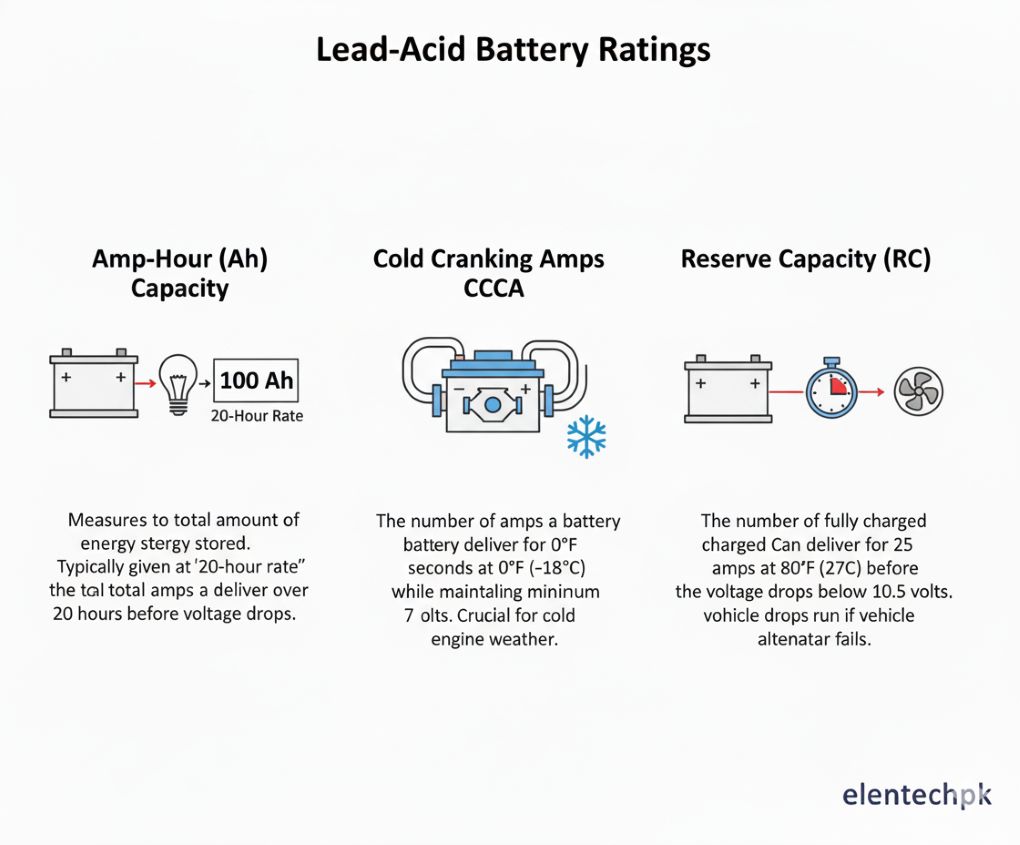
Lead-acid battery ratings.
All batteries are given a nominal (ampere-hour) capacity rating based on discharge at a specific time rate, temperature, and end voltage condition. For example, a particular battery might have an 8-hour rating of 100 Ah, discharged to 1.75 V per cell at a temperature of 77°F (24°C).
The ampere-hour capacity of a battery depends on the amount of active material in the plates that is accessible to the electrolyte, the concentration of sulfuric acid in the electrolyte, the rate of discharge, and the acceptable safe limit of discharge. To produce one ampere-hour of electricity on discharge, a certain amount of spongy lead (negative active material) and a certain amount of lead peroxide (positive active material) must react with a certain amount of sulfuric acid from the electrolyte.
Therefore, the acceptable rating depends on the construction of the plates and the number of plates connected in parallel on each side of the battery.
charges and discharges process off Lead-Acid Batteries
In a fully charged battery all the active material of the positive plates is lead peroxide, and that of the negative plates is pure sponge lead. In a fully charged battery all the acid is in the electrolyte, and the specific gravity is at its maximum value. The active material of both the positive and the negative plates is porous, so that it has absorption qualities simi lar to those of a sponge, and the pores are therefore filled with some of the battery solution.
As the battery discharges, the acid, which is in the pores of the plates, separates from the electrolyte, forming a chemical combination with the active material, changing it to lead sulfate.
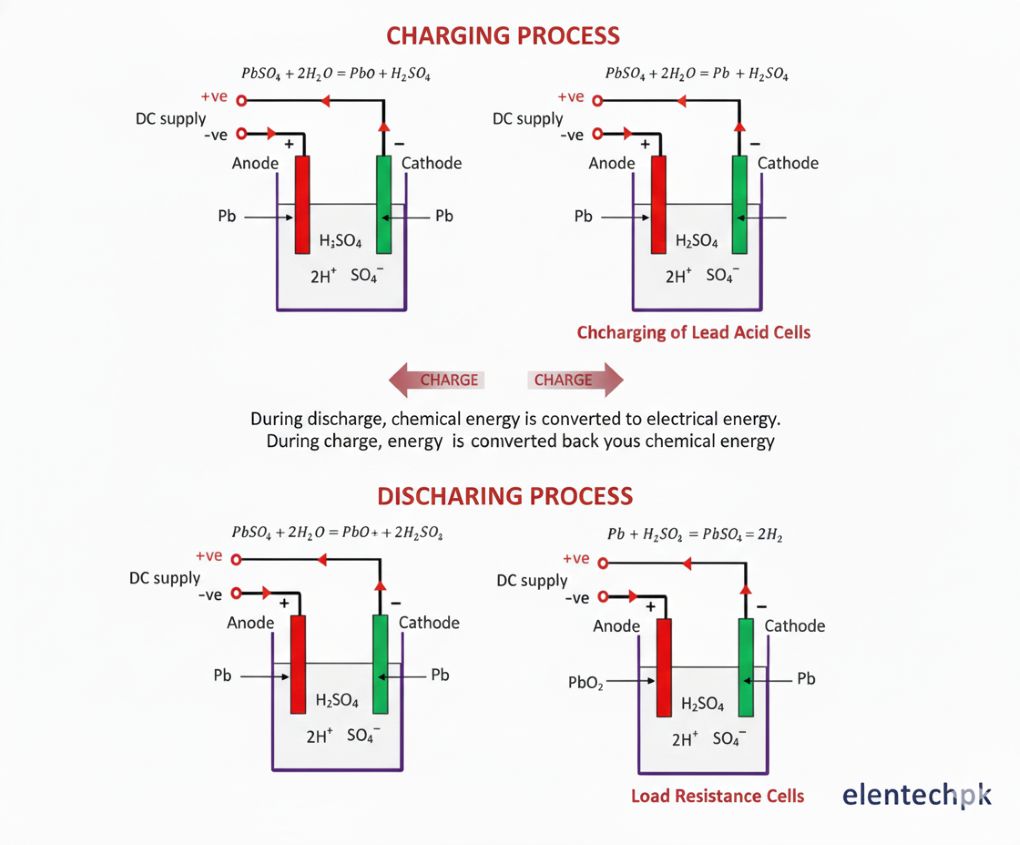
As the discharge continues, additional acid is drawn or diffused from the electrolyte into the pores of the plates and further sulfate is formed. It can be readily understood that as this process continues, the specific gravity of the electrolyte will gradually decrease, because the proportion of acid is decreasing.
On charge the reverse action takes place: the acid in the sulfated active material is driven out and back into the electrolyte. This return of the acid to the electrolyte increases the specific gravity, so that it will continue to rise until all the acid is driven out of the plates and back into the electrolyte.
After all the acid has been driven back into the electrolyte, further charging will not raise the specific grav ity any higher, as all the acid in the cells is in the electrolyte, and the battery is said to be fully charged. The material of the positives is again lead peroxide, and that of the negatives is spongy lead; the specific gravity is maximum.
The Effect of Temperature on Lead-Acid Batteries
The cell temperature should not exceed 110°F (43°C). The main effect of high temperature is a reduction in the life of the wood separators used between the positive and negative plates in some types of cells.
Wood typically has a tendency to carbonize when exposed to sulfuric acid. This tendency is greatly increased at temperatures above 110°F (43°C). If the battery is regularly operated under such conditions, it may be necessary to replace the wood separators before the battery is otherwise completely worn out.
Any commercially manufactured storage battery contains some impurities in the materials used, which can cause a very slight action within the cell, even when the battery is not actively discharging. These internal losses are increased at higher temperatures. Evidence of this is that a battery stored in a cool place will not lose its charge significantly over a period of about six months. However, if it is stored at a temperature of approximately 100°F (38°C), it will lose a considerable amount of charge in about three months.
Charging methods for lead-acid batteries.
In practice, charging methods vary with the type of service. For example, in electric vehicles, the battery is discharged over time and then recharged. The rate in amperes to use for recharge depends upon the time available and the type of cell. The lower the rate of charge the longer the time required.
The shorter the time available, the higher the rate must be to recharge, provided the rate is not higher than recommended for the type of cell. In any event, the rate must always be low at the end of charge when gassing begins. This is known as the finish charge rate.
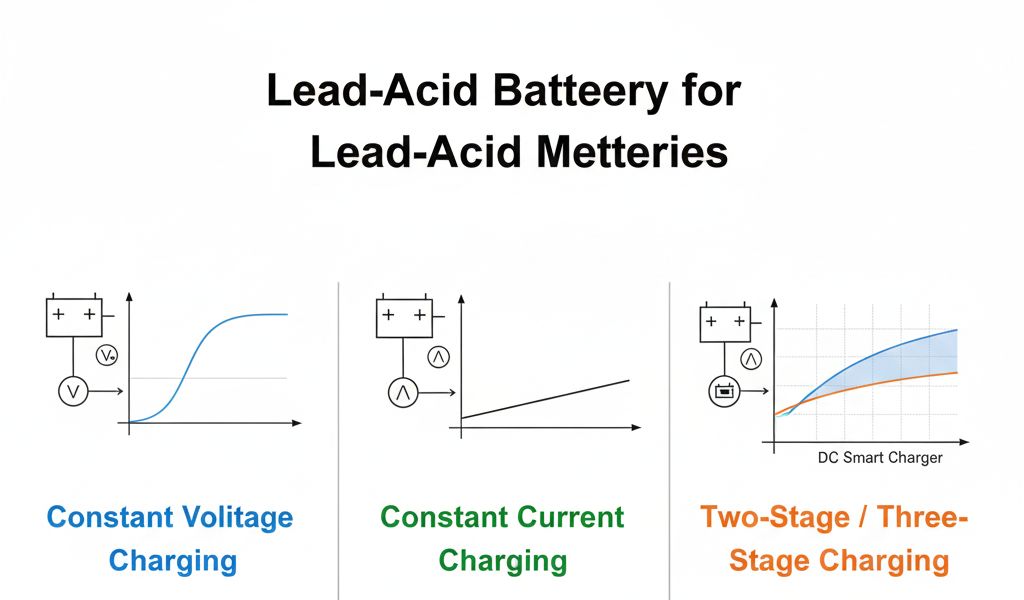
Batteries charged by this cycle method of discharge and charge can have their charging equipment arranged and designed to provide a taper charge rate automatically and inher ently, i.e., high at the start of charge, when a high rate can be utilized, and low at the end of charge, when gassing begins. In addition, the equipment can be arranged to stop the charge at the proper time, and all without any manual attention whatever.
Batteries used for reserve emergency, standby, or voltage regulation are kept fully charged by a trickle current or floating charge. A constant voltage of appropriate value impressed across the battery terminals is sufficient for proper charging. Regardless of the charging method, the rate in amperes must not cause excessive gassing; neither should the cell temperature rise above 110F (43C).
Voltage characteristics off Lead-Acid Batteries
The voltage of each cell is approximately 2 V on an open circuit but is higher than this when the battery is being charged and lower when being dis charged. The nominal voltage of a battery is, therefore, the number of cells multiplied by 2.
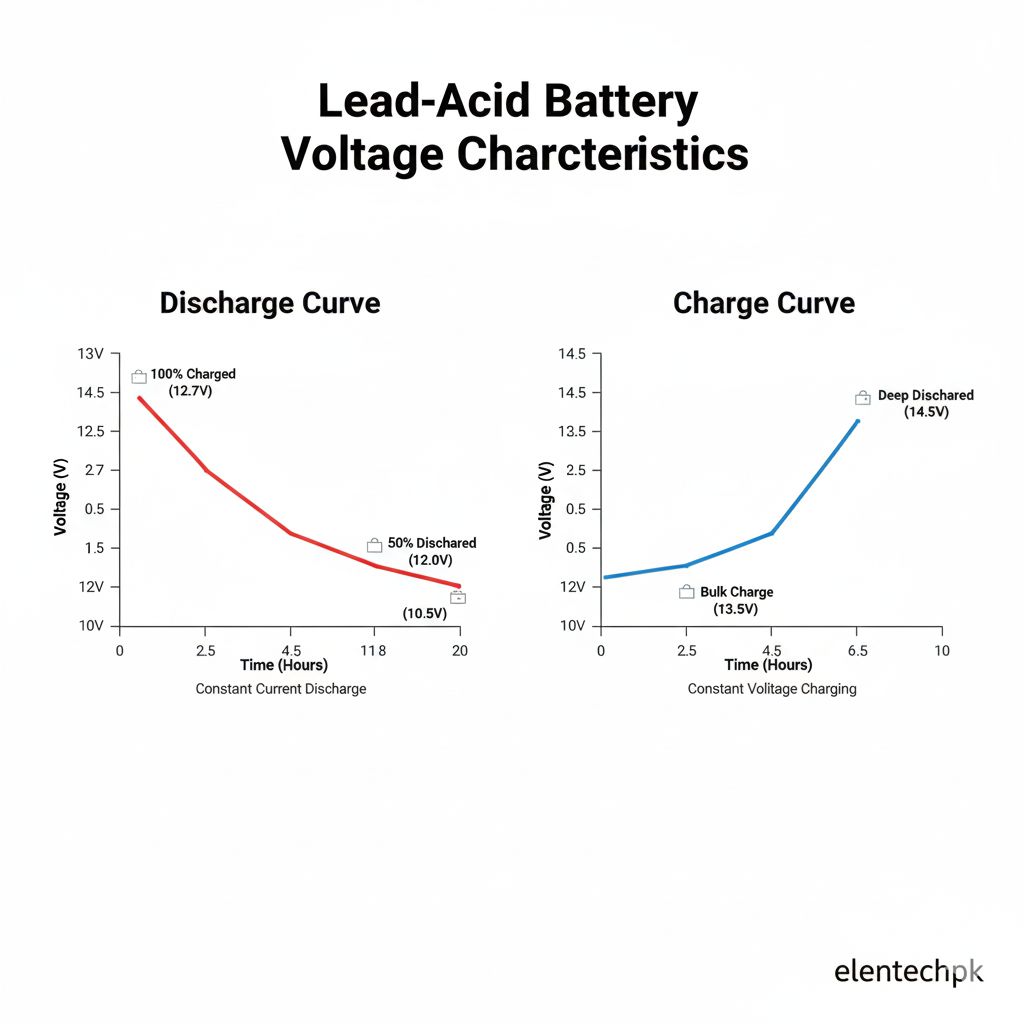
The voltage at any time on discharge or charge depends upon several factors, such as the current rate, the state of charge or discharge, and the temperature. No general averages to cover all conditions can therefore be given. In usual 6- to 8-h discharge service, the average cell voltage during discharge is roughly 1.95 V with a final voltage of about 1.75 V.
As soon as the cell is put on charge, its voltage rises to about 2.15 V and then increases during charge until at the end it is between 2.4 and 2.7, depending upon local conditions. The average voltage during the entire charge is usually considered to be 2.33 V’
FAQ
Explain the construction and working principle of Lead acid battery / secondary battery
Select 48 more words to run Humanizer.