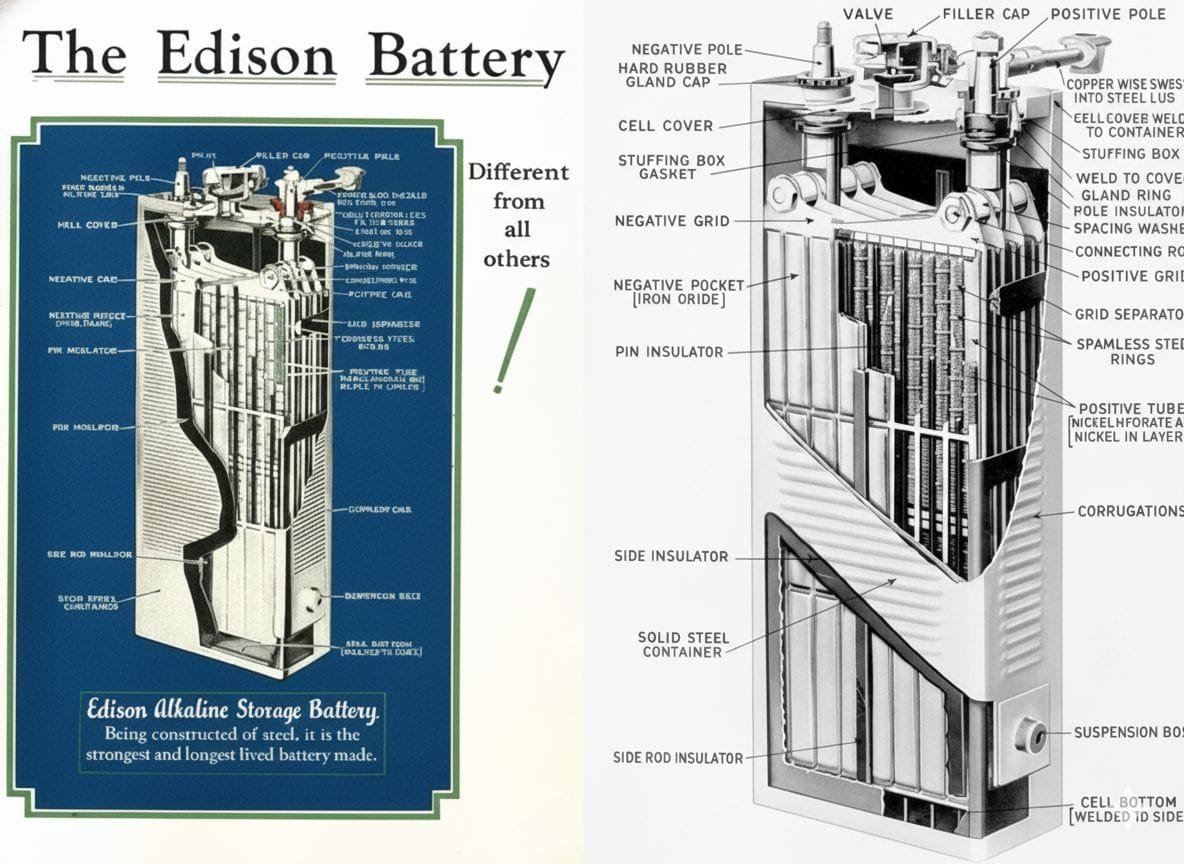
Introduction of the Edison Storage Battery.
The Nickel–Iron–Alkaline battery is the result of an effort to avoid many of the disadvantages of the lead-sulfuric acid combination and is a radical departure from it in every detail of construction. The positive plate consists of hollow, perforated, sheet-steel tubes filled with alternate layers of nickel hydrate and metallic nickel. The hydrate is the active material, and the metal, which is made in the form of microscopically thin flakes, is added to provide good conductivity between the walls of the tube and the remotest active material. The negative plate is made up of perforated, flat, sheet-steel boxes or pockets loaded with iron oxide and a small amount of mercury oxide, the latter also for the sake of conductivity.
Lead-acid cells are quite large and unsuitable for use in electronic and electrical devices where rechargeable batteries are required. Therefore, nickel-iron cells are used in such devices. They are smaller in size and are also known as Edison cells.
2. Construction of Edison Storage Battery
It consists of a steel container with nickel-plated cylindrical positive plates made of nickel-plated steel.
These plates are made of nickel-plated steel. A paste of nickel hydroxide [Ni(OH)2] is filled into these plates. Some pockets are made in these plates, and they are filled with iron hydroxide [Fe(OH)3] powder, which acts as the negative plates. A mixture of potassium hydroxide (KOH) and lithium hydroxide (LiOH) is used as the electrolyte.
The grids that support these tubes and pockets are punched from sheet steel. The cell terminals and container are likewise of steel, and all metallic parts are heavily nickel-plated. The electrolyte is a 21 percent solution of caustic potash containing a small amount of lithium hydrate. All separators and insulating parts are made of rubber. The details of the construction of the Edison storage battery are shown in Fig.
3. Working Principle of Edison Storage Battery
The current used in charging causes an oxidation of the positive plate and a reduction of the negative, and these operations on discharge are reversed. The electrolyte acts merely as a medium and does not enter into combination with any of the active material as it does in the acid battery. Its specific gravity remains practically constant throughout the complete cycle of charge and discharge. The charge and discharge curves are shown in Fig.
Chemical Reactions of Edison Storage Battery
Chemical Reactions: The chemical reactions in these cells take place in the following steps:
- Charging: After the cell is prepared, it is connected to a DC power source and charged. The following reactions occur in the cell during charging:
KOH – K++ OH
(i) At the anode:
Ni(OH)2 + 20H– Ni(OH)4
(ii)At the cathode:
Fe(OH)2 + 2K+ – Fe+2KOH
Thus, after the charging process, the positive plates become nickel hydroxide [Ni(OH)4] and the negative plates become iron (Fe).
- Discharging:
KOH → K+ + OH–
(i) At the anode: Ni(OH)4 + 2K+ → Ni(OH)2 + 2KOH
(ii) At the cathode: Fe+ + 20H– → Fe(OH)2
Thus, after the discharging process, the positive plates again become nickel hydroxide [Ni(OH)2] and the negative plates become iron hydroxide [Fe(OH)2].
3. Recharging: After the cell is discharged, it is connected to a DC source and recharged. This process is similar to the charging process, and the same chemical reactions occur as during the charging process.
4. Characteristics, Advantages, and Limitations of Edison Storage Battery
The chief characteristics of the battery are ruggedness, due to its solid, steel construction; low weight, due to its stronger and lighter supporting metal; long life, due to the complete reversibility of the chemical reactions and the absence of shedding active material; and low cost of maintenance, due to freedom from the diseases, such as sulfation, so commonly met with in storage-battery practice and from the necessity of internal cleaning and plate renewals.
The arguments against it are high first cost and high internal resistance. The importance of these must, of course, be weighed with the advantages and the resultant considered in each proposed installation. The battery has attained its chief prominence in vehicle propulsion, but its characteristics also recommend it for many other purposes.
5. Voltage Characteristics of Edison Storage Battery
Voltage characteristics. The voltage of each cell is approximately 1.5 V on open circuit, but it is higher than this when the battery is being charged and lower when being discharged. The voltage at any time depends upon the state of charge or discharge, the temperature, and the density of the electrolyte. The average discharge voltage is approximately 1.2 V per cell.
Typical voltage charge and discharge curves are shown in Fig. Cells are generally discharged until the voltage drops from 1.0 to 0.9 V per cell. Further discharge is generally not satisfactory, since the voltage drops very rapidly if the discharge is continued past this point. The maximum voltage during charge will be between 1.80 and 1.90 V per cell. The voltage for any degree of discharge is affected slightly by the rate of discharge, as shown in Fig.
6. Rating of Nickel–Iron–Alkaline Battery
Rating of nickel-iron-alkaline batteries. All batteries are given a normal ampere-hour capacity rating based on a certain rate of discharge to a final voltage of 1.0 V per cell. Some current ratings are based on a 5-h continuous discharge rate, and others on a 3⅓-h continuous rate. The ampere-hour capacity for discharging continuously at a constant rate to a final voltage of 1.0 V per cell will be affected by the rate of discharge (Fig.).
The higher the rate of discharge, the lower the capacity of the battery. The effect upon the capacity will not be so great, however, as it is for lead-acid batteries. After a high rate of discharge, the balance of the normal capacity of the battery can be obtained by continuing the discharge at a lower rate.
If the battery is discharged intermittently, the normal capacity can be obtained unless the total elapsed time of discharge is excessively short. These batteries are very rugged and withstand very severe service. They are not harmed by occasional short-circuit discharges.
7. Charging of Edison Storage Battery
7.1 Normal Charging
Charging. The best method of charging Edison batteries is by the average constant-current method. The battery is connected in series with an adjustable resistance to a constant-potential DC supply, as shown in Fig. The positive terminal of the battery should be connected to the positive terminal of the supply.
The battery should be charged at its rated current until the ampere-hours of charge are 125 percent of the ampere-hours of discharge. The condition of charge cannot be judged by means of specific-gravity readings. Automatic equipment for the control of the current during charge is being used to a greater extent.
Before starting to charge, see that the solution is at the proper level. If the solution is low, bring it to the proper level by adding pure distilled water as instructed. If the battery is in a compartment, open the covers before starting a charge. If necessary, and if full capacity is not required, a battery can be taken off charge at any time and used.
The maximum voltage available at the batteries should be at least 1.85 times the number of cells in series. Throughout the charging period, the rheostat should be periodically adjusted so that the average current will be maintained at its normal rated value. The battery should be charged until a maximum voltage has been reached and maintained for 30 minutes.
7.2 Effect of Temperature
Effect of temperature. Do not charge in a hot place or allow the temperature of the solution to exceed 115°F (46°C) on charge. High temperatures during charge or discharge will shorten the life of any kind of battery. Better efficiency is obtained if cells are charged at a temperature of 80 to 90°F (27 to 32°C). If the temperature of the solution exceeds 115°F while charging, allow the cells to cool before continuing the charge.
7.3 Charging at High Rates
Charging at high rates. In an emergency, when time for a normal charge is not available, charging can be done at any higher rates than normal, provided there is no frothing, and the temperature does not rise above 115°F (46°C).
7.4 Charging at Low Rates
Charging at low rates. If the discharge requirements are such that a low constant rate is used or if there is an intermittent rate of such value that, for a given time period, a low average rate will be had, then a charge rate of less than normal can be used, provided that this charge rate is approximately 120 percent of the constant or average discharge rate. The term low discharge rate is to be construed to mean a constant or average rate of less than 80 percent of normal.
When charging at low rates, it must be thoroughly understood that the required ampere-hour input must be put in and that, therefore, the time periods of charge must be correspondingly increased over that necessary to charge a cell fully at a normal rate.
7.5 Boosting Charge
Boosting charge. An Edison battery can be boosted, i.e., given a supplementary charge, at high rates during brief periods of idleness, thereby materially adding to the available capacity. The principal limiting feature is that the temperature of the solution in the cells nearest the center or the warmest part of the battery does not exceed 115°F (46°C).
5 min at 5 times normal
15 min at 4 times normal
30 min at 3 times normal
60 min at 2 times normal
Frothing at the filler opening is an indication that the boosting has been carried too far, and the boosting should be discontinued at once.
8. Maintenance of Nickel–Iron–Alkaline Battery
8.1 General Maintenance
Maintenance of nickel-iron-alkaline batteries. The attention required by this battery is of the simplest character. It is chiefly important that the electrolyte be replenished from time to time with distilled water so that the plates will be entirely immersed and the outside of the cells be kept clean and dry, for if this is not done, leakage of current will occur with consequent corrosion of containers by electrolysis. Perhaps once or twice during the total useful life of the cell, the electrolyte may need renewal.
Cleaning
Cleaning. The cells, trays, and battery compartment must be kept dry, and care must be taken that dirt and other foreign substances do not collect at the bottom or between the cells. Dirt and dampness are likely to cause current leakage, which may result in serious injury to the cells.
If protection of cell tops from moisture is required, they should be given a light coat of rosin or liquid Esbaline, this material being applied to the cover of the cell and sparingly to the outside of the filling aperture, care being taken not to get any great quantity on the lid hinge. Esbaline can be applied best with a small paintbrush, care being taken not to get any on the inside of lugs or on cell poles.
Rosin Esbaline must be warmed to approximately 170 to 190°F (77 to 88 °C) and thinned to good paint consistency with benzine, etc.
A wet-steam jet or even an air blast will be found most satisfactory for cleaning, but must not be used on cells while they are in the compartments.
It has been found that a pressure of 70 lb with a 1-in rubber steam hose about 10 ft long, into which has been inserted a piece of iron pipe about 12 in long with an orifice 1/8-in. in diameter will give wet steam with a velocity to clean the battery satisfactorily. (This orifice can be made by plugging one end of an iron pipe and drilling out with a 1/8-in drill.)
When removing encrustations from the tops of cells, do not allow them to fall between or into the cells. Before reassembling, make sure that all poles, connectors, and jumper lugs are clean. Also, cells, trays, and compartments must be dry before the battery is replaced.
Water or Flushing of Nickel–Iron–Alkaline Battery
Water or flushing. Do not allow the level of the solution to drop below the tops of the plates. Never fill higher than the proper level. If filled too high, the solution will be forced out during charge.
For replenishing solution in Edison cells during operation, use only pure distilled water or water that has been tested and approved by the Electric Storage Battery Co. Although pure distilled water is generally recommended for use in storage batteries, there are certain areas in the United States where the local water supply is of such high purity that it can be used satisfactorily.
No water other than pure distilled water must be used unless it has received the approval of the Electric Storage Battery Co. after test at the factory’s laboratories. The use of impure water will result in a slow poisoning of the electrolyte by the accumulation of impurities, the effects of which may not appear within a few months but will become apparent over the course of several years.
When the solution has been spilled, use the standard refill solution, which has a specific gravity of approximately 1.215 at 60°F (15.5 °C).
Battery compartments and trays must be kept dry and clean at all times; so take care when filling cells not to spill water over and around the cells and not to exceed the specified height.
Test for height of the solution before placing the battery on charge. Do not test for solution height while the battery is charging; the gassing during charge creates a false level.
A reasonably heavy-walled glass tube about 8 in (203 mm) long and of not less than 3/16 in (4.8 mm) inside diameter with ends cut straight and fused enough to round the edges can be used as illustrated in Fig. to find the level of electrolyte above plate tops. A short length of tightly fitting rubber tube forced over one end and projecting about 1/8 in (3.2 mm) will prove a very good finger grip.
Insert the tube until the tops of the plates are touched; close the upper end with the finger and withdraw the tube. The height of the liquid in the tube should be as specified by the manufacturer.
Specific Gravity of Nickel–Iron–Alkaline Battery
Specific gravity of nickel-iron-alkaline batteries. The density, or specific gravity, reading of the electrolyte of an Edison cell has no value in determining the state of charge or discharge, as the specific gravity does not change during the charging or discharging of the cell to any marked extent. The small changes ordinarily observed are either due to large changes in temperature or loss of water from the electrolyte by evaporation or electrolysis in operating the cell.
Therefore, it is not necessary to take frequent readings to determine the specific gravity. The only time it is necessary to obtain a specific-gravity reading is to determine when a change of electrolyte would be advantageous. When making such readings, certain fundamental conditions must be observed. A suitable hydrometer must be obtained and used in accordance with the rules laid down in Section 172 on hydrometer readings. The glass container must be clean and must not contain acid or other impurities, as these tend to give lower readings than the true specific gravity.
Do not take a specific-gravity reading when the cell is charging, as the bubbles of gas contained in the electrolyte will cause a lower reading than the true one. Readings taken when the temperature of the electrolyte is either very high or very low will give results that will vary with the temperature. The specific gravities quoted in this section are for 60°F (15.5 °C). Temperatures very much higher than this will give lower gravity readings, while temperatures very much lower than this will give higher readings.
Specific-gravity readings taken immediately after watering the cell are of no value, as the water has had no chance to be thoroughly mixed with the electrolyte, and the resulting readings will be low. The specific gravity should be taken when the electrolyte is at the proper height after a complete charge. It is best to allow the cells to stand for a short period after the completion of the charge to permit free bubbles of gas to dissipate before taking readings. Corrections for temperature should be made by adding 0.0025 for each 10 °F above 60°F (each 5.5 °C above 15.5 °C) to the observed reading or subtracting 0.0025 for every 10 °F below 60°F.
Solution Renewal of Nickel–Iron–Alkaline Battery
Solution renewal. Throughout the total useful life of the cell, the electrolyte gradually weakens and may need renewal once or twice, depending on the severity of service, and in some cases, when maintenance and operation have been poor or when contamination has been allowed by the use of impure water, etc., a third time might be necessary.
The low-limit specific gravity beyond which it is inadvisable to run an electrolyte is 1.160. Operation at a lower specific gravity than 1.160 should not be allowed, since such operation will produce sluggishness, loss of capacity, and rapid breakdown in severe service.
Should the specific gravity be above 1.160 and, at the same time, sluggishness and loss of capacity be evident, do not immediately renew the electrolyte until it is found that an electrolyte sample sent to the factory shows a prohibitive accumulation of impurities and until the following treatment fails to produce marked improvement:
- Discharge at normal rate to zero voltage. (When the current can no longer be kept up, either reverse the battery on the line with sufficient resistance in series or connect in series with another more nearly charged battery; then continue the discharge.) It is of prime importance that the rate be kept at normal throughout.
- Short-circuit the battery in groups of not more than about five cells each for at least 2 h.
- Charge at normal rate for 15 h for A, B, C, and N types and 10 h for G and L types.
- Discharge at a normal rate to approximately 1.0 to 0.9 V per cell.
- Charge at normal rate for 7 h for A, B, C, and N types and 4¾ h for G and L types.
- Discharge at a normal rate to approximately 1.0 to 0.9 V per cell.
If the cells do not respond noticeably to this treatment, there is probably very marked contamination of the electrolyte, and the result of the analysis of a representative sample sent to the manufacturer’s factory in accordance with instructions will show this.
Therefore, regardless of the specific gravity, the electrolyte should be replaced as follows:
- When the previous electrolyte has reached approximately the low limit of 1.160, the new solution should be a standard renewal.
- When the previous electrolyte is 1.190 or above, the new solution should be a standard refill.
It is always advisable, in case the battery exhibits trouble of any sort, to communicate all details to the manufacturer or their representative, so that immediate advice may be obtained.
Do not use any other solution than Edison electrolyte. Do not pour out old solution until you have received the new solution and are ready to use it. Never allow cells to stand empty. State type and number of cells when ordering Edison electrolyte for renewal.
When ready to renew the solution, first completely discharge the battery at a normal rate to zero and short-circuit for 2 h or more. This is done to protect the elements. Then empty cells completely. It is not necessary to shake or rinse cells, and under no circumstances should cells be filled with water.
Immediately after emptying each cell, pour in the new solution. Do not allow it to stand empty. Fill to exactly the proper height. For this purpose, use a clean glass or enamelware funnel. A plain iron funnel can be used if it has no soldered seams, but do not by any means use one of tinned or galvanized iron. A clean rubber tube can be used to siphon the solution directly from the container to the cell. If the tube is new, it should be thoroughly soaked in electrolyte for a couple of hours in such a position as to retain the solution. This is to thoroughly remove any impurities from the rubber.
Fill to exactly the proper height, for if cells are filled too full when renewing the solution and allowed to remain that way, the specific gravity of the electrolyte will be too high when the solution level returns to its proper height. This condition may lead to serious consequences and can be easily avoided with reasonable care.
Do not attempt to put in all solutions received, as an excess is allowed to make up for any loss due to spilling. It may be necessary to add some more electrolyte after the cells have stood for a little time, as some electrolyte may be absorbed by the plates.
The specific gravity of the Edison electrolyte for renewal, as shipped, is about 1.250, but this will quickly fall to normal when put into a battery, owing to mixture with the old, weak solution remaining in the plates.
Do not attempt to use the electric filler for refilling cells. It was not designed for this purpose and will not work.
When the new electrolyte is in, and the battery is again connected for service, give it an overcharge at the normal rate as outlined under Sec. 188, “Overcharging.”
Cautions in Operation of Nickel–Iron–Alkaline Battery
Cautions in the operation of nickel iron alkaline Battery
- Never put lead battery acid into an Edison battery or use utensils that have been used with acid; you may ruin the battery.
- Never bring a lighted match or other open flame near a battery.
- Never lay a tool or any piece of metal on a battery.
- Always keep the filter caps closed except when necessary to have them open for filling.
- Keep batteries clean and dry externally.
- Edison electrolyte is injurious to the skin or clothing and must be handled carefully. The solution spilled on the person should be immediately washed away with plenty of water.
Laying Up of Nickel–Iron–Alkaline Battery
Laying up nickel-iron-alkaline batteries. If the battery is to be laid up for any length of time, be sure that the plates are covered to the proper height by solution or electrolyte. The battery should be stored in a dry place. Do not leave it in a damp place, as damage to the containers may result from electrolysis. Never let the battery stand unfilled. Edison batteries are easy to lay up. Merely discharge to zero voltage and short-circuit. They can be left standing idle indefinitely in this condition without injury.
New Edison cells have received sufficient cycles of charge and discharge before shipment to give considerable capacity above that rated. However, Edison cells will increase still further in capacity if thoroughly worked in. Therefore, it is best if new cells are to stand for some time before being put into commission, to discharge them to zero at a normal rate and short-circuit for at least 6 h.
When putting the battery back into commission, go over each cell and see that all poles and connections are in good condition, as for a new cell. See that the plates are properly covered with electrolyte and then charged as here instructed. First, if not already discharged, discharge cells to zero at the normal rate and short-circuit. Follow this by an overcharge at the normal rate, and then discharge at the normal rate. Then charge at the normal rate for normal hours of charge. If the battery shows signs of sluggishness, repeat the overcharge and carry the discharge down to zero until cells are fully active; then give a regular charge.
FAQ
What are nickel-iron batteries used for?
“The battery has attained its chief prominence in vehicle propulsion, but its characteristics also recommend it for many other purposes.”
What are the disadvantages of nickel-iron batteries?
“The arguments against it are high first cost and high internal resistance.”
What are nickel-iron batteries used for?
“The Edison storage battery is the result of an effort to avoid many of the disadvantages of the lead-sulfuric acid combination and is a radical departure from it in every detail of construction. The positive plate consists of hollow, perforated, sheet-steel tubes filled with alternate layers of nickel hydrate and metallic nickel… The negative plate is made up of perforated, flat, sheet-steel boxes or pockets loaded with iron oxide and a small amount of mercury oxide.”
Are nickel-iron batteries any good?
“The chief characteristics of the battery are ruggedness, due to its solid, steel construction; low weight, due to its stronger and lighter supporting metal; long life, due to the complete reversibility of the chemical reactions and the absence of shedding active material; and low cost of maintenance.”

Hi, I’m Pranjul — the person behind this website.
I hold a Diploma and B.Tech in Electrical Engineering, along with hands-on training through ITI. For over 3 years, I worked as an ITI College Instructor, teaching electrical fundamentals and practical skills to hundreds of students.
Through that experience, I noticed something: most electrical troubleshooting information online is either too technical for everyday homeowners, or too vague to actually solve real problems. That’s the gap this website aims to fill.