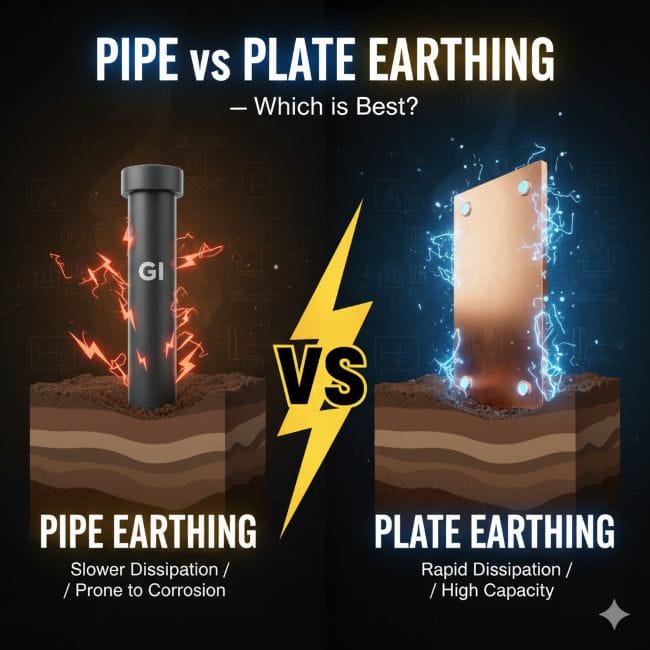
Pipe Earthing vs Plate Earthing:
The main difference is that Pipe Earthing uses a vertical G.I. pipe and is low-cost, suitable for homes and small loads, while Plate Earthing uses a Copper or G.I. plate at a deeper depth, offering very low resistance and long life for heavy loads. Pipe earthing is ideal for domestic use up to 10 kW, whereas Plate earthing is preferred for industries, transformers, hospitals, and high-load systems due to its superior conductivity and stability.
Table of Contents
Pipe Earthing vs Plate Earthing — Deep Practical Comparison
Are you wondering whether Pipe Earthing is better or Plate Earthing?
For homes, offices, factories, or transformers — choosing the right earthing determines your safety and the life of the entire system.
Choosing the wrong method can lead to:
➤ Electric shocks
➤ System failure
➤ Machinery damage
➤ Increased earthing resistance
That’s why today we give you the clearest, most practical, expert-level comparison of both earthing systems — to help you make the right choice 100%.
🟩 What is Pipe Earthing? (Simple + Practical Explanation)
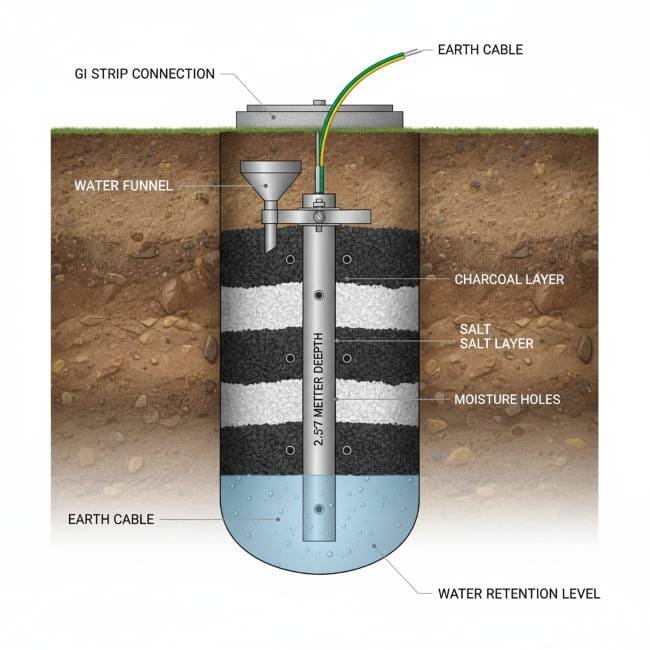
Pipe Earthing involves vertically installing a G.I. Pipe (2.75 m) in the ground.
Charcoal + salt layers are placed around it to keep the soil conductive.
✔ Holes in the pipe
Allow moisture to spread and fault current to discharge easily into the ground.
✔ Typical use
- Homes
- Small offices
- Small industries
- Street lights
- UPS / DG Set (low load)
✔ Practical Load Capacity
- Most suitable for loads up to 10 kW
🟥 What is Plate Earthing? (Deep Practical Engineering View)
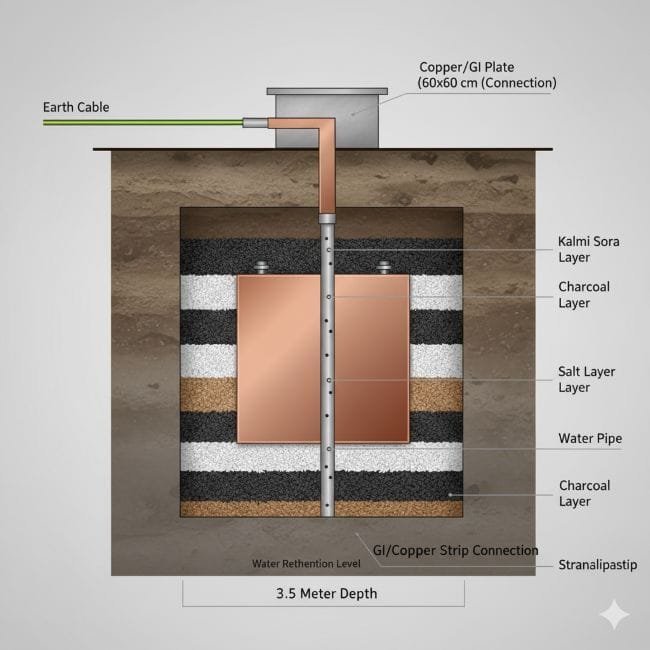
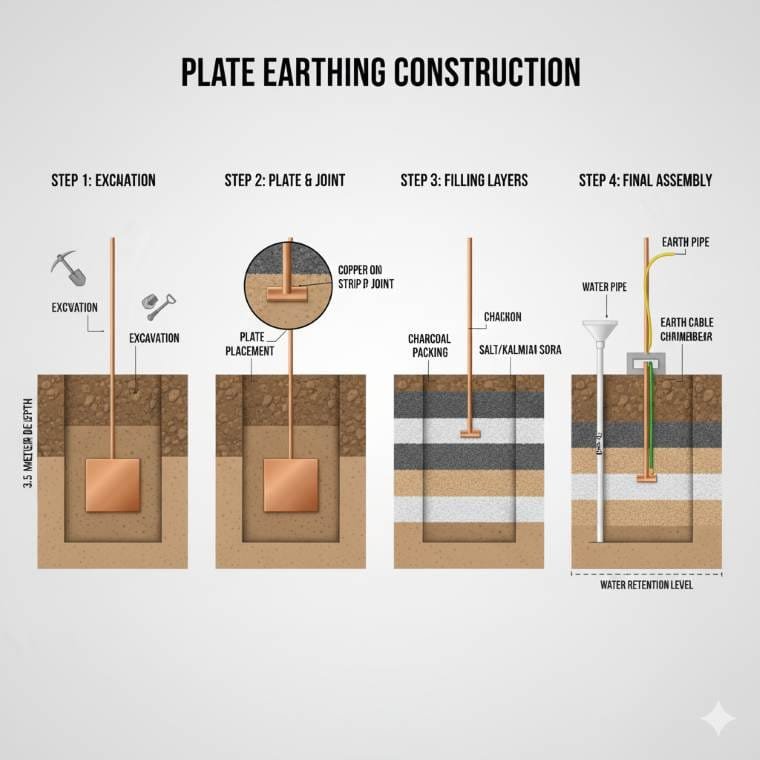
Plate Earthing involves installing a Copper or G.I. Plate (60×60 cm or 90×90 cm) at 3 meters or more depth.
Charcoal + Salt + Kalmi Sora layers are used to reduce soil resistivity.
✔ Strongest point of Plate Earthing
- Rapidly grounds fault current
- Resistance is lower than Pipe Earthing
✔ Typical use
- Transformers
- Hospitals
- Commercial buildings
- High-rise buildings
- Industries
- Large motors
- Loads 50 kW–100 kW+
🟦 Materials Used (Pipe + Plate Earthing)
Pipe Earthing Material
- G.I. Pipe (65 mm × 2.75 m)
- Charcoal (20 kg)
- Salt (20 kg)
- G.I. Strip (25×3 mm)
- Water funnel
- Moist soil
Plate Earthing Material
- Copper Plate: 600×600×3.15 mm
- G.I. Plate: 600×600×6.3 mm
- Charcoal (30–35 kg)
- Salt (30–35 kg)
- Kalmi Sora (800 g)
- PVC Water Pipe (2.5–3 m)
- G.I./Copper Strip
- Cement box with G.I. lid
🟨 Pipe Earthing vs Plate Earthing Construction Process
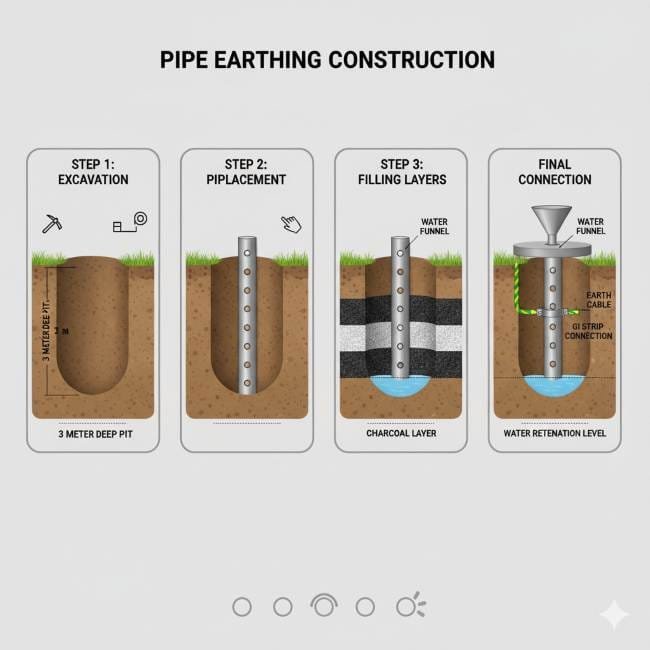
🔧 Pipe Earthing Construction
- 3 m deep pit
- Vertical GI pipe installation
- Charcoal + Salt filling
- Water funnel for moisture
- Strip connection
- Pit closing
🔧 Plate Earthing Construction
- 3–3.5 m deep pit
- Plate fixing with GI/Copper strip
- Charcoal + Salt + Kalmi Sora filling
- Water pipe installation
- Pit filling + 60×60 cm cement box
- Final strip connection to panel
🟫 How Both Earthing Systems Work (Simple + Scientific)
⚡ Pipe Earthing
- Fault current → Earthing wire → GI Pipe → Soil
- Moist soil + Salt/Charcoal spreads current easily into the ground
⚡ Plate Earthing
- Fault current → Copper plate → multisurface discharge
- Copper conductivity + large surface area → very low resistance
- Plate Earthing quickly releases high fault current into the ground
🟧 Pipe Earthing vs Plate Earthing (Real Difference Table)
| Feature | Pipe Earthing | Plate Earthing |
|---|---|---|
| Cost | Low | High |
| Resistance | Medium | Very Low |
| Lifespan | 8–12 years | 20–35 years |
| Installation Depth | 2.75 m | 3–3.5 m |
| Material | GI Pipe | Copper/GI Plate |
| Load Capacity | Up to 10 kW | 10–100+ kW |
| Maintenance | Watering required | Less frequent watering |
| Best For | Homes, Shops | Industries, Transformers |
🟦 Which Earthing Is Better? (Expert Verdict)
- Homes / Shops / Small Offices → Pipe Earthing (Low cost + easy maintenance)
- Industries / Hospitals / Factories → Plate Earthing (Low resistance + high reliability)
- Transformers / Heavy Machinery → Always Copper Plate Earthing
- High soil resistivity areas (Dry, rocky regions) → Plate Earthing performs better
🟩 Advantages & Disadvantages
⭐ Pipe Earthing Advantages
- Low cost
- Simple installation
- Perfect for light loads
❌ Pipe Earthing Disadvantages
- Higher resistance
- Requires frequent watering
- Shorter lifespan
⭐ Plate Earthing Advantages
- Very low resistance
- High conductivity
- Handles heavy loads
- Long lifespan
❌ Plate Earthing Disadvantages
- Higher cost
- Requires deep pit
💰 7. Pipe Earthing vs Plate Earthing: Cost Deep Comparison
Pipe Earthing Cost (Approx)
- ₹2,000 – ₹4,000 (material + labour)
Plate Earthing Cost
- G.I. Plate → ₹5,000 – ₹9,000
- Copper Plate → ₹15,000 – ₹25,000
✅ Plate Earthing is costlier, but the return on investment is very high.
⚡ 8. Where Should You Use Which? (Real-world Guidance)
Pipe Earthing – Best For
- Houses
- Small shops
- School rooms
- LED boards
- General domestic loads
Plate Earthing – Best For
- Industries
- Transformers
- Generator sets
- Lifts
- Server rooms
- Motor loads
- Large commercial buildings
🎯 9. Pipe Earthing vs Plate Earthing: (Experience-Based Final Decision)
- ✔ Budget earthing → Pipe Earthing
- ✔ Stable performance → Plate Earthing
- ✔ Dry or rocky soil → Plate Earthing
- ✔ Industrial or high-current loads → Plate Earthing
- ✔ No yearly maintenance → Plate Earthing
- ✔ Long future-proofing → Copper Plate Earthing is BEST
🧩 Notes
The main difference between Pipe Earthing and Plate Earthing is that Pipe Earthing uses a G.I. Pipe and is suitable for normal soil and domestic loads. Plate Earthing uses a Copper or G.I. Plate and provides the most stable and long-lasting earthing for industries, transformers, and high-load systems. Plate Earthing’s resistance remains stable throughout the year, while Pipe Earthing depends on soil and weather conditions.
How deep is Pipe Earthing?
➡ 2.75–3 meters.How deep is Plate Earthing?
➡ 3–3.5 meters or as per soil conditions.
Why is Plate Earthing better?
➡ Large surface area + high conductivity of copper → low resistance.
Which Earthing is best for homes?
➡ Pipe Earthing.
Which Earthing is used in transformers?
➡ Copper Plate Earthing is 100% recommended.
Conclusion
Choosing the right earthing system has a major impact on your safety, appliance lifespan, and fault protection.
For homes and light loads, Pipe Earthing is suitable, while for heavy and critical loads, Plate Earthing is the safest option.
If the installation is proper, materials are correctly selected, and moisture is maintained, both systems can deliver strong performance for many years.

Hi, I’m Pranjul — the person behind this website.
I hold a Diploma and B.Tech in Electrical Engineering, along with hands-on training through ITI. For over 3 years, I worked as an ITI College Instructor, teaching electrical fundamentals and practical skills to hundreds of students.
Through that experience, I noticed something: most electrical troubleshooting information online is either too technical for everyday homeowners, or too vague to actually solve real problems. That’s the gap this website aims to fill.