Introduction.
A transformer is considered the backbone of the power system. It helps transfer electricity safely and efficiently from one voltage level to another. But before any transformer is commissioned in a real power network, certain standard tests are carried out to check its safety and efficiency.
These open and short circuit test of transformer, help to determine
- the parameters of the equivalent circuit of Fig.
- the voltage regulation and
- efficiency. Complete analysis of the transformer can be carried out, once its equivalent circuit parameters are known.
The power required during these two tests is equal to the appropriate power loss occurring in the transformer.
What is an Open Circuit Test on Transformer?
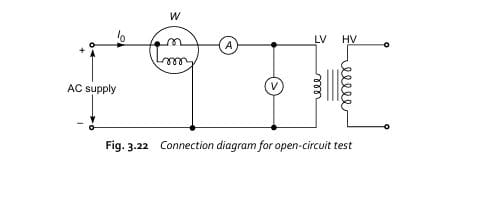
. The circuit diagram for performing an open circuit test on a single phase transformer is given in Fig. In this diagram, a voltmeter, wattmeter and an ammeter are shown connected on the low voltage side of the transformer. The high voltage side, is left open circuited. The rated frequency voltage applied to the primary, low voltage side, is varied with the help of a variable ratio auto-transformer. When the voltmeter reading is equal to the rated voltage of the l.v. winding, all the three instrument readings are recorded.
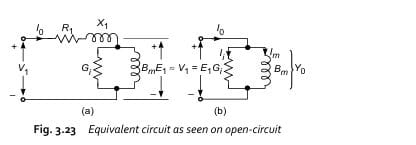
The ammeter records the no-load current or exciting current Io. Since lo is quite small (2 to 6% of rated current), the primary leakage impedance drop is almost negligible, and for all practical purposes, the applied voltage V1 is equal to the induced emf E1. Consequently, the equivalent circuit of Fig. gets modified to that shown in Fig.
Circuit diagram for open circuit test on a transformer
The input power given by the wattmeter reading consists of core loss and ohmic loss. The exciting current being about 2 to 6 per cent of the full load current, the ohmic loss in the primary
(I2r1) varies from 0.04 per cent {(2/100)×(2/100)×100} to 0.36 per cent of the full-load primary ohmic loss. In view of this fact, the ohmic loss during open circuit test is negligible in comparison with the normal core loss (approximately proportional to the square of the applied voltage). Hence the wattmeter reading can be taken as equal to transformer core loss. A negligible amount of dielectric loss may also exist. Error in the instrument readings may be eliminated if required. Let
- V1 = applied rated voltage on l.t. side,
- lo = exciting current (or no-load current)
- Pc = core loss
- Pc = V1 lo cosθ0
→ No load p.f. = cosθ0
From the phasor diagram of Fig. , it follows that
→ IC =I0cosθ0 and Im = I0 sinθ0
→ IC = PC/V1
Core loss resistance RCL = V1/IC , = V1/ I0cosθ0 ,
→ V21/ V1I0cosθ0 , = V21/PC
we know that Also, = I2CRCL = PC
→ Than, RCL = PC/ I2C, = PC/ (I0cosθ0)2
Than Magnetizing reactance,
→ XML = V1/IM, =V1/ I0 sinθ0
The subscript L with R, and X, is used merely to emphasize that these values are for the l.t. side.
This must be kept in mind that the values of R, and X, in general, refer to the side, in which the instruments are placed (the l.t. side in the present case). A voltmeter is sometimes used at the open circuited secondary terminals, in order to determine the turns ratio.
approximate equivalent circuit at no load.
Thus the open circuit test gives the following information:
- (i) core loss at rated voltage and frequency,
- (ii) core-loss current and magnetizing current,
- (iii) the shunt branch parameters of the equivalent circuit, i.e. Rc and X, and
- (iv) turns ratio of the transformer.
Short circuit test on Transformer.
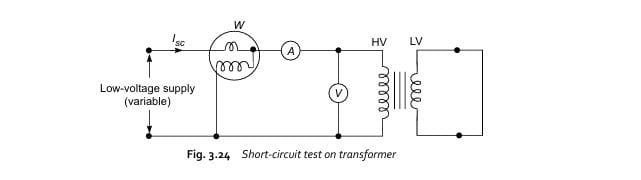
The low voltage side of the transformer is short-circuited, and the instruments are placed on the high voltage side, as illustrated in Fig. The applied voltage is adjusted by auto-transformer to circulate the rated current in the high voltage side. In a transformer, the primary mmf is almost equal to the secondary mmf; therefore, a rated current in the h.v. winding causes rated current to flow in the l.v. winding.
Short circuit test on the transformer
A primary voltage of 2 to 12% of its rated value is sufficient to circulate rated currents in both primary and secondary windings. From Fig. it is clear that the secondary leakage impedance drop appears across the exciting branch (R, and X, in parallel). About half (1 to 6%) of the applied voltage appears across the secondary leakage impedance and, therefore, across the exciting branch. The core flux induces the voltage across the exciting branch and since the latter is 1 to 6% of rated voltage, the core flux is also 1 to 6% of its rated value. Hence the core loss, being
approximately proportional to the square of the core flux, is 0.01 per cent per cent {(1/100) × (1/100) × 100} to 0.36 per cent
(= 6/100) × (6/100) × 100) of its value at rated voltage. The wattmeter, in short circuit test, records the core loss and the ohmic loss in both the windings. Since the core loss has been proved to be almost negligible in comparison with the rated-voltage core loss, the wattmeter can be taken to register only the ohmic losses in both the windings.
At rated voltage, the exciting current is 2 to 6% of full load current. When the voltage across the exciting branch is 1 to 6% of rated voltage, the exciting current may be 0.02 percent {(2×100) × (1×100) ×100} of its full-load current and can, therefore,
be safely ignored. As a result of this, the equivalent circuit of Fig. with the secondary short-circuited, gets modified to that shown in Fig. The instrument readings may be corrected, if required. Let Vsc, Isc, (The short-circuit current Isc should be, either equal to or near to the rated current.) and Psc be the voltmeter, ammeter and wattmeter readings; then from Fig, equivalent leakage impedance referred to h.v. side,
ZeH = VSC / ISC
equivalent resistance referred to h.v. side,
reH =PSC / I2SC
and equivalent leakage reactance referred to h.V. side,
XeH = √ Z2eH – R2eH
In reH, XeH and ZeH, the subscript H is used to indicate that these quantities are referred to h.v. side. These parameters can, however, be referred to the l.v. side, if required.
Equivalent circuit under short-circuit conditions
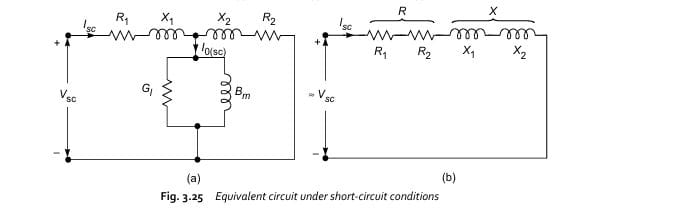
In the analysis of transformer equivalent circuit, the values of equivalent resistance and equivalent leakage reactance referred to either side, are used. However, if the leakage impedance parameters for both primary and secondary are required separately, then it is usual to take r1 = r2, = (1/2)rc and, x1 = x2= (1/2)xe, referred to the same side.
Thus, the short circuit test gives the following information:
- (i) ohmic loss at rated current and frequency and
- (ii) the equivalent resistance and equivalent leakage reactance.
Voltage regulation of a transformer can be determined from the data obtained from a short circuit test. Data from both open circuit and short circuit tests is necessary.
- (i) for obtaining all the parameters of exact equivalent circuit and
- (ii) for calculating the transformer efficiency.
Example. How can a wattmeter, connected on the h.v. side, record the ohmic loss in the l.v. winding
Solution. This question may spring up in the mind of some readers. A little thought process provides the explanation for this question. When rated current is made to flow in the HV. winding, the L.V. winding must also carry rated current, because the transformer action requires IN1 = IN2. The flow of rated current in the LV. winding causes ohmic loss, which must be supplied from somewhere. The only way to provide LV. winding loss is from the input to HV. side. But the entire input power to h.v. side is recorded by the wattmeter, therefore, the ohmic losses in both the windings are given by the wattmeter reading.
Example. Explain why open circuit and short circuit tests are performed on the L.V. side and HV. side, respectively.
Solution. Consider a 3300/220 V, 33 kVA, single-phase transformer.
For open circuit test on low voltage side, the ranges of voltmeter, ammeter and wattmeter are 220 V (rated value), 6 A (2 to 6% of rated current of 150 A) and 6 A, 220 V respectively. These are the standard ranges for ordinary instruments and, therefore, more accurate readings can be obtained. If the open circuit test is performed on the h.v. side, a source of 3300 V may not be readily available. At the same time, the instrument ranges are 3300 V, 0.4 A and 0.4 A, 3300 V which are not within the range of ordinary instruments and the results obtained may not be so accurate. Also, it be safe to work on the high voltage side.
For a short circuit test on the H.V. side, the instrument ranges are 165 V (2 to 12% of the rated voltage of 3300 V), 10 A (rated current), and 10 A, 165 V, which are well within the range of the ordinary instruments. On the other hand, instrument ranges, for a short circuit test on L.V. side are 11 V, 150 A, and 150 A, 11 V. Instruments of such ranges and an auto-transformer capable of handling 150 A, may not be readily available, and at the same time, the results may not be so accurate. It is for these reasons that the open circuit and short circuit tests are conducted on 1.v. and h.v. sides respectively.
difference between OC and SC test
| Feature / Parameter | Open Circuit (OC) Test | Short Circuit (SC) Test |
|---|---|---|
| Purpose | To determine core/iron losses (Pi), magnetizing current, and no-load parameters. | To determine copper losses (Pc), equivalent resistance (R), and equivalent reactance (X). |
| Connection | Performed on the low-voltage (LV) side, keeping the high-voltage (HV) side open. | Performed on the high-voltage (HV) side, keeping the low-voltage (LV) side shorted. |
| Applied Voltage | Rated voltage is applied to the LV side. | A small fraction (5–10%) of rated voltage is applied to the HV side to circulate full-load current. |
| Measurements Taken | Input voltage (V), no-load current (I0), and no-load power (W0). | Applied voltage (Vsc), short-circuit current (Isc), and power (Wsc). |
| Type of Loss Measured | Core/iron losses (constant losses). | Copper losses (variable losses). |
| Power Factor of Input Current | Negligible, as the current is small. | Approximately unity (since resistance dominates reactance under SC). |
| Equivalent Circuit Parameters | Determines shunt branch parameters: R0 (core loss resistance), X0 (magnetizing reactance). | Determines series branch parameters: R (equivalent resistance), X (equivalent leakage reactance). |
| Wattmeter Reading | Shows iron loss (Wi). | Shows copper loss at full-load current (Wc). |
| Current Magnitude | Very small (no-load current ≈ 2–5% of full load). | Full-load current flows through the windings. |
| Heat Generation | Conducted for a short duration to avoid overheating. | Significant heating due to full-load current. |
| Safety | Very safe, since voltage and current are low. | Requires caution due to high currents in the windings. |
| Duration of Test | It can be conducted for a long duration without damage. | Conducted for short duration to avoid overheating. |
🔹 Key Differences: OC Test vs SC Test (Phasor Perspective)
| Feature | OC Test | SC Test |
|---|---|---|
| Applied Voltage | Rated | Small |
| Current | Small (I₀) | Rated (Isc) |
| Focus | Iron/Core Loss | Copper Loss |
| Phasor Components | Iw (in-phase) + Iµ (90° lag) | Voltage drops across Rsc and Xsc |
| Measurement | No-load parameters | Series impedance parameters |
Comparison of Transformer Tests
Different transformer test methods have varying purposes, advantages, and disadvantages. Below is a comparison of Direct Loading Test, Open Circuit Test, Short Circuit Test, and Sumpner’s Test.
| Test Type | Purpose / Features | Advantages | Disadvantages |
|---|---|---|---|
| Direct Loading Test | Two identical transformers are tested at full load; measures both iron and copper losses. | Very accurate results; accurately represents actual performance. | Expensive; wastes energy; not practical for large transformers. |
| Open Circuit Test (OC Test) | Determines iron/core loss and shunt parameters of the transformer. | Simple; requires low power; safe. | Does not measure copper loss. |
| Short Circuit Test (SC Test) | Determines copper loss and series parameters; allows full-load current at low voltage. | Requires very low voltage; economical; easy to measure losses separately. | Cannot measure core loss. |
| Sumpner’s Test (Back-to-Back Test) | Two identical transformers are tested at full load; measures both iron and copper losses. | Most effective; accurate measurement of full-load efficiency and voltage regulation. | Requires two identical transformers; not always feasible. |
Conclusion
The Open Circuit Test and Short Circuit Test are essential diagnostic tools for transformers. Together, they help engineers determine equivalent circuit, efficiency, voltage regulation, and losses with minimal power consumption.
By understanding their procedures, applications, limitations, and safety measures, students and professionals can better design, maintain, and operate transformers safely and economically.
👉 Want to learn more? Explore our detailed guides on transformer polarity test, insulation class, and power factor improvement.
FAQ
What is the purpose of the Open-Circuit (OC) Test in a transformer?
Answer: The OC test is used to determine the iron/core losses and the parameters of the shunt branch (magnetizing reactance and core loss resistance) of the transformer.
What is the purpose of the Short-Circuit (SC) Test in a transformer?
Answer: The SC test is performed to determine the copper losses at full load and the equivalent series parameters (equivalent resistance Rsc and leakage reactance Xsc) of the transformer.
Why is the OC test carried out on the LV side of the transformer?
Answer: The OC test is done on the Low Voltage (LV) side because rated voltage can be applied easily and safely, while the High Voltage (HV) side remains open.
Why is the SC test carried out on the HV side of the transformer?
Answer: The SC test is conducted on the High Voltage (HV) side because only a small fraction of rated voltage is required to circulate the full-load current, making it safer and more practical.
What losses are measured in the OC test?
Answer: Only iron losses (hysteresis and eddy current losses) are measured, as copper loss is negligible due to very small no-load current.
What losses are measured in the SC test?
Answer: Only copper losses are measured, as iron losses are negligible because the applied voltage is very small compared to the rated voltage.
. What is the significance of Vsc in SC test?
Answer: The applied short-circuit voltage (Vsc) helps in calculating the equivalent resistance (Rsc) and equivalent reactance (Xsc) referred to the test side of the transformer.

Hi, I’m Pranjul — the person behind this website.
I hold a Diploma and B.Tech in Electrical Engineering, along with hands-on training through ITI. For over 3 years, I worked as an ITI College Instructor, teaching electrical fundamentals and practical skills to hundreds of students.
Through that experience, I noticed something: most electrical troubleshooting information online is either too technical for everyday homeowners, or too vague to actually solve real problems. That’s the gap this website aims to fill.