
What is a transformer?
Definition
A transformer is a static electrical device that transfers alternating electrical energy (AC) from one circuit to another, without changing the frequency, through mutual magnetic flux.
The working principle of transformer is electromagnetic induction, according to which a time-varying magnetic flux in the primary winding induces EMF in the secondary winding.
Explanation
A transformer basically consists of two or more electrical circuits or coils. These circuits are electrically isolated from each other, but are connected through a common magnetic flux. The coil connected to the AC voltage source is called the primary winding, while the coil that supplies electrical energy to the load is called the secondary winding. In a transformer, electrical energy is transferred not by direct electrical contact, but through a magnetic field, and during this entire process the frequency remains unchanged.
Working Principle of Transformer
Definition
The operation of a transformer is based on the principle of electromagnetic induction or mutual induction.
Faraday’s Law of Electromagnetic Induction
Definition
Faraday’s law of electromagnetic induction states that when the magnetic flux linked with a coil changes with time, an electromotive force (EMF) is induced in that coil.
Explanation
According to this law, the magnitude of the induced EMF in a coil is equal to the rate of change of flux linkage (Ψ). If a coil has N turns and the magnetic flux linked with each turn is φ, then the total flux linkage is Ψ = Nφ. Whenever this flux linkage changes with time, an EMF is produced in the coil. This principle forms the basis of the operation of transformers, generators, and other electrical devices.
Mathematical Form
Where:
e = induced electromotive force (EMF), in volts
N = number of turns in the coil
Ψ = flux linkage (Ψ = Nφ), in weber-turn (Wb-turn)
φ = magnetic flux, in weber (Wb)
t = time, in seconds
Working Operation of Transformer
Explanation
When the primary winding is connected to an alternating voltage V₁, an alternating current Iₘ flows through it. This current produces an alternating magnetic flux φ in the magnetic circuit of the transformer, which completes its path through the core. This time-varying flux links both the primary and secondary windings, and therefore both windings remain magnetically coupled.
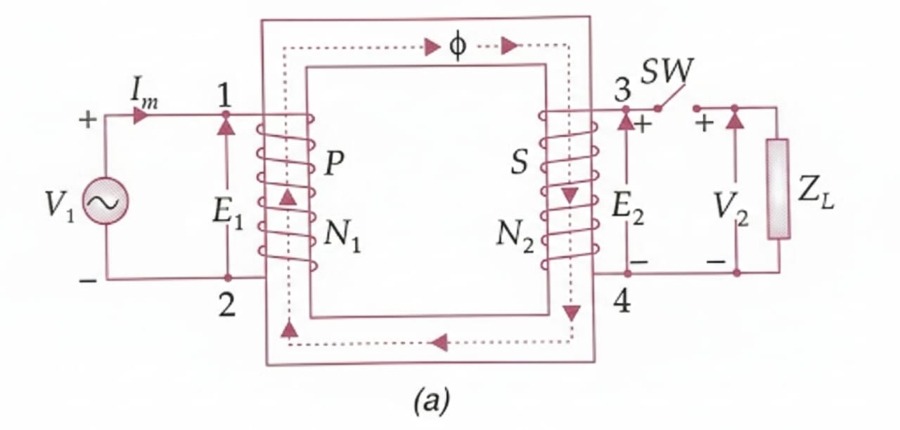
According to Faraday’s law of electromagnetic induction, due to the change in this flux, a self-induced EMF E₁ is produced in the primary winding and a mutually induced EMF E₂ is produced in the secondary winding. When the secondary winding is connected to a load, current flows in the secondary circuit due to the induced EMF, and the load receives electrical power.
During this entire process, the primary and secondary windings remain electrically insulated from each other, and energy transfer does not occur through direct electrical contact, but through the coupled magnetic field. The frequency remains unchanged in transformer operation, while the magnitude of the secondary voltage depends on the ratio of the number of turns N₁ and N₂. Thus, the electrical energy drawn by the primary is effectively transferred to the secondary winding and the load through transformer action.
Why is a transformer called an energy conversion device?
Definition
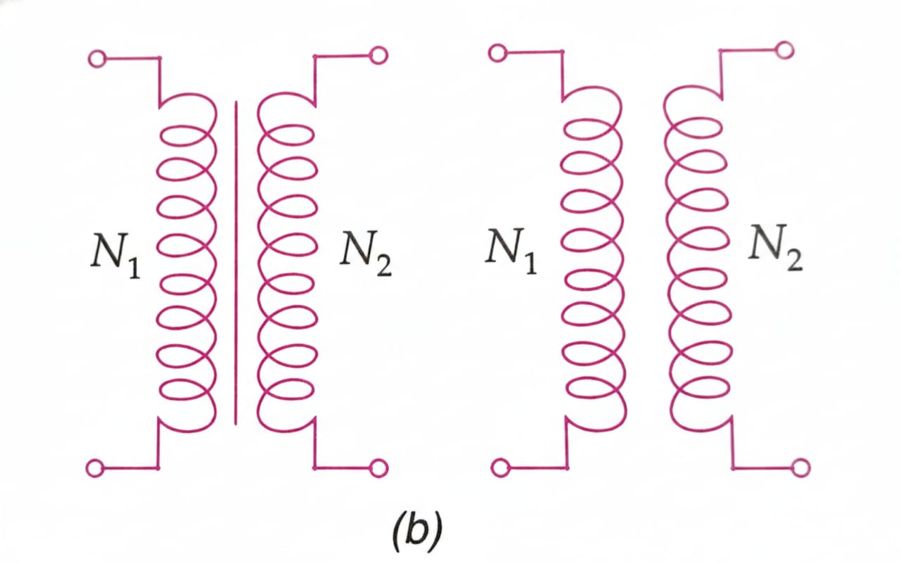
A transformer is an electromagnetic energy conversion device in which electrical energy is first converted into magnetic field energy and then reconverted into useful electrical energy.
Explanation
When an alternating supply is applied to the primary winding of a transformer, the current flowing through it produces a magnetic field in the magnetic core. Thus, the electrical energy received by the primary is first converted into magnetic field energy, and later this same energy is converted back into electrical energy in the form of induced EMF in the secondary winding. If a voltmeter is connected between primary terminal 1 and secondary terminal 3, the voltmeter reading is zero. This clearly indicates that the primary and secondary windings are electrically isolated, while they remain magnetically coupled through a common magnetic field.
Conclusion
A transformer is a static electromagnetic device. The working principle of transformer is based on the principle of electromagnetic induction. In it, the alternating electrical energy received by the primary winding is first converted into magnetic field energy and then reconverted into electrical energy in the form of induced EMF in the secondary winding. The primary and secondary windings remain electrically isolated but magnetically coupled. The entire operation of a transformer is based on Faraday’s law, and the frequency remains unchanged. For this reason, the transformer is a very important component of the electrical power system.
FAQ
What is a transformer?
→ A static device that transfers AC electrical energy from one circuit to another without changing the frequency.
Why is a transformer called a static device?
→ Because it has no rotating parts.
On which principle does a transformer work?
→ Electromagnetic induction / mutual induction.
What does Faraday’s law state?
→ A changing flux induces EMF in a coil.
How is energy transferred in a transformer?
→ Through a coupled magnetic field.
Does a transformer work on DC?
→ No, because in DC the flux does not change.
What is the primary winding?
→ The winding connected to the AC supply.
What is the secondary winding?
→ The winding that supplies energy to the load.
Why does the frequency not change in a transformer?
→ Because the EMF is generated from the same flux frequency.
What is flux linkage (Ψ)?
→ Ψ = Nφ
What is the formula for induced EMF?
e=dΨdt=Ndϕdte = \frac{d\Psi}{dt} = N \frac{d\phi}{dt}Why is electrical isolation necessary in a transformer?
→ For safety and fault protection.
Why does the voltmeter show zero (Primary–Secondary)?
→ Because both are electrically isolated.
What is magnetic coupling?
→ When both windings are linked by the same flux.
What is the function of the magnetic core in a transformer?
→ To provide a low-reluctance path for flux.
Why are EMFs E₁ and E₂ produced?
→ Due to time-varying magnetic flux.
Why is a transformer called an energy conversion device?
→ Because electrical → magnetic → electrical conversion takes place.
What does the turns ratio affect?
→ Voltage and current.
How is power transferred in a transformer?
→ From primary to secondary through the magnetic field.
What is the importance of a transformer in a power system?
→ Voltage control, loss reduction, and safe transmission.
Source
- Electrical Machines – Fundamentals of Transformers (Standard academic concept)
- NPTEL: Electrical Machines (IITs)
👉 https://nptel.ac.in - Bureau of Indian Standards (BIS) – Transformer fundamentals and standards.
- https://www.bis.gov.in
- NCERT – Physics & Basic Electrical Concepts (Electromagnetic Induction)
- https://ncert.nic.in
- AICTE Model Curriculum – Electrical Engineering.
- https://www.aicte-india.org
- Polytechnic / ITI Electrical Machines curriculum (State Technical Boards)
About the Author
Pranjul Yadav is an electrical engineering educator and technical content writer specializing in Board, ITI, and Diploma-level electrical subjects. His work focuses on delivering clear, concise, and exam-oriented explanations that maintain theoretical accuracy without heavy textbook language.
He creates plagiarism-free, human-written educational content designed to help students understand core concepts quickly and score better in exams. His areas of expertise include transformers, electrical machines, power systems, and basic electrical engineering fundamentals.