
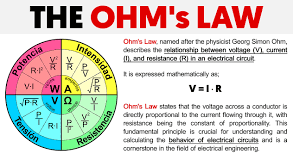
What is Ohm’s Law?
State Ohm law
Ohm’s Law helps us understand how electricity moves through wires and other materials. It shows the connection between three important things: Voltage (V), Current (I), and Resistance (R).
Thank you for reading this post, don't forget to subscribe!A long time ago, a scientist from Germany named Georg Simon Ohm discovered this simple but powerful rule.
He found that:
If the temperature and other conditions stay the same, then the voltage across a wire is always directly related to the current flowing through it.
This means:
Voltage (V) = Current (I) × Resistance (R)
Or simply,
V = I × R
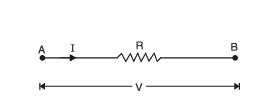
Let’s understand it like this:
- Voltage is like the push that moves electric charges.
- Current is how much electric charge is flowing.
- Resistance is what slows it down.
If you increase the voltage (the push), more current will flow — but if the resistance is high (more opposition), the current will be less.
So, Ohms Law gives us a clear way to find out how much current will flow, how much resistance is there, or how much voltage is needed — just by knowing the other two.
It’s a very useful rule in all electrical work, from small gadgets to big machines!
state Ohm Law in a Simple Way
Let’s imagine two points in a wire — we’ll call them point A and point B. If there is a certain amount of voltage (let’s say V volts) between these two points, and some electric current (say I amperes) is flowing through, then the resistance between A and B is found by dividing voltage by current.
So, the formula is:
R = V / I
This value R is called resistance, and it stays the same as long as the wire or material doesn’t change.
Now think about this — if we increase the voltage, what will happen to the current? It will also increase in the same way. For example, if the voltage becomes double, the current will also become double. But the ratio V divided by I will still give us the same resistance R.
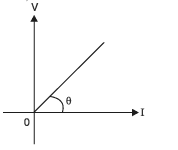
If you draw a graph between voltage (V) and current (I), it will be a straight line going through the center point (called the origin). This line shows that both V and I grow at the same rate, keeping the resistance constant.
This straight-line graph tells us something important: the slope (or tilt) of the line is equal to the resistance. Mathematically, it’s written like this:
R = tan θ = V / I = Constant
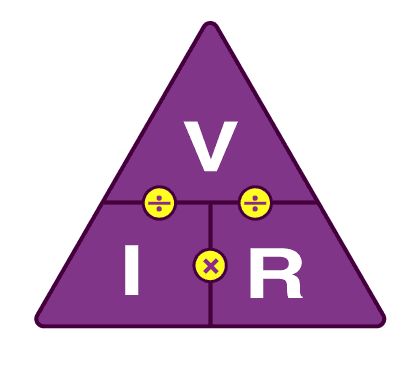
Ohm Law can be written in three simple ways:
- I = V / R
- V = I × R
- R = V / I
You can use these formulas for any part of a simple electric circuit or even for the whole thing.
| Quantity | Symbol | Unit (Abbreviation) | What It Means | Simple Explanation |
|---|---|---|---|---|
| Voltage | E | Volt (V) | The push that makes electrons move | Voltage is like the pressure that pushes electricity through a wire. |
| Current | I | Ampere (A) | How fast electrons are moving | Current is how many electrons are flowing in the wire at once. |
| Resistance | R | Ohm (Ω) | What slows down the flow | Resistance is like a barrier that makes it harder for electricity to flow. |
Remember:
- If voltage is measured in volts,
- And current is measured in amperes,
- Then resistance will be measured in ohms.
The unit ohm is named after the scientist Georg Simon Ohm, who discovered this relationship.
Everything around us, including circuits, is made up of tiny building blocks called atoms.
Non-ohmic Conductors
Some materials don’t follow Ohm’s Law. These are called non-ohmic conductors.
Ohms Law says that the current (I) flowing through a conductor is directly proportional to the voltage (V) across it. In simple words, if you increase the voltage, the current increases in a regular way. But in the case of non-ohmic conductors, this doesn’t happen.
Examples of non-ohmic conductors include:
- Vacuum tubes
- Transistors
- Electrolytes
These special conductors behave differently. Here’s how:
The V-I graph is not a straight line.
This means the relationship between voltage and current keeps changing. Sometimes, the current increases fast, and other times, slowly. It’s not steady.
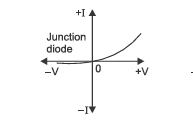
The graph may not start from the origin.
In ohmic conductors, the graph always starts from zero. But here, it might start somewhere else. This shows that even with no voltage, there might be no current—or the current starts only after a certain voltage is applied.
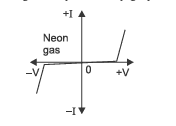
They may not work the same in both directions.
If you reverse the voltage, the conductor may stop working or conduct very little. This is different from ohmic conductors, which work the same way no matter which way the voltage flows.
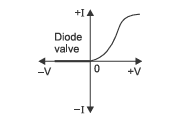
Since their behavior is not simple or predictable, we can’t use regular formulas to solve problems with non-ohmic conductors. Instead, we use graphs to understand and solve these kinds of circuits.
Example :
Question:
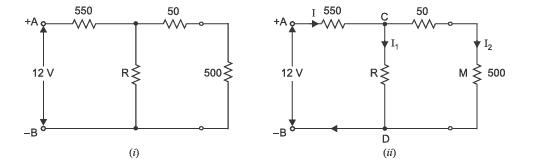
Look at the circuit shown in Figure(i). What is the value of the unknown resistor R, if the voltage drop across the 500-ohm resistor is 2.5 volts?
(All resistances are in ohms.)
Solution:
Let’s understand this step by step:
From the figure, we can see the current going through the 500-ohm resistor.
We know that:
Current (I₂) = Voltage ÷ Resistance
So,
I₂ = 2.5 ÷ 500 = 0.005 A (which is the same as 5 milliampere)
This same current (0.005 A) also flows through the 50-ohm resistor that is in series with the 500-ohm resistor.
So, the total voltage across both these resistors (from point C to D) is:
V₍CD₎ = I₂ × (50 + 500) = 0.005 × 550 = 2.75 V
Now, the total current coming from the source is:
I = (12 – 2.75) ÷ 550 = 9.25 ÷ 550 = 0.0168 A
This is the current entering point C.
Out of this total current, 0.005 A (which we already calculated) goes through the 500-ohm and 50-ohm path.
So the rest of the current, which goes through the unknown resistor R, is:
I₁ = I – I₂ = 0.0168 – 0.005 = 0.0118 A
Now we use Ohm’s Law to find R.
We already know that the voltage across R is also 2.75 V (same as across CD).
So:
R = V ÷ I = 2.75 ÷ 0.0118 = 233 ohms
Final Answer:
The value of the unknown resistor R is 233 ohms.
Question:
A metal filament lamp takes 0.3 A at 230 V. If the voltage is reduced to 115 V, will the current be half?
Answer:
No, the current will not be half.
Here’s why:
We might think that if we reduce the voltage by half, the current should also become half. That would be true only if the resistance of the lamp stays the same. But in this case, it doesn’t.
The metal filament in the lamp gets very hot when it’s working, and that heat makes its resistance go up — a lot! When you lower the voltage to 115 V, the filament doesn’t get as hot, so its resistance becomes much lower.
Because of this change in resistance, the current does not simply follow the usual rule of “half the voltage = half the current.” That rule (Ohm’s law) works only when the resistance stays the same, which isn’t true for this lamp.
To understand it better:
When the lamp is hot, its resistance is more than 10 times higher than when it’s cold. So when the voltage drops, the lamp gets colder, the resistance drops, and the current doesn’t just go down in a neat, even way.
So, in short:
The current will not be half because the resistance changes when the lamp cools down.
Relationship Between Voltage, Current and Resistance
One of the most important and simple rules in the world of electricity is called Ohm Law. It helps us understand how electricity moves in a circuit.
Imagine water flowing through a pipe. The more pressure you apply, the faster the water flows. Electricity works in a similar way. Ohm’s Law tells us how voltage, current, and resistance are connected.
What Does Ohm’s Law Say?
Ohm’s Law says:
The voltage across a conductor increases when the current through it increases, as long as everything else (like temperature) stays the same.
Ohm’s Law Formula
We can write this relationship using a simple formula:
V = I × R
Where:
- V is the Voltage (the force pushing the current)
- I is the Current (the flow of electricity)
- R is the Resistance (how much the conductor tries to stop the current)
This means:
- If you know the voltage and resistance, you can find the current:
I = V / R - If you know the voltage and current, you can find the resistance:
R = V / I
When Does Ohm Law Work?
Ohm’s Law works only when the temperature and other physical conditions don’t change.
But in real life, some things behave differently. For example, the filament of a light bulb gets very hot when current flows through it. As the temperature rises, the resistance changes too. In this case, Ohm’s Law doesn’t work perfectly, because one of its key conditions (constant temperature) is not met.
In Simple Words
Ohm’s Law is like a rule that shows how electricity flows. If you keep everything the same and increase the push (voltage), more current will flow. But if something changes—like temperature—the rule might not work exactly right.
This basic law is the foundation for understanding how electric circuits work. Whether you’re learning electricity for the first time or just need a quick reminder, Ohm’s Law is where it all begins.
Ohms Law – Explained with a Water Pipe Analogy
Electricity can feel a bit hard to understand because we can’t see it with our eyes. That’s where the water pipe example comes in—it helps us picture how electricity flows in a very simple way.
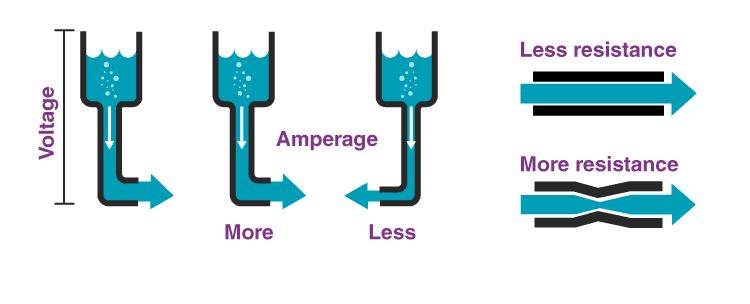
Imagine a pipe filled with water. When you push water through it, it flows from one side to the other. Now think of this like an electric circuit.
Voltage is like the water pressure—it’s the force that pushes the water (or in real life, the electric current).
Current is like the amount of water flowing through the pipe. More pressure means more water flow, just like more voltage means more electric current.
Resistance is like the size of the pipe. A narrow pipe makes it hard for water to pass through—it resists the flow. A wide pipe lets water move easily. That’s the same as electrical resistance: the higher it is, the harder it is for current to flow.
So, in short:
- Higher pressure (voltage) = more water flow (current)
- Bigger pipe (lower resistance) = easier flow
- Smaller pipe (higher resistance) = harder flow
This simple example helps us see how voltage, current, and resistance are all connected. That connection is called Ohm Law.
Ohm’s Law shows that:
Current = Voltage ÷ Resistance
So, if we increase the voltage or make the resistance smaller, more current will flow—just like in the water pipe!
ohm law Circuits diagram
Everything around us, including circuits, is made up of tiny building blocks called atoms. Atoms are made from even smaller parts:

- Protons, which have a positive charge
- Neutrons, which have no charge
- Electrons, which have a negative charge
Atoms stay together because the protons in the center attract the electrons that move around them. When a circuit is turned on with a power source, this makes the electrons start to move. They are pulled toward the positive parts, creating a flow called electric current.
Some parts of the circuit can slow down this flow. When that happens, we call it resistance. It’s like how rocks in a river can slow down the water.
Experimental Verification of Ohm Law
Ohm’s Law tells us that the current flowing through a resistor is directly related to the voltage across it. To check if this is true, we can do a simple experiment.
What You Need:
- A resistor
- An ammeter (to measure current)
- A voltmeter (to measure voltage)
- A battery
- A plug key (a switch)
- A rheostat (a variable resistor)
- Wires to connect everything
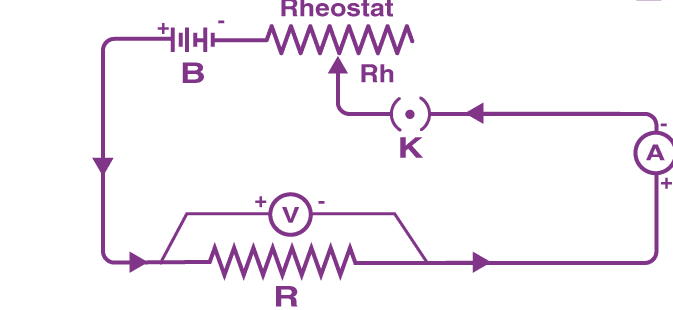
How to Set It Up:
- Connect all the parts following the circuit diagram (the battery, resistor, ammeter, voltmeter, rheostat, and plug key).
- Close the switch (plug key) so that the current can flow.
- Adjust the rheostat to get the smallest current reading on the ammeter.
What to Do:
- Slowly move the sliding part of the rheostat to increase the current step by step.
- Each time you change the current, write down the current value from the ammeter and the voltage from the voltmeter.
- Keep doing this to get many pairs of current and voltage readings.
What You’ll See:
- When you divide the voltage (V) by the current (I) for each reading, the result stays almost the same. This number is called resistance (R).
- If you draw a graph with voltage on one side and current on the other, the points will form a straight line. This means voltage and current increase together in a steady way.
What It Means:
This experiment shows that the current through a resistor changes directly with the voltage across it. This is exactly what Ohm’s Law says!
Electric Power: What It Means and How to Calculate Using Ohm Law
Electric power is how fast work is done in an electric circuit. Imagine you have a battery and some wires connected to a bulb. When the battery pushes the electric current (which is just tiny particles called electrons) through the wires, work is happening. This work might light up the bulb, make a fan spin, or heat up a toaster.
What is Electric Power?
Electric power tells us how quickly this work is done. If a lot of work happens in a short time, the power is high. If the work is slow, the power is low.
How Do We Measure Electric Power?
We measure power in watts (W). One watt means one joule of work is done every second.
Basic Terms to Know:
- Voltage (V): Think of this as the “push” that moves the electrons. It’s like water pressure in a pipe.
- Current (I): This is how many electrons are flowing, like the amount of water flowing through the pipe.
- Resistance (R): This is anything that slows down the flow of electrons, like a narrow or rough pipe.
- Time (t): How long the current flows.
How to Calculate Electric Power
There are a few ways to find power, depending on what you know:
- If you know the voltage (V) and current (I), the power is:
Power = Voltage × Current
Or simply,
P = V × I - If you know the voltage (V) and resistance (R), use this:
Power = Voltage squared ÷ Resistance
Or,
P = V² / R - If you know the current (I) and resistance (R), use:
Power = Current squared × Resistance
Or,
P = I² × R
Why Does This Matter?
Knowing electric power helps us understand how much energy devices use. It also tells us how much heat or light something will produce. This is important for safety and efficiency.
What is a Power Triangle?
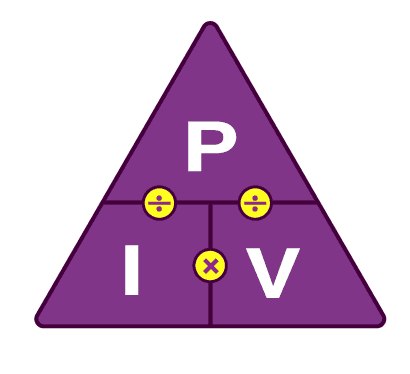
The Power Triangle is a simple way to understand the relationship between power, voltage, and current in an electric circuit. Imagine a triangle where each corner stands for one of these three things:
- At the top of the triangle is Power (P)
- At the bottom left is Current (I)
- At the bottom right is Voltage (V)
This triangle helps us find any one of the three values, as long as we know the other two. It’s like a shortcut that makes things easier to understand and calculate.
Let’s look at how it works:
1. If you know Current and Voltage:
You can find Power using this formula:
Power (P) = Voltage (V) × Current (I)
2. If you know Power and Voltage:
You can find Current using this formula:
Current (I) = Power (P) ÷ Voltage (V)
3. If you know Power and Current:
You can find Voltage using this formula:
Voltage (V) = Power (P) ÷ Current (I)
This triangle makes it very easy to remember the formulas. Just cover the value you want to find, and the triangle will show you how to calculate it using the other two.
Ohms Law Pie Chart
Understanding electricity becomes much easier when we break it down into simple parts. One of the best ways to learn how voltage, current, resistance, and power are connected is by using something called the Ohm Law Pie Chart.
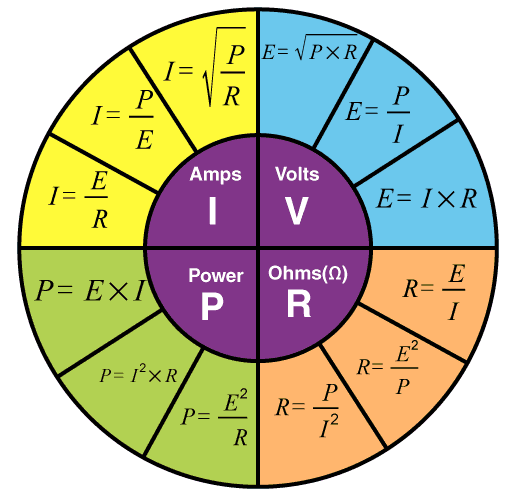
This chart is like a guide that shows you all the important formulas in one place. You can use it to quickly find what you need—whether you’re looking for voltage (V), current (I), resistance (R), or power (P). It’s a simple, clear way to remember how these things work together.
Ohm Law Formulas
Here are the basic equations that the chart shows:
- V = I × R (Voltage = Current × Resistance)
- I = V ÷ R (Current = Voltage ÷ Resistance)
- R = V ÷ I (Resistance = Voltage ÷ Current)
- P = V × I (Power = Voltage × Current)
- P = I² × R (Power = Current squared × Resistance)
- P = V² ÷ R (Power = Voltage squared ÷ Resistance)
Each of these formulas helps us solve different parts of an electrical circuit. And the best part? You don’t have to memorize them all—just look at the pie chart, and you’ll know what to do.
Think of the Ohm’s Law Pie Chart as your friendly helper. Whether you’re a student, a beginner, or just someone who wants to understand how electricity works, this chart makes it easy and fun to learn.
Ohm Law – Simple Uses in Real Life
Ohms Law is like a basic rule in electricity. It helps us understand how voltage, current, and resistance are connected. Here are some of the main ways we use Ohm’s Law:
To Find Voltage, Current, or Resistance
If we know two things (like current and resistance), we can easily find the third (like voltage). It’s like solving a simple puzzle to understand how electricity is working in a circuit.

To Control the Flow of Electricity
Ohm Law helps make sure the right amount of voltage reaches different parts of a device. This keeps things running safely and smoothly—like making sure a light bulb doesn’t get too much power and burn out.
To Share Current in Devices Like Ammeters
Ohm Law is also used in special measuring tools like DC ammeters. It helps guide the current properly so we can measure it or use it safely without damage.
Limitations of Ohm Law
Ohms Law is a helpful rule that tells us how voltage, current, and resistance are related in an electric circuit. But just like everything else, it has its limits. It doesn’t always work in every situation. Here’s where Ohm’s Law falls short:
Doesn’t Work for One-Way Devices
Ohm’s Law cannot be used for devices like diodes and transistors. These are special components that let electricity flow in only one direction. Since current doesn’t behave the same in both directions, Ohm’s Law doesn’t apply here.
Not for Non-Linear Elements
Some electrical parts don’t have a steady relationship between voltage and current. Their values change over time depending on the situation. For example, things like capacitors and some special resistors don’t follow a straight line rule. Because of this changing behavior, Ohm’s Law can’t be used with them.
How Temperature Affects Ohm Law
Ohms Law is a simple idea. It says that if you apply more voltage to something like a wire, more current will flow through it. Or in other words:
Voltage = Current × Resistance
But there’s an important detail we need to understand — this only works well when the temperature stays the same.
Why? Because the resistance of a material (like copper or iron) changes when its temperature changes. When electricity flows through a wire, it can heat up. This heating can change the resistance, making it harder (or easier) for the current to flow.
This means that even though we think of resistance as staying the same, it actually doesn’t. As the wire heats up from the current flowing through it, its resistance increases. So the more current you push, the hotter the wire gets, and the more the resistance can change.
That makes it tricky to test Ohm’s Law perfectly in real life — because as the current flows, it naturally causes heating. Scientists like James Clerk Maxwell came up with clever ways to measure this accurately by using very small currents, which don’t cause much heat.
But even very tiny currents can create small temperature changes, especially where the wire connects to other materials. This is because of something called the Peltier effect, which can heat or cool a connection point depending on the direction of current. These small temperature changes cause small changes in voltage too — this is called the Seebeck effect.
So even if we try to keep the current low, there’s always a small “thermal correction” to the resistance — a tiny adjustment caused by temperature differences. Sometimes, this correction is almost as big as the resistance itself!
Understanding the Link Between Heat and Electricity
Let’s imagine two everyday things: heat and electricity. You’ve felt heat when you touch something warm. And you’ve seen electricity at work when you switch on a light. But did you know that the way heat and electricity move through materials is actually very similar?
Here’s how.
When heat moves through something, like a metal spoon left in a hot cup of tea, it travels from the hotter end to the cooler end. The same thing happens with electricity. When you plug in your phone, electric charge flows through the wire from one end to the other.
What’s interesting is that both of these follow the same basic rule: things flow from more to less. Heat flows from hot to cold. Electricity flows from high voltage to low voltage.
Two smart scientists, a long time ago, helped us understand this. Joseph Fourier explained how heat moves, and Georg Ohm did the same for electricity. Even though they were talking about different things, they used similar ideas. Both said that the flow—whether it’s heat or electricity—depends on how big the difference is between the two ends. The bigger the difference, the stronger the flow.
For example:
- A hotter stove will heat your pot faster.
- A higher voltage will charge your phone faster.
This idea is super helpful. It means that if we understand one (like electricity), we can use that knowledge to understand the other (like heat).
Of course, real life can be a little more complex. Some materials behave differently when things get really hot. And some wires don’t carry electricity as easily as others. But the basic idea stays the same: flow happens because of differences, and the bigger the difference, the faster the flow.
So, whether it’s a warm blanket on a cold night or a lightbulb brightening up a room, the same simple rule is at work. Heat and electricity might feel different—but deep down, they’re more alike than you think.
Magnetic Effects Made Simple
When electricity flows through a wire, it creates a magnetic field around it. That’s a basic idea from science. But something interesting happens when the wire is moving through a magnetic field. This movement creates an extra push on the electric charges inside the wire. This push is called the Lorentz force.
Because of this force, an extra electric current appears in the wire. So now, the total current doesn’t just depend on the electric field (the thing that usually moves charges), but also on how fast the wire is moving and the strength of the magnetic field.
We can write it like this:
Current = Material’s conductivity × (Electric field + Motion × Magnetic field)
That might sound like a big formula, but it’s just saying:
The faster the wire moves through the magnetic field, the more current it can create.
But here’s something even cooler:
If you were sitting on the wire and moving with it (imagine riding on it like a train), it wouldn’t feel like the wire was moving at all. From that point of view, there’s no extra current caused by motion, because you’re moving together with the wire. This shows us that electric and magnetic fields can look different depending on where you’re standing or how you’re moving. That’s part of what Einstein’s special relativity talks about!
Now, what if the current in the wire keeps changing—like turning on and off really fast? That happens when we use things like alternating current (AC). In that case, the wire doesn’t just face resistance (which slows current down), but it also faces something called reactance. Reactance comes from the wire trying to push against changes in the current, like a spring pushing back when you press it.
Reactance becomes even stronger if:
- The current is changing very quickly (high frequency), or
- The wire is coiled up (like in a motor or transformer).
So, in short:
- Motion through a magnetic field adds extra current.
- That current depends on how fast you’re moving and the strength of the field.
- If the current changes rapidly, the wire pushes back with reactance.
This is how electricity and magnetism dance together, creating many of the amazing things we use every day—from electric motors to wireless chargers.
Conductive Fluids – Explained Simply
Imagine a special kind of fluid that can carry electricity — like plasma, for example. This type of fluid is called a conductive fluid.
Now, let’s say this fluid is moving through a magnetic field. Just like how wind moving through a forest causes trees to sway, the motion of the fluid creates something special: it produces an electric field.
This electric field pushes the tiny charged particles inside the fluid — mostly electrons. When these electrons move, they create an electric current.
But there’s more going on.
In this fluid, the electrons feel three main things:
- The push from the electric field
- A drag force from bumping into other particles
- A twist from the magnetic field (because moving charges and magnets interact in a cool way)
Normally, we’d write a big equation to describe all this. But in simple words, scientists realized something interesting: because electrons are super light compared to other particles, we can ignore some parts of the math and get a neat result.
That result tells us this:
The total electric field that the electrons feel is balanced by the electric current in the fluid, plus the effect of the fluid moving through the magnetic field.
This leads to a simple relationship:
Electric Field + (Fluid Speed × Magnetic Field) = Resistance × Electric Current
Here, resistance is just how much the fluid resists the flow of electricity. The easier it is for electricity to flow, the lower the resistance. The harder it is, the higher the resistance.
Some people use the symbol η (eta) for resistance. But sometimes, eta is also used for something called magnetic diffusivity, which is about how magnetic fields move through the fluid. So you might see some confusion in symbols — but the idea remains the same.
In Short:
Resistance plays a key role in how strongly the fluid conducts electricity.
Conductive fluids can carry electric current.
When they move through a magnetic field, they create an electric field.
This causes charged particles to move and form a current.
The relationship between electric fields, currents, and magnetic effects can be written in a simple form.
What You Can Check with Ohm Law
Ohm Law helps us check if parts of an electrical circuit are working right. It lets us see if the values of things like resistance, current, and voltage are what they should be.
For example, if a tool measuring current shows more electricity flowing than usual, it might mean the resistance in the circuit has gone down or the voltage has gone up. This can be a sign that something is wrong with the power supply or the circuit itself.
On the other hand, if the current is less than expected in a direct current (DC) circuit, it could mean the voltage has dropped or the resistance has gone up. When resistance goes up, it might be because connections are loose, parts are rusty, or something is broken.
In a circuit, devices or parts that use electricity are called loads. Loads can be anything—from small gadgets, like phones or computers, to big machines like motors. Usually, these devices have a label (called a nameplate) that shows important info, like their usual voltage and current.
Technicians look at these nameplates to know what the normal values should be. When they test a circuit and the numbers don’t match what the meters say, they use Ohm’s Law to figure out which part of the circuit isn’t working right. This helps them find and fix problems faster.
FAQ
What does Ohm’s law state?
Ohm’s law says that the electric current flowing through a wire depends on the voltage across it. If you increase the voltage, the current also increases — as long as everything else stays the same.
What can Ohm’s law be used for?
Ohm’s law helps us check and understand how electricity moves in a circuit. It lets us figure out how much current is flowing, what the voltage is, and how much resistance is in the circuit.
Is Ohm’s law universal?
No, Ohm’s law is not universal. It works well with some materials like copper and iron, but it doesn’t work with everything. Some materials don’t follow this rule, so we can’t use Ohm’s law for them.
Why is Ohm’s law not applicable to semiconductors?
Semiconductors don’t follow Ohm’s law because their behavior changes with voltage. They don’t have a steady relationship between voltage and current like wires do. So the rule doesn’t fit them.
When does Ohm’s law fail?
Ohm’s law doesn’t work well with special devices like diodes, or when conditions like temperature or pressure change a lot. In those situations, the law doesn’t give correct results.