

Fan Capacitors
Electric fans are all around us. We use them in our homes, offices, factories, and even inside cars, trains, and computers. They help move air to keep us cool or to keep machines from overheating. Depending on how they get power, electric fans are mainly divided into three types: AC fans, DC fans, and AC/DC fans.
Thank you for reading this post, don't forget to subscribe!There are also different models of fans made for different purposes:
- Ceiling fans – These hang from the ceiling and are commonly found in bedrooms, living rooms, and kitchens.
- Table fans – Small and portable, perfect for placing on a desk or table.
- Pedestal fans – These stand on the floor and can be moved around easily.
- Exhaust fans – These help remove hot air, smoke, or bad smells from rooms like kitchens or bathrooms.
Among these, ceiling fans are the most commonly used in homes. They come in different sizes based on the length of the blades. The most popular sizes are:
- 36 inches (900mm)
- 48 inches (1200mm)
- 52 inches (1300mm)
These sizes are chosen based on how big or small a room is. The bigger the room, the larger the fan you might need.
But have you ever wondered how the fan starts spinning when you switch it on? That’s where a small but very important part comes in – the fan capacitor.
What is a Fan Capacitor?
A fan capacitor is a small electrical part inside the fan that helps it start and run smoothly. Without it, the fan blades wouldn’t begin to spin, or they would spin very slowly. You can think of the capacitor like a helper that gives the fan a little push to start moving.
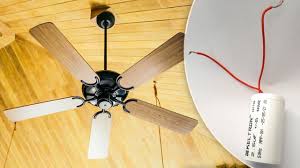
A fan capacitor is a small but very important part inside a ceiling fan. It helps the fan start and spin smoothly. Without it, the fan wouldn’t work properly.
When you turn on a ceiling fan, electricity flows through different parts like the stator, rotor, regulator, and of course, the capacitor. Among these, the capacitor has a special job. It gives the fan a little push to start moving and keeps it running at the right speed.
The fan capacitor is a non-polarized AC capacitor. This means it works with the type of electricity we use at home. It has no positive or negative side, so you can connect it either way
In simple words, a fan capacitor is like a helping hand. It gives your fan the energy it needs to start spinning and keeps it steady while it runs. Even though it’s small, it’s one of the most important parts of the fan.
Why is it Important?
- It helps the fan start quickly.
- It keeps the fan running at the right speed.
- It helps the fan work quietly and without shaking.
If a fan capacitor stops working, you’ll notice that your fan may hum, turn slowly, or not start at all.
Specifications
This fan capacitor is built to do its job well and last a long time. Here’s everything you need to know about it, explained in a clear and simple way:
Mounting Style: It’s made for through-hole mounting, which means it fits easily into a specific spot on the fan.
Capacitance: The power it can hold ranges from 1.5 to 4 microfarads (MFD).
Voltage Rating: It can handle up to 440 volts of AC power safely.
Shape & Size: The capacitor is cylindrical in shape, and its size is 27 mm in diameter and 52 mm in length.
Tolerance: It works with 5% tolerance, which means it stays close to the given value, making it reliable.
Frequency: Made for a 50Hz frequency, which is standard for most fans.
Phase: It is made for single-phase connections, commonly used in home appliances.
Temperature Range: It works well in different weather, from -25°C to +85°C.
Connections: Comes with wire terminals for easy connection.
How a Fan Capacitor Works
Let’s understand how a fan capacitor works with a simple example.
Imagine you switch on your ceiling fan. As soon as you do, electricity flows through the fan’s wires and reaches the motor. This electricity makes the fan blades start to move. But have you ever wondered how the fan starts spinning and how it changes speed? That’s where the capacitor plays a big role.
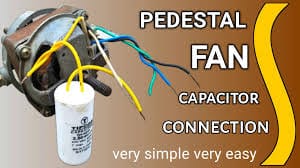
A capacitor is a small device inside the fan that helps control the flow of electricity. It stores a little bit of electric charge and then releases it when needed. This helps the motor run smoothly and at different speeds.
Most ceiling fans have two types of capacitors:
- Starting Capacitor – This helps the fan motor get a strong push when it starts. Without it, the fan might not start spinning at all.
- Running Capacitor – This keeps the fan running steadily at the speed you choose.
In some fans, both of these functions can be done by one single capacitor. Whether it’s one or two, the job of the capacitor is to help the fan start easily and run at the speed you want.
What Are Start and Run Capacitors?
Start capacitors are usually big, round cans made of aluminum or filled with oil. They have two wires sticking out from the top. These capacitors help machines get started by giving an extra boost of energy.
Run capacitors are smaller than start capacitors. They can be round or flat. Unlike start capacitors, run capacitors work all the time when the machine runs. They don’t have special protection against high voltage. However, they are made for regular use.
Run capacitors typically range from 1 to 50 microfarads (µF). They can manage voltages from 120 volts to 450 volts. You often find these capacitors in machines using single-phase electricity
One cool thing about run capacitors is that they can heal themselves. If they get a little overloaded, they can fix the damage inside as long as they don’t get too hot. Because they run all the time, run capacitors don’t have a positive or negative side — you can connect their wires either way, and they will still work fine.
How Does a Fan Capacitor Control the Speed of a Fan?
When you turn on a fan, the capacitor inside starts to fill up with electric energy slowly. It stores this energy and then quickly releases it in a short burst. This burst of energy helps give the fan motor a strong push at the very beginning, making it easier for the motor to start turning.
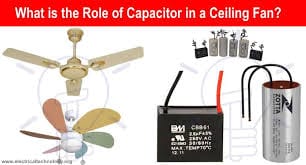
Because of this extra push, the motor gets more power and starts spinning faster. As the motor spins faster, the fan blades move quicker too, which makes the fan blow air faster.
In short, the capacitor helps the fan motor get going smoothly and controls how fast the fan can spin.
Fan Capacitor Polarity
A ceiling fan capacitor does not have a positive or negative side. This means it’s a non-polarized capacitor, so you can connect it without worrying about which way it goes. Usually, the capacitor is attached to the outside metal part of the fan.
No matter how you connect it, the fan always turns in the same direction. When electricity flows, the current moves one way in the first half of the cycle. Then, in the second half, it moves the opposite way. Still, the fan’s rotation stays the same.
How to Connect a Capacitor to a Ceiling Fan
This is a simple guide to show you how to connect a capacitor to a ceiling fan. The ceiling fan needs a few parts to work properly — a switch, a capacitor, and a regulator. This helps the fan start and run smoothly.
Inside the fan, there are two coils: the running winding and the starting winding. The capacitor connects to the starting winding to help the fan start. This connection is in series. The capacitor links right after the starting winding and then goes to the power supply. The running winding connects straight to the power supply.
To do this correctly, you first need to identify the two windings in your fan. Usually, the fan wires come in three colors: blue, black, and red. These wires help you find the right places to connect the capacitor and power.
Most of these fans usually have three wires on the outside. If you look inside at the winding connections, you’ll see that one end of each winding is joined together and brought out as a common wire. You can check the winding terminals by measuring their resistance with a tester.
For example, if you measure the resistance between the wires, you might find:
- Between the Red and Black wires, the resistance is about 200 ohms.
- Between the Red and Blue wires, the resistance is about 210 ohms.
- Between the Blue and Black wires, the resistance is around 500 ohms.
When checking the wires in a ceiling fan, you can find the starting and running windings by measuring resistance. If the resistance between the black and blue wires is higher, these two wires belong to the starting and running windings. The red wire is the common wire, connected to both windings.
Usually, the starting winding has a higher resistance than the running winding. So, if the resistance between the red and blue wires is higher than between the red and black wires, the blue wire is the starting winding, and the black wire is the running winding.
Once you know which wires are which, the capacitor should be connected between the starting and running windings. This helps the fan work properly, just like the diagram shows.
How Does a Fan Capacitor Work?
A ceiling fan has two special coils inside called the starting winding and the running winding. If you try to run the fan without a capacitor, both these coils get electricity at the same time and create magnetic forces that cancel each other out. Because of this, the fan won’t start spinning.
That’s where the capacitor comes in. The capacitor is like a helper that changes the timing of the electricity going to the starting coil. It shifts the electrical current just a little bit, making the magnetic forces work together instead of against each other.
Thanks to this shift, the fan gets a push to start turning. Once the fan is moving, it keeps running smoothly. So, the capacitor’s job is to create a small delay in the electricity that helps the fan get going and keeps it spinning properly.
Working of a Ceiling Fan Capacitor:
A ceiling fan usually uses two capacitors – one for starting and one for running. The motor inside the fan is called a permanent split capacitor motor, or sometimes a two-value capacitor run motor.
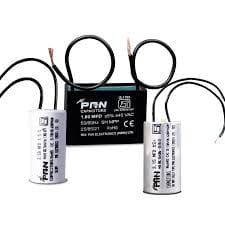
Let’s break it down.
When you turn on your fan, one capacitor with a higher value helps the fan start spinning. This is connected to the starting winding. The other capacitor, which has a lower value, helps the fan keep spinning and is connected to the running winding.
Now, here comes the interesting part:
Why is a capacitor needed in the first place?
A fan motor works on single-phase electricity, which doesn’t naturally create a spinning magnetic field needed to rotate the motor. So, the capacitor steps in. It splits the current into two different paths and creates a time difference between them. This time gap is what we call a phase difference. Because of this, a rotating magnetic field is created inside the motor. This magnetic field gives the rotor (the spinning part of the fan) the push it needs to start moving.
Without the capacitor, the motor wouldn’t know which direction to spin – and honestly, it wouldn’t spin at all! It would just sit there humming.
This is why the capacitor is so important in a ceiling fan. It gives that initial kickstart and keeps the fan running smoothly.
Now, here’s a little twist:
If the capacitor isn’t the right size or value, things can go wrong. The fan might run slower, make noise, or not start at all. That’s why the correct capacitor rating matters.
Fan Capacitor Ratings – What You Should Know:
- The capacitor used in ceiling fans usually has a value between 1.5 to 10 microfarads (μF).
- The voltage rating is usually 370V or 440V.
- Using the wrong capacitor value can mess up the magnetic field and cause the fan to perform poorly.
Some table fans also use capacitors in the same way to help them start and run. However, exhaust fans usually don’t use capacitors because they are lighter and don’t need that extra starting push. Also, their motors are simpler, and using a capacitor might damage them.
In Short:
- Capacitors help fans start and keep running.
- They create a spinning magnetic field inside the motor.
- Without a capacitor, the fan won’t spin.
- Always use the correct capacitor value for smooth performance.
Types of Fan Capacitors
Fans need special parts called capacitors to help them work well. There are different kinds of capacitors used in ceiling fans. Let’s talk about one of them:
Non-Polarized Electrolytic Capacitor

This type of capacitor is used inside ceiling fans. It is called “non-polarized” because it has no positive or negative side. That means you can connect it in any direction, and it will still work. These capacitors are also used in other machines to help make signals stronger, fix problems in circuits, or helping parts work smoothly together.
Fixed Capacitor

A fixed capacitor is a small part inside electrical devices that stores a set amount of electric charge. Once made, this amount cannot be changed because it’s carefully set during the manufacturing process. These capacitors help keep the flow of electricity steady and stable. For example, they are often used in ceiling fans to make sure the fan runs smoothly and doesn’t get too much or too little power.
Fixed Fan Capacitor
A fixed fan capacitor works the same way — it holds a fixed electric charge that helps the fan motor run just right. This makes the fan quieter and more efficient, so it lasts longer and uses less energy.
Oil-Filled Fan Capacitor
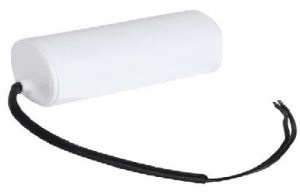
Oil-filled capacitors are special capacitors that have oil inside them. This oil helps keep the capacitor cool, especially when it’s working with high power or high voltage. These capacitors are often used in things like motors, fans, and devices that need power factor correction (which helps save energy). The oil stops the capacitor from getting too hot and helps prevent damage, making it safer and more reliable over time.
These capacitors have been trusted for many years because they keep their strength and do not lose their ability to hold power. They are very important for keeping ceiling fans running smoothly at the right speed. Their design stops any leaks, making them safe and reliable. That’s why people in many countries use these capacitors again and again.
Features of the Fan Capacitor
- It never loses its power or strength over time.
- It works just as well whether it’s very hot, very cold, dry, or humid.
- It lasts for a long, long time without needing to be replaced.
- It wastes very little energy, so it stays efficient.
- If it faces a small problem, it can fix itself without breaking down.
- It is very well protected against electricity leaking where it shouldn’t.
- It does not let any electricity escape, keeping things safe and steady.
What is a Fan Capacitor Used For?
A fan capacitor is a small but important part inside a ceiling fan. It helps the fan start spinning on its own without needing a push.
Here’s how it works in easy words:
- When you turn on the fan, the capacitor gives a little extra push to the fan’s motor. This push helps the fan start moving smoothly.
- Inside the fan, the capacitor helps create a special shift in the electric flow. This shift is what makes the fan blades turn around.
- Thanks to this, the fan can spin steadily and blow air nicely.
Think of the capacitor as a tiny energy helper. It stores electricity for a moment and then uses it to give the fan’s motor more power to start and keep turning.
Every ceiling fan needs a capacitor because the fan changes electric energy into movement, turning the blades to cool you down. The capacitor makes sure this change happens easily and without trouble.
fan Capacitor : Simple Facts You Should Know
A capacitor is a small but very important part of your fan. It helps the fan motor start and keeps it running smoothly. Without a good capacitor, your fan might not work well or may not start at all.
What makes RIC Capacitors special?
RIC Capacitors are designed with something called self-healing technology. This means that if there’s a small problem inside the capacitor—like a tiny short circuit—it can fix itself in just a few milliseconds. It does this without stopping the fan or damaging the capacitor. This makes RIC Capacitors very safe and reliable.
Want your fan to spin faster?
There’s a special kind of capacitor known as a high-speed fan capacitor. These are made to boost the speed of ceiling fans. If your fan feels slow, replacing the regular capacitor with a high-speed one can make a difference.
For example, a high-speed fan capacitor usually has a higher value, like 3.15 microfarads (mfd). This higher value gives your fan the extra push it needs to spin faster and cool better.
FAQ
What is a Fan Capacitor?
A fan capacitor is a small electrical part inside the fan that helps it start and run smoothly. Without it, the fan blades wouldn’t begin to spin, or they would spin very slowly. You can think of the capacitor like a helper that gives the fan a little push to start moving.