
What is a Nickel–Cadmium Battery?
Nickel cadmium batteries are a relatively new addition in the United States to the storage-battery family. These batteries consist of an interleaved assembly of positive and negative plates.
Thank you for reading this post, don't forget to subscribe!Construction of Nickel–Cadmium Battery
Cell containers are made of nickel-plated steel. Active materials, nickel hydroxide (positive) and cadmium oxide (negative), are encased in finely perforated steel pockets. Plates consist of rows of pockets crimped together and locked into steel frames under many tons of pressure.
Positive and negative plates are welded or bolted to heavy steel busbars. Plate groups are interleaved and are separated by thin plastic rods.
The alkaline electrolyte is a solution of potassium hydroxide.
Working Principle and Chemical Reaction of Nickel–Cadmium Batteries
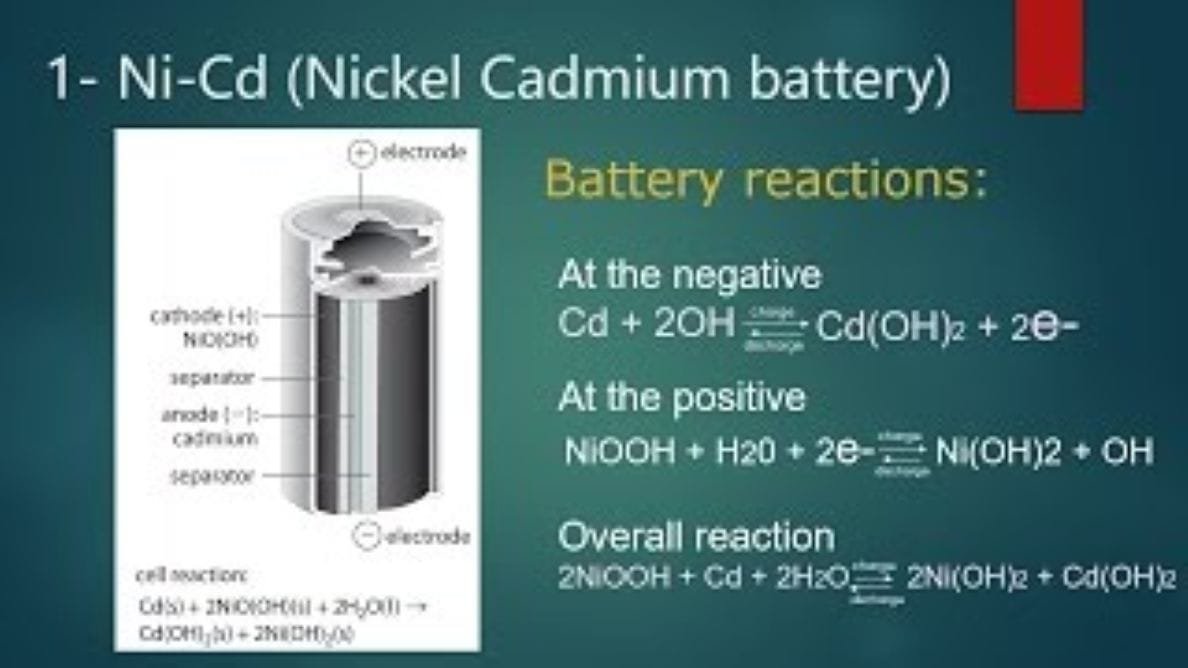
The active materials are converted on charging and discharging in accordance with the chemical reaction, which may be written as follows:
2NiO OH + Cd+ 2H2O ⇌ 2Ni(OH)2+ Cd(OH)2
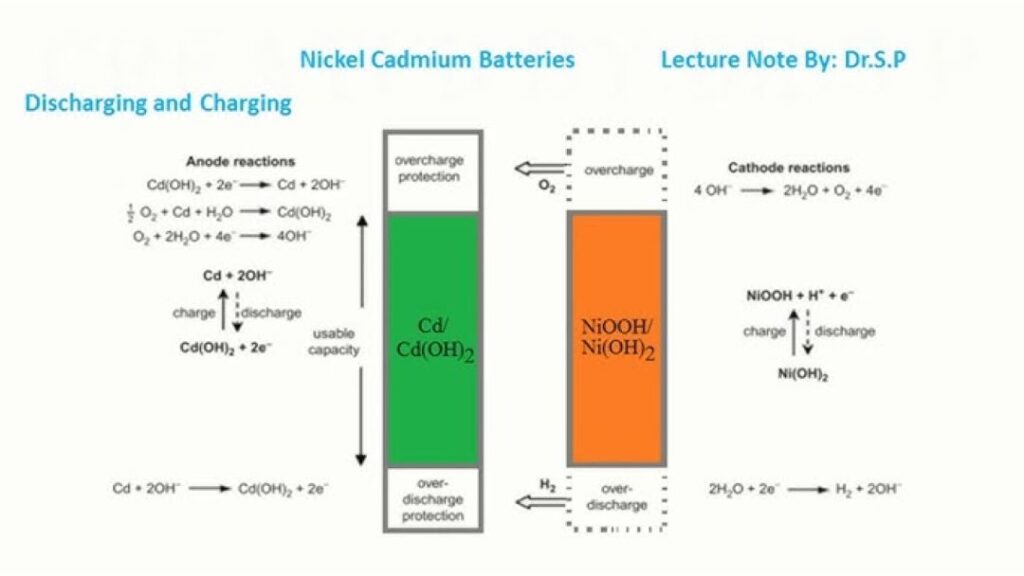
On discharge of the battery, the reaction proceeds in the forward direction, while on charge, the reaction is reversed. The system stores chemical energy when the battery is charged, and this chemical energy is converted back to electrical energy on discharge.
Reversibility of this reaction under extreme environmental conditions is one of the outstanding properties of the nickel-cadmium electrochemical system.
During charge or discharge of a nickel-cadmium cell, there is practically no change in the specific gravity of the electrolyte. The sole function of the electrolyte is to act as a conductor for the transfer of hydroxide ions from one electrode to the other, depending on whether the cell is being charged or discharged.
Data for Nickel–Cadmium Batteries
Table: Standard Data for Nickel–Cadmium Batteries
| Cell type | Amp-hr capacity at 8-hr rate | Width of tray (in.) | Height of tray (in.) | Length of tray containing (in.) | Weight per cell (lb) |
|---|---|---|---|---|---|
| 2 cells | 3 cells | ||||
| EBZ17 | 80 | 6 | 16 | 13¼ | 20⅛ |
| EBZ19 | 90 | 6½ | 16 | 13¼ | 20⅛ |
| EBZ22 | 105 | 7¼ | 16 | 13¼ | 20⅛ |
| EBZ25 | 120 | 8 | 16 | 13¼ | 20⅛ |
| EBZ28 | 135 | 8¾ | 16 | 13¼ | 20⅛ |
| EBZ31 | 150 | 9½ | 16 | 13¼ | 20⅛ |
| ERX23 | 165 | 7½ | 18 | 15¼ | 23⅛ |
| ERX25 | 180 | 8 | 18 | 15¼ | 23⅛ |
| ERX27 | 195 | 8½ | 18 | 15¼ | 23⅛ |
| ERX29 | 210 | 9 | 18 | 15¼ | 23⅛ |
| ERX33 | 240 | 10 | 18 | 15¼ | 23⅛ |
| ERX37 | 270 | 11 | 18 | 15¼ | 23⅛ |
Characteristics of Nickel–Cadmium Batteries
Characteristics
Nominal voltage per cell. – 1.2 V (a 6-V battery consists of 5 cells).
Temperature range. – 60 to 200F (51 to 93C).
Maximum discharge current. – Up to 25 times rated ampere-hour capacity.
Capacity at 60°F (51 °C). – Up to 90 percent at low rates.
Internal resistance is very low. – 0.001 for 10-Ah–type cell.
Full charge. – By constant potential in 1 h at 1.55 V per cell.
Charge retention. – Up to 70 percent after 1 year at room temperature.
Orientation. – Any discharge position.
Full charge. – By constant potential in 6 h at 1.43 V per cell.
Charge, trickle. – 1.35 V per cell to maintain a charged battery.
Gassing discharge. – None.
Gassing charge. – Virtually none below 1.47 V per cell.
Vibration resistance. – Excellent.
Shock. – 80 g.
Altitude. – Pressure-release valve opens at 25 psi (172,369 Pa) above ambient.
Cycle life. No known limit.
Storage life. No known limit in any state of charge.
Advantages of Nickel–Cadmium Batteries
- Advantages of nickel-cadmium batteries as stated by Nicad Division of Gould–National Batteries, Inc.:
- High surge currents. Good voltage maintenance under extremely high current discharge conditions.
- Constant-voltage source. Close voltage regulation during discharge.
- Rapid-charge acceptance. It can be completely recharged at high rates without damage.
- Long life. Designed to give exceptionally long life under cycle and float service.
- Extreme-temperature operation. Normal and high-rate discharge and charge possible at temperatures from 40 to 165°F (40 to 74 °C).
- Excellent charge retention. Charged cells filled with electrolyte will retain approximately 70 percent of their charge after 1 year of idle storage at normal temperature.
- Storageability. It can be laid up in any state of charge for long periods without attention or fear of deterioration.
- Discharge in any position. Can be discharged in any position.
- Easy maintenance. Negligible loss of water during service. Records of specific gravity are not necessary.
- Vibration and shock resistance. Capable of withstanding up to 50 g shock and severe vibration.
- Alkaline electrolyte. The potassium hydroxide electrolyte does not give off corrosive fumes on charge or discharge.
- Pressure sealing. The smaller cells are normally provided with pressure-sensitive sealed vents.
- Economy. Low cost per year due to long life. Very low maintenance costs. Low-cost, high-rate performance.
- Small size and light weight. Nicad sintered plate batteries are smaller and lighter than conventional batteries under high-current-drain conditions.
Installation and Care of Nickel–Cadmium Batteries
Installation and care of nickel-cadmium batteries. The following instructions for the installation and care of nickel-cadmium batteries are those recommended by the Nicad Division of the Gould–National Batteries, Inc.
12.1 Important Precautions of Nickel–Cadmium Batteries
Important precautions
- Maintain the battery compartment, cells, and trays in a clean and dry condition. Dirt and moisture will cause self-discharge, corrosion, and eventual leakage of cell containers.
- Check the electrolyte level before adding distilled water. Maintain correct electrolyte level, but do not add water in excess of the recommended maximum level. Do not spill water or electrolyte on the cells or trays.
- The electrolyte is an alkaline solution of caustic potash—not sulfuric acid, as used in lead batteries.
- Sulfuric acid or traces thereof will rapidly ruin the Ni-Cd battery by corroding its steel plates and cell containers. Therefore, use only the hydrometer and level test tube furnished with the battery.
- Do not discharge at normal rates below 1.10 V per cell. Repeated overdischarges will damage the battery.
- Always keep the vent caps closed except when checking the electrolyte or adding water.
- Never examine the cells with an open flame. Keep tools and other metal objects away from the battery.
- Apply boric acid solution if electrolyte is splashed on a person or clothing.
Installation of Nickel–Cadmium Batteries
Installing the battery. Place the battery in a clean, dry room located so that it can be easily inspected and watered. On mobile equipment such as vehicles or ships, it must be securely tied down.
Avoid placing the battery in a hot location (above 125°F, or 52 °C) or where it will be exposed to corrosive gases or fumes.
It is not good practice to install Ni-Cad batteries and lead-acid batteries in the same room unless there is ample ventilation to carry away fumes from the lead-acid batteries.
All battery rooms and compartments must have good ventilation and drainage, and at the same time, cinders, road dirt, soot, dust, rain, snow, and seawater must be kept out.
Accumulations of dirt and moisture on cell tops and particularly between the cells will cause corrosion and leakage of cell containers.
Holes or gratings which permit ready entry of dust, water, etc., must be closed up. However, four small drainage holes (maximum diameter of holes 1/4 in, or 6.35 mm) should be provided in the bottom, one at each corner of the compartment.
Compartments which have previously housed lead-acid batteries must be washed out, neutralized with ammonia or washing-soda solution, allowed to dry thoroughly, and then painted with Nicadvar asphalt paint. Wood liners must be removed and replaced with new ones. Ample space should be provided above the battery for inserting the electrolyte-level test tube and the hydrometer into the cells.
If the battery is to be serviced through the top of a compartment, allow a minimum clearance of 2 in (50.8 mm) between the top of the battery and the underside of the access cover.
If the battery is to be serviced from the side, the clearance between the battery and the ceiling of the compartment should be at least 8 in (203.2 mm).
Small stationary batteries can be placed directly on a clean, dry floor or on a suitable wall shelf. Large batteries should be placed on racks.
Checks, Connections, and Electrical Precautions After Installation
Check the electrolyte level and the specific gravity, and be sure that the battery is thoroughly clean and dry before placing it in position.
Nothing should be placed or allowed to lodge in the open spaces between or underneath the cells. These air gaps serve as electrical insulation between the cells and are an essential part of the battery. For this reason, they must be kept open, clean, and unobstructed at all times.
Variation of specific gravity may be found between individual cells. A maximum variation of plus or minus 0.005 points is permissible. For example, if the normal specific gravity called for is 1.210, a minimum of 1.205 and a maximum of 1.215 specific gravity is satisfactory.
The cell containers must not be grounded, and the bottoms of the cells must not be allowed to rest on any object. Battery trays should never be stacked directly on top of one another, nor should water or spilled electrolyte be allowed to accumulate under the battery.
All cables leading to the battery posts should be fitted with nickel-plated cable lugs. Do not use bare copper cable lugs or connectors. After connecting cable lugs to the battery, cover lugs with Nicad petroleum jelly No. 32982.
All wiring to the battery should be properly spaced and firmly secured to prevent any chance of a short circuit.
Wires or cables should never be allowed to rest on top of the cells.
Never connect to the battery a device or instrument that might cause an unnecessary constant drain, however small, as it will ultimately discharge the battery when left standing on open circuit. Voltmeters, for instance, should be connected to the battery only by means of a normally open pushbutton switch.
If either side of a high-voltage battery is grounded, it will expose personnel and the battery to hazardous conditions. The shock hazard to personnel is obvious. In such cases, additional high-resistance grounds in any part of the circuit will cause trouble and possibly a serious short circuit. For example, an inductive surge from breaker operations can cause a slight ground to become larger and rapidly discharge the battery. When checking battery voltage, also take readings between each terminal of the battery and ground for possible leakage, as ground indicator lights may not show slight grounds.
Most storage batteries consist of a single series of cells of the same type and ampere-hour capacity. If the battery consists of more than one tray, be sure that the negative end terminal of each tray is connected to the positive end terminal of the following tray. Cells wrongly connected will receive a reverse charge and will be damaged if the condition is allowed to continue.
On completing the installation, make sure that no loose objects such as screws or tools have been accidentally left in the battery compartment.
Check and tighten all cell-post nuts, as loose electrical connections will heat up and can cause sparking.
Verify that every person who is going to take care of the battery has a copy of these instructions.
Mount the instruction card accompanying the battery in a conspicuous position for future reference.
Charging of Nickel–Cadmium Batteries
Charging. The positive terminal post of every cell is identified by a plus mark on the cell container. When charging, always connect the positive terminal of the battery to the positive lead from the charger. Only direct current can be used for charging storage batteries. If only alternating current is available, a rectifier or a motor generator is necessary to convert the alternating current into direct current. Information concerning various types of charging equipment is available from manufacturers.
When a battery is first placed in service, the charging rate may vary somewhat before it is stabilized. During the first week or two, the adjustment should be checked every few days.
A reasonable amount of overcharging, particularly at low- or trickle-charge rates, has a beneficial effect on Ni-Cd batteries. When in doubt at any time as to the state of charge, it is advisable to overcharge rather than to undercharge.
Variations in line voltage due to local conditions can be large enough to throw charge voltages off normal. A normal setting during the day may rise to a point of overcharge and excessive charging at night and on weekends. If such a condition exists, it is desirable to install a constant-voltage transformer ahead of the charger.
The open-circuit voltage is the voltage of a storage battery when standing idle, i.e., when it is neither on charge nor on discharge. All types of storage batteries standing idle for a period of time have an open-circuit voltage independent of the state of charge. It therefore cannot be used to indicate the state of charge of a battery.
The open-circuit voltage of a NiCd cell is approximately 1.30 V. NiCd batteries possess the characteristic common to all storage batteries that their voltage rises throughout the charge. Hence, when the battery voltage ceases to rise and the charge current remains steady, it is an indication that the battery is fully charged. The voltage of a fully charged battery, still on charge, will depend upon the magnitude of the charge current; the heavier the current, the higher the battery voltage.
The accuracy of voltmeters and ammeters is of considerable importance. Temperature changes and even slight vibration can change their adjustment. Good storage-battery maintenance requires that meters, particularly panel-mounted ones, be checked periodically to an accuracy of 0.5 percent.
Several methods of charging batteries are described below.
Charging Engine-Starting Batteries
Charging engine-starting batteries. The generator voltage regulator should be set so as to hold the battery voltage between 1.45 and 1.50 times the number of cells in the battery. Readings should be taken at the battery terminal posts with the voltage regulator at proper working temperature, with its cover in place, and only after the battery voltage has ceased to rise.
If the engine is started infrequently, as in emergency standby services, or if the engine is operated only for very short periods at a time (insufficient to keep the battery in a fully charged condition), it is recommended that the battery be maintained on constant trickle charge, preferably from a dry disk or plate, metallic rectifier, at a voltage equal to 1.40 to 1.45 times the number of cells in the battery. At this charge voltage, the battery may require watering as often as every 6 to 9 months.
Trickle Charging or Floating
Trickle charging or floating. Fully charged batteries floated across the line should be maintained at a voltage equal to 1.40 times the number of cells in the battery. If the discharges, although momentary, are relatively heavy and frequent, the voltage should be raised to 1.45 times the number of cells in the battery to ensure that the total input will exceed the total output over a period of time.
Otherwise, the battery will slowly discharge and require so-called equalization or overcharging from time to time to bring it back to a fully charged condition.
The recommended battery voltages will hold the individual cell voltages below 1.47 V. Above 1.47 V, the cells will begin to gas and hence consume water. Variations in voltage up to a maximum of 0.05 V between the individual cells of a battery on float should be disregarded, as they are of no importance. One of the most valuable features of the Ni-Cad battery is that its floating voltage is not critical, provided, of course, that it is high enough to compensate for the loads imposed on the battery from time to time. Floating at above 1.47 V per cell will not harm the battery, but its water consumption will be considerably increased, requiring additional attention.
Purpose and Equipment for Trickle Charging
Trickle charging is actually preservation charging and should be used only to keep a charged battery in a fully charged condition. It cannot be used as a substitute for normal charging of a discharged battery. Trickle chargers should be equipped with a variable resistance and a voltmeter of a suitable range and accuracy. Information on suitable equipment for trickle and high-rate charging of Ni-Cad batteries will be furnished by the manufacturer upon request.
Constant-Current Charging
Constant-current charging. This method consists of charging at a constant current, not for a definite length of time or to a definite end voltage, but until the battery voltage ceases to rise, indicating that the battery is fully charged.
The length of time required to charge the battery by this method depends on the magnitude of the charge current and the state of charge of the battery at the time it is put on charge.
It is usual to insert a variable resistance of suitable size between the DC line and the battery and to reduce the resistance from time to time by hand, during the charge, so as to hold the charge current reasonably constant.
A DC line voltage of 1.40 times the number of cells in the battery is necessary at the beginning of the charge, and of 1.85 times the number of cells in the battery at the end of the charge. In theory, practically any rate of charge can be employed, provided that the electrolyte temperature, which is the limiting factor, is not allowed to exceed 145°F (63 °C).
Too high a charge current, however, particularly if the electrolyte is above the maximum permissible level, may cause the electrolyte to be forced out of the cell vents.
When charged by the constant-current method at the normal (7-h) charge rate, NiCd batteries will commence to gas after about 4½ h, i.e., when the battery voltage has risen to about 1.47 V per cell. Therefore, if a period of more than 7 h between discharges is available, it is desirable to charge at a lower rate than normal. This will reduce gassing and consequently the amount of water required by the battery. For example, a 100-Ah battery has a “normal” charge rate of 20 A (for 7 h) but may conveniently be charged at 14 A for 10 h or 10 A for 14 h.
The specific gravity of the electrolyte remains practically constant during charge and discharge; therefore, specific-gravity readings are not necessary.
Ascertaining the State of Charge of a Nickel–Cadmium Battery
Ascertaining the state of charge. Open-circuit voltage readings (no current passing into or being delivered by the battery) cannot be used as an indication of the state of charge of any storage battery.
The density of the electrolyte of the Ni-Cd battery does not change appreciably on charge or discharge, and specific-gravity measurements, therefore, do not indicate its state of charge at any time.
To determine the state of charge of a partially charged battery, it becomes necessary to take simultaneous current and voltage readings. There are several ways of doing this, and for services in which it is necessary to determine the state of charge frequently, a satisfactory method can generally be worked out.
For certain applications involving heavy rate discharges of short duration, such as switch tripping, it has been found advantageous to install a voltmeter and a fixed resistance near the battery to provide an artificial load equal in value to the normal load. Voltage readings obtained while the battery is connected momentarily to the artificial load indicate the ability of the battery to carry the normal load.
Information regarding methods and equipment can be obtained from manufacturers of nickel-cadmium batteries.
Discharging of Nickel–Cadmium Batteries
Discharging. Heavy discharges (such as engine starting) will not damage the Ni-Cd battery. Do not, however, discharge the battery below 1.10 V per cell at rates from 3- to 10-h rates or below 1.20 V per cell at lower current rates. Overdischarging at low rates regularly continued below these end voltages will damage the battery and is an indication that the battery is too small for its work.
Electrolyte of Nickel–Cadmium Batteries
Electrolyte. The electrolyte (solution) in Ni-Cd batteries is alkaline and consists of specially purified caustic potash (KOH, potassium hydroxide) dissolved in distilled water. The specific gravity of the electrolyte does not change with the state of charge but remains practically constant on charge and discharge.
The use of anything other than Ni-Cd can damage the battery. Ordinary commercial grades of caustic potash should never be used, as they are not sufficiently pure.
Nicad refill or renewal electrolyte of proper specific gravity is available in nonreturnable containers holding 5, 10, 15, 20, and 130 lb (2.3, 4.5, 6.8, 9, and 59 kg). Use an enamelware or glass pitcher and a funnel for filling cells with electrolyte or water. Earthenware, hard rubber, and plastic utensils are also suitable.
Refill electrolyte is used to replace electrolyte accidentally lost in transit or otherwise, while renewal electrolyte is used when changing the electrolyte, as described in.
If electrolyte is lost by accident from any of the cells, replace the lost quantity with Nicad refill electrolyte. If the refill electrolyte is not available, take the battery out of service and add enough water to cover the plates (so as to prevent damage to the plates by exposing them to the air) and procure renewal electrolyte. Upon its arrival, empty out all the old electrolyte and fill the cells with renewal electrolyte. Charge the battery and check that the specific gravity is correct and uniform in all the cells before putting the battery back into service.
Maintenance of Nickel–Cadmium Batteries
Maintenance. Keep the cells and trays clean and dry externally at all times. Moisture and dirt allowed to accumulate on top of and particularly between the cells will permit stray intercell currents, resulting in corrosion through electrolysis of the cell containers. For this reason, any water or electrolyte spilled on the cells or the trays must be wiped off. Use compressed air or, better still, low-pressure steam to clean cells and trays. Do not allow dirt to enter the vents when cleaning cells. After cleaning, regrease the cell tops and connectors with Nicad petroleum jelly No. 32982 to protect the metal.
Batteries that are charged at high rates may gas heavily toward the end of charge, giving off minute quantities of potassium hydroxide. This combines with carbon dioxide in the air, forming potassium carbonate, which deposits a noncorrosive, inert white powder on the cell tops and connectors. Potassium carbonate is electrically conductive when damp, and if allowed to build up, can cause current leakage and possibly discharge the battery. Any accumulation should be removed with a brush or a damp cloth.
Keep all vent caps closed to prevent air from entering the cells. Open caps only to check the electrolyte. Caps must be closed when the battery is charging.
Always check and service only one cell at a time.
Never place or drop any metal articles, such as post nuts, cable lugs, or tools, on or between the cells. These will cause heavy short circuits, which may damage the cell containers.
Never permit sparks, open flame, or lighted cigarettes near a storage battery. All storage batteries, when gassing, give off a highly explosive mixture of hydrogen and oxygen. A non-metallic flashlight is desirable for battery inspection. Keep all connections tight.
Use only spirit thermometers when taking temperature readings. Ordinary mercury thermometers may break. Mercury running into the cell between its plates will cause sparking and explosions.
Damage from Impurities in Nickel–Cadmium Batteries
Damage from impurities. Impurities of all kinds must be kept out of the cells, as they have a harmful effect and can eventually ruin the battery.
Even a trace of sulfuric acid can ruin a Ni-Cd battery by attacking and corroding its steel plates and cell containers. To prevent contamination, never use any tools or utensils such as hydrometers, funnels, rubber hoses, battery fillers, etc., which have been used at any time for servicing lead-acid batteries.
Any vegetable oil or grease accidentally introduced into the cells will cause them to froth on charge.
Method of Adjusting Electrolyte Specific Gravity
Method of adjusting electrolyte specific gravity. Cells having lost their electrolyte in shipping or by accident should be filled immediately to the proper level with Nicad refill electrolyte, and no adjustment of electrolyte specific gravity will be needed. If, however, they have been filled with water pending the arrival of the refill electrolyte, the following electrolyte adjustment treatment will be necessary.
Dump the weak electrolyte-water mixture from the cells and fill with the refill electrolyte. Cells that have lost electrolytes in varying amounts need adjustment of electrolyte specific gravity. Adjustment should be made during charge and toward the end of the charge when the cells are gassing freely.
If the electrolyte is too strong, add distilled water. If the electrolyte is too weak, add special 1.400-specific-gravity electrolyte supplied by Nicad on request. Three adjustments may have to be made before the normal specific-gravity reading is obtained. Allow 30 minutes between each adjustment during charge.
The amount of distilled water or special 1.400-specific-gravity electrolyte required can be found only by trial. For example, one cell may need only half a syringe full to bring the electrolyte to normal specific gravity. Yet another cell may need several syringes full, depending on the size of the cell and the strength of the electrolyte in the cell.
Each time that electrolyte is withdrawn from a cell during this adjustment, it should be replaced with an equal amount of special electrolyte or water to maintain the correct electrolyte level above the plate tops.
Once adjusted to the correct specific gravity at the maximum level, the cell will need only distilled water to keep the electrolyte at the maximum level.
The above-described method of adjusting the electrolyte specific gravity may seem slow and cumbersome, but it is necessary to ensure good performance and to maintain the capacity of the cells.
The electrolyte will readily absorb carbon dioxide from the air to form potassium carbonate, which has the effect of temporarily lowering the capacity of the battery. Electrolytes must therefore be stored in airtight containers. Cell vent caps should be kept closed at all times except when adding water or checking the electrolyte, and this should always be done as quickly as possible, opening only one vent cap at a time.
When handling electrolyte wear goggles and rubber gloves, avoid splashes. The electrolyte is injurious to skin and clothing and must therefore always be handled carefully. Particularly guard the eyes! A generous quantity of concentrated boric acid solution (5 oz of boric acid powder to each quart, or 0.14 kg/0.95 L of water) should be kept handy in a bottle or open bowl for neutralizing any accidental splashes on the person or clothing. Use an eyecup for eye injuries.
Boric acid powder will dissolve in warm water within 1 h. With cold water, allow 24 h. Do not use the boric acid solution on cells or trays.
Checking the Electrolyte Level and Specific Gravity
Checking the electrolyte. Storage batteries normally lose water through natural evaporation and particularly when gassing freely on charge. While there are no corrosive or obnoxious gases given off by Ni-Cd batteries, traces of the potassium hydroxide are lost with the gas, resulting in a gradual lowering of the specific gravity of the electrolyte over the years.
The level of the electrolyte as well as its specific gravity must therefore be checked periodically, as serious damage will be done to the plates if the electrolyte level falls below the top of the plates or the specific gravity is less than the minimum value stated on the wall card.
The electrolyte level is determined by inserting the 3/16-in. (4.8-mm) Bore plastic tube shipped with the battery through the vent until it rests on top of the plates, then place your finger tightly over the end and withdraw the tube for inspection. Be sure to return the electrolyte in the tube to the cell from which it was withdrawn.
A hydrometer is used to measure the specific gravity of the electrolyte, which should be within the specified range on the wall card. The illustrations show the positions of the float in electrolyte, which is too weak and too strong.
Use only a Nicad hydrometer to take specific-gravity readings. First, rest the tip of the nozzle firmly on top of the plates in the cell; then, squeeze and release the bulb. This method will prevent Celoil from being drawn up into the barrel. Draw up a sufficient solution to permit the float to move freely, and then tap the glass barrel of the hydrometer gently with the finger to prevent the float from giving a false reading by sticking to the barrel wall.
The maximum level of the electrolyte is halfway between the tops of the plates and the inside of the cell covers (excluding vent height). At this level and down to the minimum level of 1/2 in (12.7 mm) above the plate tops, the specific gravity of the electrolyte should be within the range specified on the wall card. These figures apply to normal temperatures. When extreme temperatures prevail, and the observed hydrometer readings are outside these limits, it will be necessary to apply temperature- and electrolyte volume-correction factors as described below.
To arrive at the true specific gravity of the electrolyte at 72°F (22°C), the temperature used as a base for purposes of calculation, observe and make a record of:
- The electrolyte specific gravity
- The electrolyte temperature
- The electrolyte level above the plates
If the electrolyte temperature is above 72°F, add to the specific gravity reading 0.001 for every 4 above 72°F (every 2.2°F above 22°C).
If the temperature is below 72°F, subtract 0.001 from the specific-gravity reading for every 4 below 72°F.
For every 1/4 in (6.35 mm) of electrolyte above the top of the plates, add 0.005 to the specific-gravity reading.
FAQ
What is a nickel–cadmium battery used for?
How does a Ni-Cd battery work?
During discharge, chemical energy is converted into electrical energy, and during charge the reaction is reversed and energy is stored again. The electrolyte acts only as a conducting medium and does not take part in the reaction.
What is the nominal voltage of a Ni-Cd battery cell?
A 6-V Ni-Cd battery consists of five cells connected in series.
Why does a Ni-Cd battery have long life?
What electrolyte is used in nickel–cadmium batteries?
The specific gravity of the electrolyte remains practically constant during both charge and discharge.